Living abroad while your parents grow older in Lahore brings a particular kind of worry that’s hard to explain to anyone who hasn’t lived it. You see them on a video call, and everything looks fine, but you can’t check if they took their evening medicine, or notice if they’ve been unsteady on their feet lately. A missed call at an unusual hour can send your heart racing before you even answer. Yes, overseas Pakistanis can hire qualified nurses for their parents in Lahore, and it has become one of the most practical ways families abroad manage this exact worry. Shine Care Home Nursing Lahore works specifically with families in the UK, USA, Canada, UAE, Saudi Arabia, Australia, and across Europe, arranging trained nursing care for parents while keeping relatives abroad genuinely informed. This guide walks through exactly how that process works, what’s involved, and what to look for in a nursing provider you’ll likely never meet in person.
Why Home Nursing Works Better Than Trying to Manage Things Remotely
Trying to coordinate a parent’s health care from another time zone rarely works well through phone calls alone. Someone needs to be physically present — checking medication, noticing subtle changes, responding if something goes wrong within minutes, not hours. A qualified home nurse in Lahore becomes that physical presence, while you remain the decision-maker from wherever you’re living.
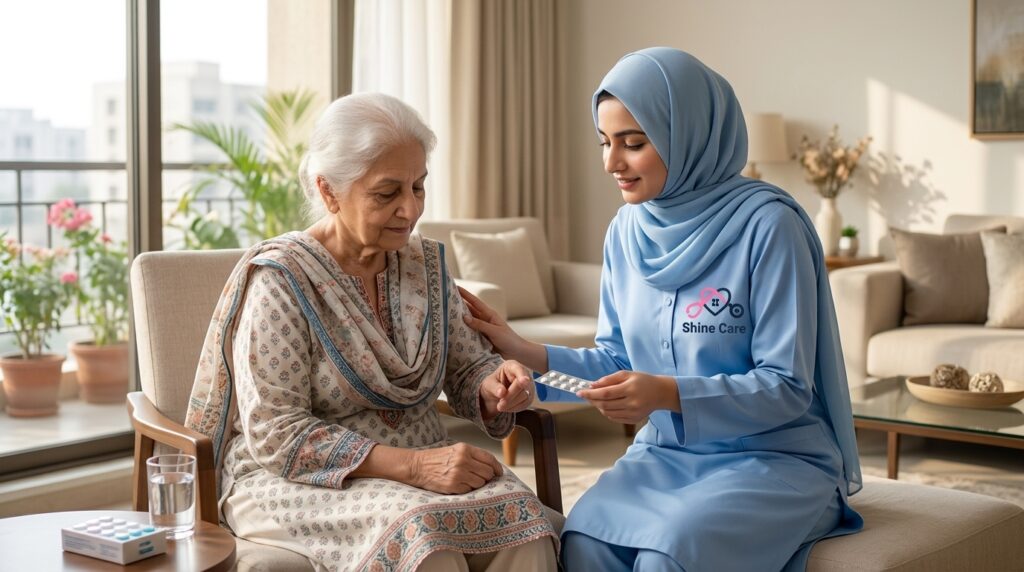
This matters more than it might seem at first. A nurse trained to recognize early warning signs — confusion that shouldn’t be there, a wound that isn’t healing properly, blood pressure readings trending the wrong way — can flag a problem before it becomes a hospital admission. A family member checking in over video calls, however attentive, generally can’t catch these signs the same way.
How Shine Care Helps Overseas Families
Shine Care Home Nursing Lahore starts every overseas case with a direct conversation, usually over phone or WhatsApp, to understand your parent’s current health, daily routine, and the specific concerns that prompted you to look into nursing care. From there, we coordinate a proper assessment, either through direct discussion with the family or in consultation with the parent’s treating doctor in Lahore.
A nurse gets matched based on your parent’s actual condition, not assigned from a general list. Someone managing diabetes needs different expertise than someone recovering from a stroke, and we treat that distinction as central to how care actually works, not a minor detail.
Can Payments Be Made From Abroad?
Yes. Families abroad typically arrange payment through international bank transfer or other remote payment methods discussed directly during the initial consultation. This gets settled clearly upfront, so there’s no ambiguity partway through the arrangement.
How Families Receive Patient Updates
Updates typically happen through scheduled phone calls, written summaries, and photo or video check-ins when the family requests them and the parent is comfortable with it. The specific format and frequency get agreed upon at the start, based on what actually reassures your family, rather than a generic reporting schedule applied to everyone.
How Nurses Communicate With Overseas Relatives
Beyond scheduled updates, nurses working with Shine Care Home Nursing Lahore are expected to flag anything unusual immediately, rather than waiting for the next scheduled check-in. If your parent’s blood pressure looks off, or their appetite has dropped noticeably, you hear about it the same day, not during a weekly summary.
Types of Nursing Services Available
Home nursing in Lahore covers considerably more ground than most families initially expect:
- General elderly care — daily support, medication management, and companionship for aging parents
- 24-hour nursing care — continuous, shift-based coverage for patients needing round-the-clock attention
- ICU care at home — intensive monitoring and equipment support for critically ill patients stable enough to leave a hospital ICU
- Post-hospital recovery care — support during the critical weeks immediately following discharge
- Chronic condition management — ongoing care for diabetes, hypertension, and cardiac conditions
- Patient attendant services — non-medical daily support like bathing, mobility, and meals for stable patients
When Families Should Hire a Nurse
Deciding when to actually arrange nursing support is often harder than deciding whether to do it at all. A few situations make the timing fairly clear: a recent hospital discharge, a new diagnosis requiring ongoing management, or a parent living alone who’s started showing signs of struggling with daily tasks.
Waiting until a crisis forces the decision usually means a harder, more stressful transition than arranging care proactively, once the early signs are already visible.
Signs Your Parents May Need a Home Nurse
- Medication is being missed, doubled up, or taken at inconsistent times
- Falls have happened, even minor ones that seemed harmless at the time
- Your parent sounds noticeably more confused or forgetful during calls than they used to
- Weight loss or reduced appetite has become apparent over the past few weeks
- A recent hospital discharge came with care instructions no one at home feels confident managing
- Your parent has mentioned feeling unsteady, dizzy, or generally unwell more often
- You’ve noticed housework or personal hygiene slipping during video calls
Benefits Compared With Hospital Stays
| Factor | Hospital Stay | Home Nursing |
|---|---|---|
| Comfort | Unfamiliar clinical environment | Familiar home surroundings |
| Family involvement | Restricted by visiting hours | Family stays closely informed and involved |
| Personal attention | Divided among multiple patients | Focused one-on-one care |
| Infection risk | Higher exposure in hospital settings | Generally lower in a properly managed home |
| Emotional wellbeing | Often more stressful for elderly patients | Typically calmer and more reassuring |
| Cost over time | Often higher for extended stays | Can be more manageable, depending on needs |
Patient Safety and Background Verification
Every nurse working with Shine Care Home Nursing Lahore goes through background verification before ever being placed with a family. This matters enormously for overseas families specifically, since you’re extending trust to someone you may never meet in person, based entirely on the provider’s own screening process.
Verification includes checking references, confirming relevant nursing qualifications, and matching experience to the type of case being handled. This isn’t a courtesy step — it’s a standard part of how every placement happens.
Emergency Response Process
A proper nursing arrangement includes a clear plan for emergencies, not just day-to-day care. This means the nurse knows exactly when a situation requires calling the treating doctor, when it requires immediate hospital transfer, and how quickly the overseas family gets notified in either case.
Given time zone differences, this protocol matters more for overseas families than for relatives living locally. Decisions sometimes need to happen before you’re reachable, and a properly coordinated arrangement accounts for that reality directly.
How Personalized Care Plans Are Created
A care plan starts with understanding your parent’s actual condition, daily routine, and specific needs — not a template applied uniformly across every patient. This typically covers medication timing, monitoring requirements, dietary considerations, and any specific concerns the family has raised.
The plan gets revisited regularly, since a parent’s needs rarely stay static for long. What works in the first month often needs adjusting as recovery progresses or a condition evolves.
How Long Nursing Services Can Continue
Some families arrange short-term nursing support, covering a specific recovery period after surgery or a hospital stay. Others arrange long-term, ongoing care for parents managing a chronic condition or general age-related decline. There’s no fixed duration — the arrangement continues for as long as it genuinely serves your parent’s needs, and it can be adjusted or ended as circumstances change.
Common Mistakes Families Make
Choosing a provider based only on price often means skipping proper verification, which matters far more than a small cost difference when your parent’s safety is involved.
Not asking about the replacement policy leaves families surprised when a nurse is unexpectedly unavailable and no backup plan exists.
Assuming a caregiver and a nurse are interchangeable can mean a patient with genuine medical needs doesn’t get proper clinical attention.
Skipping a clear communication plan leads to unnecessary anxiety, since overseas families are then left guessing rather than genuinely informed.
Ignoring the treating doctor’s recommendations in favor of a generic care arrangement risks missing condition-specific needs a properly coordinated plan would address.
How to Choose a Trustworthy Nursing Provider
Ask directly about background verification, how nurses get matched to specific conditions, what happens if your assigned nurse is unavailable, and how communication actually works day to day. A provider willing to answer these clearly, rather than vaguely, is one worth taking seriously.
Quick Facts Box
- Home nursing can be arranged entirely remotely, without visiting Lahore first
- Payments can typically be made from abroad through bank transfer
- Care plans are personalized to each patient’s actual condition
- Nurses are matched based on relevant experience, not assigned generically
- Communication frequency and format are agreed upon before care begins
Why Families Choose Shine Care Home Nursing Lahore
Families across DHA Lahore, Gulberg, Model Town, Johar Town, Bahria Town Lahore, Valencia Town, Wapda Town, Lahore Cantt, and Askari Lahore have worked with Shine Care Home Nursing Lahore for parents managing everything from general elderly care to post-surgical recovery. Coverage extends toward Bedian Road and Barki Road as well, for families in Lahore’s outer residential areas.
Nurses are matched to a patient’s specific condition, with relevant experience prioritized over general placement. Doctor coordination remains consistent throughout, keeping the nursing plan aligned with the parent’s actual medical treatment rather than operating separately from it. Families receive regular updates in whatever format genuinely reassures them, and emergency protocols stay in place throughout every arrangement.
A Realistic Scenario
Consider a common situation: a father in Lahore has just been discharged after a hip surgery, and his daughter, living in Toronto, can’t take time off work to fly back immediately. She arranges a nurse through Shine Care Home Nursing Lahore before he even leaves the hospital, based on a phone consultation covering his surgery details and discharge instructions. The nurse handles wound care, medication timing, and mobility support during the first critical weeks, sending regular updates so the daughter knows exactly how recovery is progressing, even from a different continent and time zone.
Step-by-Step Process to Book a Nurse
- Contact Shine Care Home Nursing Lahore by phone, WhatsApp, or email, whichever suits your time zone.
- Share your parent’s medical background — current conditions, medications, and recent hospital visits if relevant.
- Have a consultation call to discuss the situation in detail and ask any questions.
- Receive a proposed care plan, covering the type of nursing needed and suggested schedule.
- Confirm payment arrangements, suited to your location abroad.
- A nurse gets matched and assigned based on your parent’s specific needs.
- Care begins, with regular updates sent according to the agreed communication plan.
- The plan gets reviewed periodically, adjusting as your parent’s condition changes.
Frequently Asked Questions
You’ll need at least one consultation call or message exchange to discuss your parent’s specific situation, but this can happen entirely through phone, WhatsApp, or video call without needing anyone else in Pakistan to coordinate on your behalf.
This is common, and a good provider takes time during the initial visits to build comfort and trust gradually, rather than expecting immediate acceptance from a parent unfamiliar with the arrangement.
This depends on their specific condition and daily needs. A proper assessment, discussed with the nursing provider, helps determine whether continuous coverage or scheduled visits actually fit the situation.
Yes, and this should be communicated directly to the provider. A mismatch in personality or approach is worth addressing quickly rather than persisting with an arrangement that isn’t working.
Many arrangements include this as part of daily support, though the specific logistics should be confirmed directly with the provider based on your parent’s location and appointment schedule.
A properly arranged nursing plan includes protocols for the nurse to act and contact the treating doctor immediately if needed, without waiting for the overseas family to be reachable, given that emergencies don’t wait for convenient hours.
It’s reasonable to ask for confirmation of formal nursing training, relevant experience with your parent’s specific condition, and any additional certifications relevant to specialized care like ICU or wound management.
Yes, this is typically something you can specify during the initial consultation, based on what’s most comfortable for your family.
Some families do this if timing allows, though many arrange care entirely remotely and adjust the plan after receiving initial updates rather than delaying care until a visit is possible.
The arrangement can be scaled back or ended based on your parent’s actual condition — there’s no obligation to continue a fixed level of care once it’s no longer necessary.