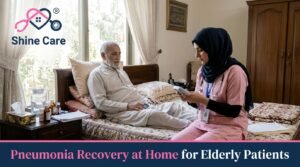
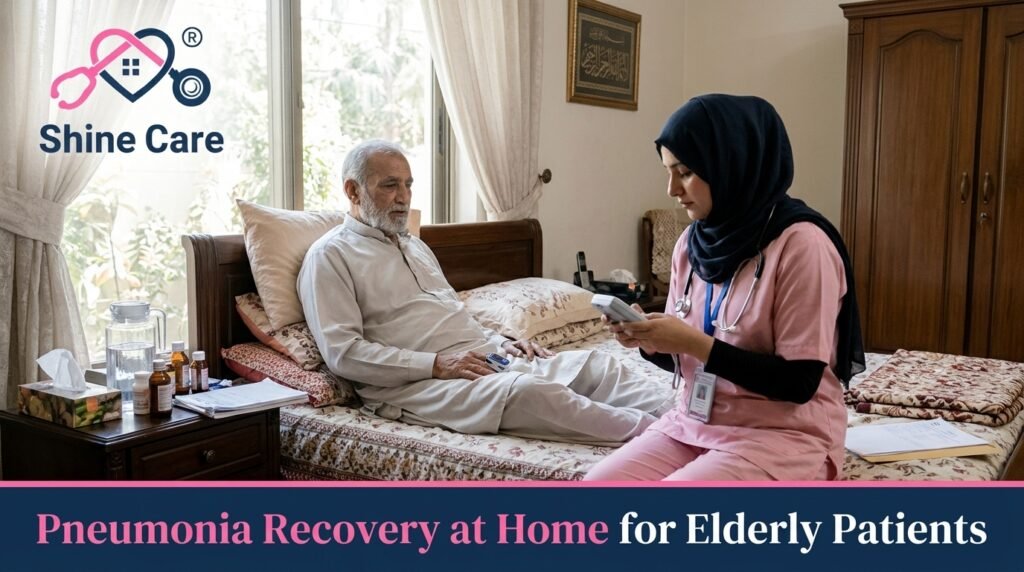
Your 76-year-old mother is discharged from a Lahore hospital after a week on antibiotics for pneumonia. The ward team says she is out of danger. The family brings her home expecting a quick return to normal. Three weeks later she is still exhausted, still coughing occasionally, still not interested in food. The family wonders if the pneumonia came back. Usually it has not — pneumonia recovery in elderly patients is slow, often much slower than families expect. The acute illness ends in days. The full recovery takes weeks to months. This article walks Lahore families through what pneumonia recovery actually looks like at home for elderly patients, what families should watch for, and when a trained home nurse makes the real difference.
Nothing in this article replaces the treating doctor’s specific instructions. Pneumonia severity, the organism involved, the patient’s other illnesses, and the recovery timeline are all individual. The point of this article is to help families understand the pattern so what the doctor says fits into a picture that makes sense at home.
Why Pneumonia Recovery Takes So Long in Elderly
Pneumonia in a 25-year-old resolves in 1 to 2 weeks. In a 75-year-old the same infection takes 6 to 12 weeks for full recovery. The reasons are physiological:
- Reduced immune function means the inflammation takes longer to clear
- Underlying heart or lung disease complicates recovery
- Muscle loss during the acute illness is significant — a week in bed can take months to recover
- Appetite often stays suppressed for weeks after the infection
- Fatigue is severe and prolonged
- Cognitive recovery (confusion from the illness itself) can lag physical recovery
- Secondary complications — chest tightness, residual cough, muscle weakness — persist
Families who expect quick recovery often become anxious or frustrated when the patient is still unwell at week 3 or 4. Understanding the realistic timeline reduces that anxiety and lets families plan appropriate support rather than rushing a recovery that cannot be rushed.
The Typical Recovery Timeline
Week 1 — Still Fragile
Patient has just been discharged, often still weak, finishing antibiotics, likely still with cough and reduced appetite. Energy is minimal. Sleep patterns disrupted. This is the highest-risk week for readmission.
Week 2 — Early Improvement
Fever has settled. Antibiotic course usually complete. Cough reducing but not gone. Appetite returning slowly. Energy still very limited. Walking a short distance is tiring. Patient needs daytime naps.
Week 3 to 4 — Baseline Function Returning
Most patients return to roughly their pre-illness daily routine, but at a slower pace. Light tasks possible. Short walks tolerated. Chest X-ray at the follow-up visit often still shows residual changes.
Month 2 to 3 — Full Energy Recovery
Fatigue gradually resolves. Appetite normalises. Chest X-ray clears. Patient feels like themselves again.
Month 3 to 6 — Long-Term Effects
Some elderly patients never return quite to pre-pneumonia baseline — a bit less walking tolerance, slightly reduced lung function, more fatigue. Pneumonia marks a step down on the functional curve for some patients.
Daily Care in the First Two Weeks
The first two weeks after discharge are where good home care prevents readmission. The patient is clinically out of danger but still fragile.
Rest and Pacing
- Rest much of the day — short periods of activity between naps
- Walk short distances inside the house 4 to 6 times a day — not for exercise, for preventing complications
- Avoid bed rest for whole days — causes muscle loss and chest problems
- Comfortable sitting-up position for most of the day, lying flat only for sleep
- Head of bed elevated 30 degrees while sleeping — easier breathing
Hydration
- 1.5 to 2 litres of fluid daily unless the doctor has restricted
- Water, soups, broths, light teas, lassi (unless dairy-restricted)
- Watch urine colour — pale yellow means adequate fluid
- Dehydration thickens secretions and makes cough less productive
Nutrition
- Small frequent meals rather than large ones
- Protein in every meal — eggs, chicken, dal, yogurt — to rebuild muscle
- Soft easy-to-swallow foods first — khichdi, soft chapati, soup with rice
- Fresh fruit for vitamins and hydration
- Avoid heavy spicy fried food in the first two weeks
- Do not force food when appetite is poor — small amounts of what the patient wants is better than fighting over big meals
Breathing Exercises
- Deep breathing exercises every hour while awake
- Incentive spirometer (the small plastic device with balls) if provided — several times a day
- Huff coughing — short sharp breaths out to clear residual secretions
- Nebulizer treatments if prescribed, on schedule
- Avoid lying flat for long periods — the chest clears better upright
Medication Discipline
- Complete the full antibiotic course even if the patient feels better
- Pain relief (paracetamol usually) for chest discomfort
- Prescribed inhalers or nebulizer medicines on schedule
- Continue all usual chronic medicines (blood pressure, diabetes, cardiac) unless the doctor has changed them
- Watch for new side effects — some antibiotics affect kidneys or cause diarrhoea
For families managing an elderly parent’s pneumonia recovery alongside existing chronic conditions, this is often where a trained home nurse visit twice or three times a week in the first two weeks prevents the readmissions we see so often. Medication timing, oxygen monitoring, chest physiotherapy — all are easier with professional support.
Monitoring at Home — What to Watch
Daily Checks
- Temperature twice daily — morning and evening
- SpO₂ with a pulse oximeter — once or twice daily, more often if breathless
- Pulse rate
- How many pillows the patient needs to sleep comfortably
- Appetite and fluid intake
- Cough — frequency, nature of secretions, any blood
- Energy level — same, better or worse than yesterday
- Mental clarity — new confusion is a warning sign
A simple written log kept by the family or caregiver makes trends visible. Patterns matter more than single readings. A gradual rise in temperature over three days is a warning that the single highest number may not show.
Oxygen Levels
Many elderly pneumonia patients come home still needing supplemental oxygen for days or weeks. For these patients:
- Pulse oximeter check 2 to 4 times a day
- Prescribed flow rate exactly as the doctor set — do not adjust at home
- Target SpO₂ as the pulmonologist specifies — usually 92% or above, 88 to 92% for COPD patients
- Backup oxygen cylinder for load-shedding — essential in Pakistani homes
- Call the doctor if SpO₂ drops below the prescribed target despite oxygen
For families setting up health at home around a recovering elderly pneumonia patient, the pulse oximeter plus clear instructions on what readings matter is often the most useful simple intervention.
Warning Signs — When to Call the Doctor
Readmissions after pneumonia discharge are common in elderly patients. Early recognition of worsening prevents the hospital trip.
Call the doctor the same day for:
- Fever returning after it had settled
- Cough getting worse rather than better
- New or increased breathlessness
- SpO₂ dropping below the usual range
- Chest pain
- Blood in sputum
- Severe diarrhoea (possible antibiotic side effect)
- Dark urine or no urine (dehydration or kidney effects)
- Confusion that is new
- Falls
- Significant loss of appetite that is not improving
- Swelling in the ankles or legs (possible heart stress from the illness)
Call for emergency services for:
- Severe breathlessness
- SpO₂ below 85% despite oxygen
- Blue lips or fingertips
- Chest pain with sweating
- Severe confusion or drowsiness
- Collapse or near-collapse
- High fever with shaking and confusion (possible sepsis)
Preventing Readmission
Studies consistently show that elderly patients readmitted within 30 days of pneumonia discharge have worse long-term outcomes than those who stay out of hospital. The main causes of readmission are preventable:
- Early return of infection — missed by not watching symptoms
- Dehydration from poor oral intake
- Medication errors — missed antibiotic doses, wrong dose, interactions
- Falls during the weak recovery period
- Chest infection complications — mucus plug, secondary infection
- Heart failure triggered by the stress of pneumonia
- Depression and withdrawal — patient does not eat, drink or move
- Family exhaustion — carers burn out and care slips
Each of these is reduced by a few key practices — daily monitoring, scheduled visits from a trained home nurse near me, chest physiotherapy, structured nutrition, and sometimes just an outside eye checking on the patient every day. For higher-risk elderly patients (over 80, multiple chronic conditions, recent ICU stay), visit-based nursing in the first 2 to 3 weeks is one of the most useful nursing care arrangements a family can make.
Chest Physiotherapy at Home
Residual secretions in the lungs after pneumonia cause the long-term cough and shortness of breath that frustrate families. Chest physiotherapy clears them.
What Families Can Do
- Deep breathing — in slowly through nose, hold, out slowly through pursed lips
- Huff coughing — short sharp outward breaths without full cough
- Walking as tolerated — gentle, repeated, through the day
- Avoiding smoking and smoke exposure at home
- Humidified air if the room is dry
- Steam inhalation (carefully) for 10 to 15 minutes a few times a day
What a Physiotherapist Adds
- Specific postural drainage positions to clear lung segments
- Vibration and percussion techniques
- Breathing retraining
- Progressive walking and strength programmes to rebuild function
- Oxygen titration during exercise
For elderly patients recovering from severe pneumonia, a visiting physiotherapist 2 or 3 times a week for 2 to 4 weeks measurably speeds recovery. The physio also teaches the family what to continue between visits.
Chest X-ray Follow-Up
Pneumonia changes on chest X-ray resolve slowly — often 6 to 8 weeks even when the patient feels well. Most hospitals recommend a repeat chest X-ray at 6 to 8 weeks after discharge to confirm resolution and rule out any underlying mass that was hidden by the pneumonia.
Do not skip this follow-up. In elderly patients, pneumonia occasionally reveals an underlying lung cancer that was obscured by the infection. The 6-week X-ray catches it.
Preventing Future Pneumonia
Elderly patients who have had one pneumonia are at higher risk of another. Prevention matters:
- Pneumonia vaccine — PCV13 and/or PPSV23 as the doctor recommends
- Annual flu vaccine — one of the most useful interventions for elderly
- Hand washing — reduces respiratory infection transmission in the household
- Oral hygiene — poor oral hygiene increases aspiration pneumonia risk
- Dental review — treating dental infections reduces pneumonia risk
- Not smoking — passive smoking exposure in the home matters too
- Managing chronic conditions well — well-controlled COPD, diabetes, heart failure all reduce pneumonia risk
- Swallowing assessment for patients with stroke, dementia or swallowing problems — aspiration prevention
- Nutrition — malnourished elderly patients get pneumonia more easily
- Winter precautions — Lahore winter is high-risk; keep the room warm and reduce visitor exposure
When Home Nursing Genuinely Helps
Not every pneumonia patient needs professional home nursing. Many manage recovery with family support alone. The situations where visit-based nursing care makes a measurable difference:
- Elderly patients living alone or with elderly spouses
- Patients discharged on oxygen
- Patients with multiple chronic conditions
- Patients recovering from ICU stay for severe pneumonia
- Patients with swallowing problems or dementia (aspiration risk)
- Working families where no one is home during the day
- Overseas families managing care for a parent remotely
- Patients who have been readmitted once already
- Patients with poor functional baseline before the illness
The typical pattern is 2 to 4 visits per week in the first 2 to 3 weeks, scaling down as recovery progresses. Each visit covers vital signs, oxygen monitoring, medication review, chest physio, mobility support and family education. By week 4 most patients need only occasional review.
About Shine Care
Shine Care is Pakistan’s largest home nursing company serving Lahore, Islamabad and Rawalpindi. For elderly patients recovering from pneumonia at home, we provide trained nurses for visit-based monitoring, longer-shift nursing where needed, chest physiotherapy, oxygen management, and visiting doctor review when the hospital clinic is far.
Our team covers DHA (Phase 1 to 10), Gulberg, Model Town, Garden Town, Johar Town, Faisal Town, Wapda Town, Valencia Town, Bahria Town Lahore, Lake City, Cantt, Askari, DHA Rahbar and most other Lahore neighbourhoods, with twin-cities coverage for Islamabad and Rawalpindi.
For related services on this site, see elderly care at home for ongoing support, home nursing services in Lahore for broader nursing arrangements, registered nurse in Lahore for IV medication and clinical procedures where needed, visiting doctor at home for assessment visits, and physiotherapy at home for chest physio and mobility rehabilitation.
Call or WhatsApp 0344-9226778 to arrange home nursing support for an elderly pneumonia patient recovering at home in Lahore.
Frequently Asked Questions
How long does it take for an elderly patient to fully recover from pneumonia?
Clinical recovery (fever gone, cough much better, able to eat) usually 2 to 4 weeks. Full functional recovery (back to pre-illness energy, chest X-ray clear) often 6 to 12 weeks. Some patients never return quite to their previous baseline.
Can we stop the antibiotics early if my mother feels better?
No. Stopping the course early is one of the main causes of pneumonia relapse. Complete every dose at the right time even if the patient feels well.
Why is my father still so tired weeks after discharge?
Prolonged fatigue is one of the most common post-pneumonia complaints in elderly patients. It can last 2 to 3 months. If it continues beyond that or if there is weight loss, the doctor should assess for other causes.
Should we have a follow-up chest X-ray?
Yes — usually at 6 to 8 weeks. The X-ray confirms resolution and rules out any underlying problem the infection may have hidden.
Does Shine Care provide nurses for pneumonia recovery in Lahore?
Yes. Visit-based nurses for medication, oxygen monitoring and chest physio, scaling down as recovery progresses. Call 0344-9226778.
Can my mother have the pneumonia vaccine while still recovering?
Usually best timed a few weeks after recovery, when the body is ready to respond. The treating doctor advises on specific timing.
This article is a general guide. Pneumonia severity and recovery vary individually. For any warning signs — returning fever, severe breathlessness, chest pain, severe confusion — contact the doctor or go to hospital at once. External reference: NHS — Pneumonia.