
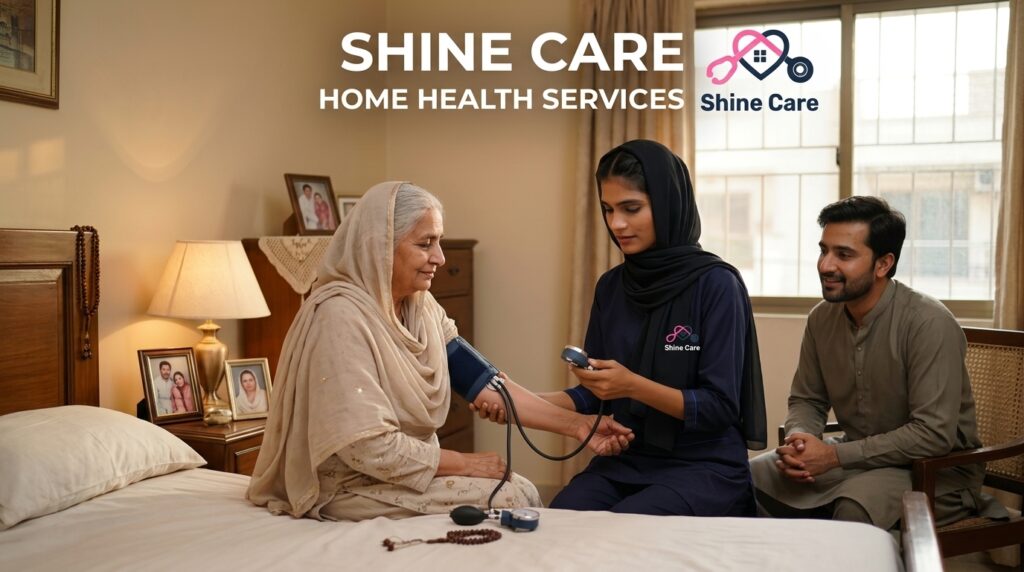
Yes, you can hire a nurse for 24 hours in Lahore, and for many families, this becomes the right choice once a patient’s condition needs more than occasional visits or a family member doing their best without medical training. A parent recovering from major surgery, a grandparent living with advanced dementia, or a patient managing a ventilator at home — these situations call for continuous, trained supervision rather than someone checking in a few times a day.
Shine Care arranges 24-hour nursing coverage for families across Lahore, and this article walks through exactly what that involves, who actually needs it, and how to think through the decision properly.
What Does 24-Hour Home Nursing Mean?
Continuous nursing care means a trained nurse is present with the patient at all times, day and night, rather than visiting for an hour and leaving. This is usually arranged through shift-based nursing, where two or three nurses rotate across the day so the patient always has someone alert and capable present, instead of one exhausted person trying to stay awake through the night.
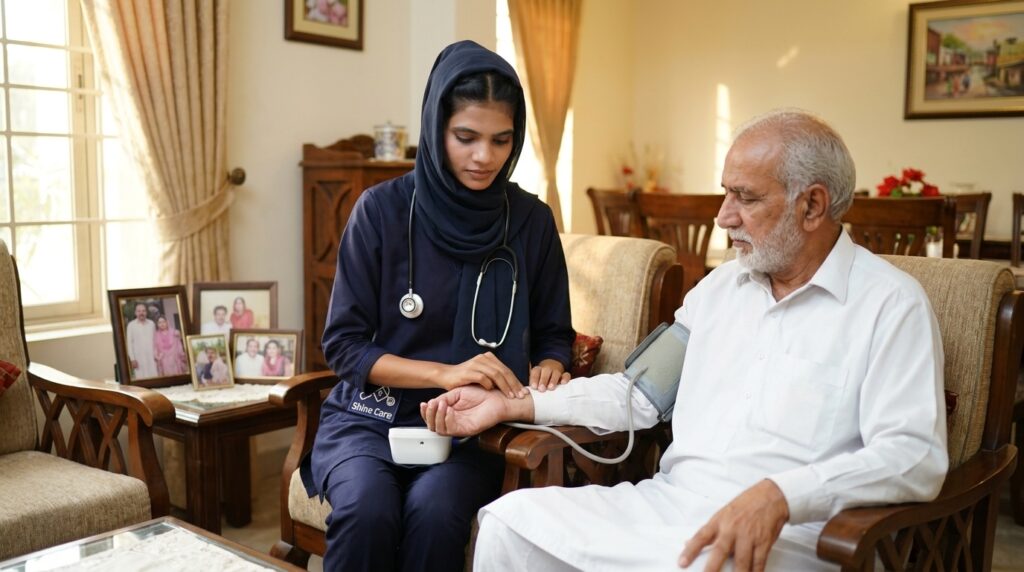
Some families prefer a live-in nurse arrangement instead, where one or two nurses stay at the home for extended periods, alternating rest and active care hours. Shine Care works with families to figure out which setup actually fits their household and the patient’s specific condition.
This is different from hiring a general caregiver. A caregiver typically helps with daily tasks — bathing, mobility, company — without medical training. A nurse handles medication, wound care, vitals monitoring, and recognizing early signs of a medical problem. Families sometimes assume the two are interchangeable, and that assumption can be risky if the patient actually needs clinical oversight.
Who Needs a 24-Hour Nurse at Home?
Elderly patients with multiple health conditions often reach a point where daily supervision becomes a safety matter rather than a comfort matter — missed medication, falls, or sudden confusion are the kinds of things a trained nurse catches early.
Stroke patients, particularly in the weeks right after hospital discharge, need consistent support with mobility, feeding, and monitoring for any signs of a second stroke.
ICU patients who are stable enough to leave the hospital but still need intensive-level monitoring benefit from having that same level of attention continued at home, under proper nursing supervision.
Cancer patients, especially during intensive treatment phases, often need help managing symptoms, medication schedules, and general comfort care that a family alone isn’t equipped to provide safely.
Parkinson’s disease patients frequently reach a stage where medication timing becomes too complex to manage without professional support, since even small delays can affect symptom control.
Dementia patients, particularly in middle or later stages, often need constant supervision due to wandering risk, confusion, or unpredictable behavior changes.
Bedridden patients need regular repositioning, hygiene care, and monitoring to prevent complications like pressure sores, which can develop quickly without consistent attention.
Ventilator patients require continuous, skilled monitoring that simply cannot be left to family members without clinical training.
Post-surgery patients, especially in the first several days after a major operation, face the highest risk of complications and benefit significantly from constant, trained observation.
What Services Are Included?
| Service | Description |
|---|---|
| Medication management | Ensuring medicines are given at the correct time and dosage, without gaps |
| Vital signs monitoring | Regular checks of pulse, temperature, and general condition |
| Blood pressure monitoring | Consistent tracking, particularly important for cardiac and elderly patients |
| Blood sugar monitoring | Regular checks for diabetic patients to catch fluctuations early |
| Injection administration | Prescribed injections given correctly and on schedule |
| IV drip management | Setting up and monitoring intravenous fluids or medication |
| Oxygen therapy | Monitoring oxygen equipment and levels consistently |
| Ventilator support | Trained monitoring for patients on ventilators at home |
| NG tube care | Managing nasogastric feeding tubes safely and hygienically |
| Catheter care | Regular maintenance and hygiene to prevent infection |
| Wound dressing | Proper technique-driven dressing changes, watching for infection |
| Bed sore prevention | Regular repositioning and skin checks for immobile patients |
| Personal hygiene | Bathing, grooming, and general hygiene maintained consistently |
| Mobility assistance | Helping patients move safely, reducing fall risk |
| Emergency observation | A trained nurse present to recognize and respond if something changes |
| Family updates | Regular communication so families know exactly how the patient is doing |
Benefits of Hiring a 24-Hour Nurse at Home
Recovery tends to move faster when a patient has consistent, trained attention rather than gaps between visits. A wound that’s checked every few hours heals differently than one checked once a day — small problems get caught before they become bigger ones.
Better monitoring means fewer surprises. A nurse present around the clock notices subtle changes — a shift in breathing pattern, slightly reduced appetite, unusual drowsiness — long before these become emergencies. Families managing care alone often don’t catch these signals until they’re harder to reverse.
Reduced hospital visits follow naturally from this kind of attentive monitoring. When complications are caught early at home, many can be managed without a return trip to the hospital, which matters both for the patient’s comfort and for reducing exposure to hospital-acquired infections.
Emotional comfort matters as much as physical care. Patients generally do better, mentally and emotionally, recovering in a familiar home environment surrounded by family, compared to an unfamiliar hospital ward with rotating staff and fixed visiting hours.
Family peace of mind is one of the most underrated benefits. Knowing a trained nurse is present, especially overnight, allows family members to actually rest instead of staying alert out of worry, which matters for their own health and their ability to stay involved in the patient’s care long-term.
Better medication compliance comes from having someone specifically responsible for tracking doses and timing, rather than relying on memory during an already stressful period.
Lower infection risk is a genuine advantage of home-based care for many patients, since hospitals, despite necessary infection control measures, still carry exposure risks that a well-managed home environment reduces.
Why Families Across Lahore Trust Shine Care
Shine Care works with experienced, registered nurses who are matched to a patient’s actual condition rather than assigned generically. A patient recovering from surgery needs different expertise than a patient managing Parkinson’s, and Shine Care treats that distinction seriously during placement.
Families can choose between male and female nurses, based on what’s most comfortable for the patient. For patients needing intensive-level care, Shine Care provides ICU-trained professionals who understand ventilator support, complex medication schedules, and close vitals tracking.
Every patient at Shine Care receives a personalized nursing care plan, built around their specific condition, medical history, and daily routine, rather than a standard package applied to everyone. Shine Care offers flexible 12-hour and 24-hour shift arrangements, so families can choose the setup that actually fits their situation.
All nursing staff go through background verification before being placed with a family — this isn’t a formality, it’s a standard step in how Shine Care operates. Unlike hiring an unverified caregiver through word of mouth, Shine Care assigns trained and supervised nurses whose backgrounds have been properly checked.
Shine Care maintains emergency support and clear communication with families throughout the care period, with regular updates on the patient’s condition. The nursing team at Shine Care coordinates directly with the patient’s treating doctor, ensuring the home care plan stays aligned with actual medical treatment rather than operating separately from it.
Families across Lahore trust Shine Care because of this experienced nursing team and a consistent focus on patient comfort, safety, and dignity throughout recovery, not just clinical task completion.
How to Choose the Right Home Nursing Provider
Before hiring any provider, it’s worth asking a few direct questions:
- How exactly are nursing staff verified before being placed with a family?
- Are staff matched based on relevant experience with the specific condition, or assigned generally?
- What happens if the assigned nurse is unavailable one day?
- Is there coordination with the patient’s treating doctor, or does the nursing plan operate independently?
- Are shift options flexible enough to match what the household actually needs?
- Is pricing and what’s included explained clearly, without vague answers?
A provider that answers these clearly, rather than deflecting, is usually one worth taking seriously. At Shine Care, every one of these questions gets a direct answer during the initial conversation, before any commitment is made.
How to Book a 24-Hour Nurse from Shine Care
The process starts with a phone conversation about the patient’s condition, current medications, and hospital discharge instructions if applicable. From there, Shine Care matches a nurse — or a rotating team for full 24-hour coverage — with relevant experience for the specific case.
A care plan is then set up covering medication timing, monitoring needs, and any specialized requirements like wound care or ventilator support. Once this is agreed, nursing staff begin providing continuous coverage at home according to the plan.
Shine Care stays in touch with the family throughout the arrangement and adjusts the care plan as the patient’s condition changes, which happens often, especially during recovery or with progressive conditions like Parkinson’s or dementia.
Final Thoughts
Bringing in 24-hour nursing care is rarely a quick decision. It usually comes after weeks of trying to manage things another way, and reaching that conclusion doesn’t mean a family failed — it means the level of care needed has moved beyond what’s realistic without trained support.
Professional home nursing changes recovery in ways that are easy to underestimate until you’ve experienced it: fewer missed warning signs, steadier medication routines, and a patient who’s comfortable at home instead of anxious in an unfamiliar hospital bed. Shine Care works with families across Lahore to arrange this kind of care properly, matching the right nurse to the right situation and staying involved as needs shift over time.
Reach out to Shine Care to talk through your family member’s situation and figure out what level of nursing support actually makes sense.
Frequently Asked Questions
Yes, when the patient is medically stable enough to be managed outside a hospital, continuous nursing at home is a safe option. A trained nurse handles monitoring, medication, and emergency observation the same way hospital staff would, with the added benefit of one-on-one attention rather than managing multiple patients at once. For patients who are genuinely unstable, a hospital setting remains the safer choice, and Shine Care is upfront about this distinction during the initial assessment rather than accepting every case regardless of fit.
A private nurse hired independently usually comes without background verification, no backup if they’re unavailable, and no coordination with a broader care team. Going through Shine Care means the nurse has been screened, matched based on relevant experience, and backed by a replacement system if something comes up. There’s also ongoing communication and adjustment of the care plan, which an individually hired nurse typically can’t offer on their own.
Yes, this is one of the more common ways families first arrange 24-hour nursing. Shine Care can typically organize an assessment call and match a nurse within a short timeframe, with cases involving immediate post-hospital discharge usually prioritized, since the first few days after leaving the hospital often carry the highest risk of complications.
Both. While the core responsibility is medical — medication, monitoring, wound care — a good nurse also provides genuine companionship throughout the day, particularly important for elderly or bedridden patients who might otherwise spend long stretches alone. This combination of clinical skill and personal attentiveness is part of what makes continuous nursing different from just having medical tasks completed on a checklist.
The process usually starts with understanding the patient’s condition, medical history, and daily routine in detail. From there, a nurse with relevant experience is matched to the case — someone who has handled stroke recovery for a stroke patient, for example, rather than a general assignment. Shine Care treats this matching process as central to how care is arranged, since a mismatch between a nurse’s experience and a patient’s actual needs is one of the most common reasons home care arrangements fail.
This is common, and a good provider should expect it rather than treating the initial arrangement as fixed. Conditions change — a patient recovering from surgery may need less support after a few weeks, while a dementia patient may need more over time. Shine Care checks in regularly and adjusts shift patterns, staffing levels, and care plans as these needs shift, rather than locking families into an arrangement that stops making sense.
Yes, and this is usually the healthiest arrangement. A nurse handles the medical and continuous-monitoring side of things, while family members remain involved in decision-making, emotional support, and the parts of daily life that don’t require clinical training. Having a nurse present doesn’t mean stepping back entirely — it means the burden of round-the-clock medical responsibility no longer falls entirely on one exhausted family member.
It’s not limited to elderly patients at all. Post-surgical recovery, ventilator dependence, cancer treatment, and serious injury recovery can all require continuous nursing regardless of the patient’s age. The deciding factor is the level of medical monitoring and support required, not the patient’s age group.
A nurse tracks how a patient is responding to prescribed pain management, flags anything that isn’t improving as expected, and communicates with the treating doctor if adjustments seem necessary. Beyond medication, comfort also comes from consistent positioning, hygiene care, and simply having someone attentive present, which matters especially for bedridden or post-surgical patients.
Many patients recovering from stroke, surgery, or mobility-limiting conditions need physiotherapy support alongside nursing care. While a physiotherapist typically visits separately for formal sessions, a home nurse can support prescribed exercises between visits, helping maintain progress rather than losing ground on days without a scheduled therapist visit.