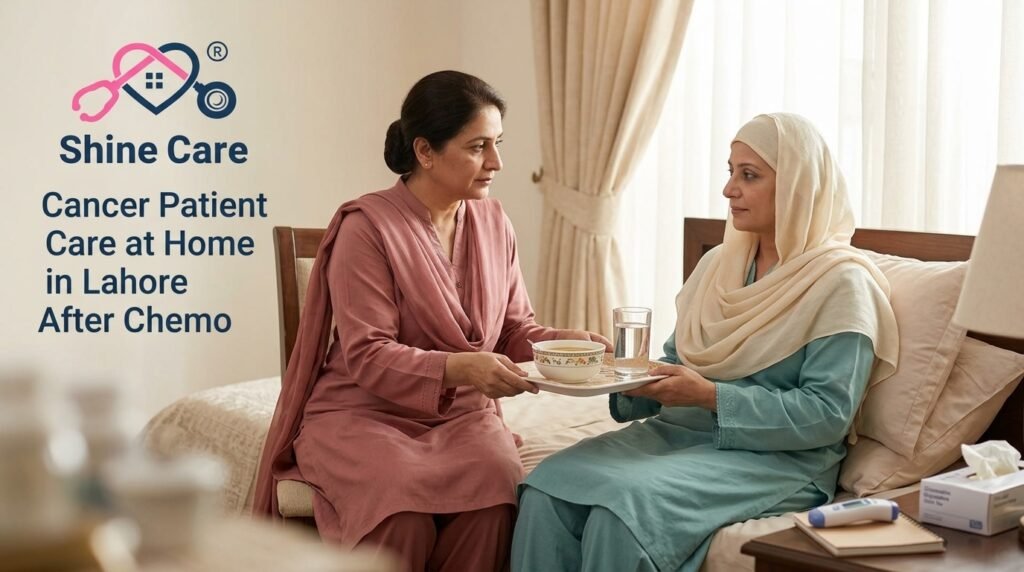
The chemotherapy session finishes, the patient is discharged the same day or the next, and the family brings them home. The hospital part is over for this cycle.
The part that decides how the next two weeks go happens at home — and most of it comes down to a handful of things that nobody explains properly in a busy day-care unit. At Shine Care we look after cancer patients across Lahore between their cycles, and the same gaps appear in almost every household.
This guide covers them, starting with the one that matters more than everything else on this page combined.
Rule one: fever after chemo is an emergency
Not “let us see how he is in the morning”. Not “give him paracetamol and check again”. An emergency, tonight.
Chemotherapy reduces the white blood cells that fight infection. When those cells drop low enough, the patient cannot mount a normal defence — and an infection that would give a healthy person a mild fever can move into the bloodstream and become life-threatening within hours. It has a name: neutropenic sepsis.
Oncology guidance is consistent on the threshold. A temperature of 38°C (100.4°F) or above in a patient who has had chemotherapy in the last few weeks means contacting the treating team immediately — and going to hospital, not waiting.
Some patients feel shivery with chills and rigors before the temperature climbs. Take that seriously too.
Three things every family should have from day one of treatment:
- A working digital thermometer, and somebody who checks it whenever the patient feels unwell
- The oncology unit’s emergency number, written on paper and stuck where everyone can see it
- A clear agreement that nobody gives paracetamol for a fever without telling the doctor first — it lowers the temperature and hides the very thing that needed to be reported
That last point causes real harm here. A family brings down a fever with a tablet, feels reassured, and arrives at hospital two days later with a much sicker patient.
When the risk peaks: the nadir
White cell counts do not fall immediately after a cycle. They drop over the following days and are typically at their lowest around seven to fourteen days after the infusion, then recover before the next cycle.
That window is when the patient is most vulnerable, and it is also — cruelly — when they often feel a little better and the family relaxes.
Ask the oncologist when the nadir falls for this particular regimen, and mark those days on a calendar. Vigilance should peak when the counts are lowest, not on the day after chemo.
Preventing infection at home
Most of what protects a chemo patient is unglamorous and free.
- Handwashing — the patient, the family, and every single visitor
- Nobody with a cough or cold comes near the patient. This is difficult in our households where visiting a sick relative is expected. Explain it once, clearly, and hold the line
- Limit visitors during the nadir days, and keep children with colds away entirely
- No street food, no cut fruit from a cart, no raw salads from outside. Food should be freshly cooked and hot
- Boiled or properly filtered water only, for the whole household
- Peel fruit yourself, wash it thoroughly first
- Avoid crowds — bazaars, mosques at peak times, weddings — during the nadir
- No gardening, no repotting plants, and no fresh flowers or standing water in the room
- Somebody else handles pet litter and animal waste
- Keep the room low in dust, and away from construction work
- No dental work or vaccines without checking with the oncology team first
The 48 hours nobody warns families about
This section is the one families in Pakistan almost never hear, and it matters.
For roughly 48 to 72 hours after a chemotherapy dose, small amounts of the drugs are present in the patient’s body fluids — urine, stool, vomit, sweat and blood. Those are cancer drugs, and they are not harmless to the people handling them.
Guidance from Roswell Park Comprehensive Cancer Center on home precautions after chemotherapy is specific: caregivers must wear gloves when handling the patient’s blood, urine, stool or vomit, dispose of the gloves after each use and wash their hands afterwards.
And then a line that describes exactly what goes wrong in most Pakistani homes: any sheets or clothes soiled with body fluids should be machine-washed twice in hot water with regular detergent — not hand washed. If they cannot be washed straight away, they go into a sealed plastic bag.
In most of our households, soiled linen is hand-washed, and very often by a domestic helper who has been told nothing at all. That person is being exposed to chemotherapy residue with bare hands, repeatedly, and nobody has thought to mention it.
What this means practically for the first 48 to 72 hours after each cycle:
- Disposable gloves in the house — a box from any pharmacy — for anyone handling body fluids
- Wash hands after removing gloves, every time
- Soiled linen machine-washed twice in hot water, separately, and never hand-washed
- Tell whoever does the laundry. This is not optional, and it is a matter of basic fairness to them
- Men should sit to use the toilet to reduce splashing
- Lid down, flush twice, and clean any splashes with soap and water
- Keep the lid down between uses so pets do not drink from it
- If skin is exposed to any body fluid, wash the area with soap and water straight away
Ask the oncology unit how long the precautions apply for this specific regimen. It varies by drug, and some take longer than 48 hours to clear.
The mouth: the most neglected part of chemo care
Chemotherapy damages the fast-dividing cells lining the mouth, which is why ulcers and soreness are so common. It is called mucositis, it is miserable, and it stops patients eating and drinking — which then causes a second set of problems.
It is also a route for infection at exactly the time the patient cannot fight one.
- A very soft toothbrush, gently, after meals and at bedtime
- Salt water or a bicarbonate rinse several times a day, if the team approves it
- No alcohol-based mouthwash — it stings and dries the mouth further
- Keep lips moist with something the team has approved
- Avoid spicy, acidic, very hot or hard foods during a sore phase — for our patients that usually means easing off chillies and citrus for a while
- Check the mouth daily in good light, and report white patches, bleeding or ulcers that stop the patient eating
Eating when nothing appeals
Nausea, taste changes and a metallic taste are normal after chemo, and families often make it harder by pushing large meals out of love.
What tends to work:
- Small amounts, often — six small plates beat three large ones
- Bland and soft during the worst days — khichri, yakhni, soup, yoghurt, banana, plain rice, boiled potato
- Take anti-sickness medicine on schedule, before nausea builds, not after it arrives
- Cool or room-temperature food often smells less and is tolerated better than steaming hot food
- Keep the patient out of the kitchen while cooking — cooking smells trigger nausea more than the food itself
- Protein matters — eggs, daal, yoghurt, meat where they can manage it
- Do not force. Pressure increases nausea and creates a battle at every meal
Weigh the patient weekly and write it down. Steady weight loss is worth reporting before it becomes obvious.
Fluids and constipation
Dehydration is one of the most common reasons a chemo patient ends up back in hospital, and it is largely preventable. Fluids through the day, unless the doctor has restricted them. Sips frequently work better than glasses occasionally.
Both constipation and diarrhoea are common depending on the regimen and the anti-sickness medicines. Both should be reported rather than treated with whatever is in the cupboard — laxatives and anti-diarrhoeals are not always safe in these patients.
Fatigue is not ordinary tiredness
Cancer-related fatigue does not improve with a night’s sleep, and it is the symptom patients report as most limiting.
Short rests rather than long ones. Gentle activity where the patient can manage it, because complete inactivity worsens fatigue. Priorities set for the day — one outing, or one visit, not both. And no expectation that the patient should be “fighting” it.
Warning signs
Go to hospital immediately for:
- Temperature of 38°C or above, or shivering and chills
- Breathlessness or chest pain
- Bleeding that will not stop — nose, gums, or in urine or stool
- Sudden confusion or difficulty waking the patient
- Severe abdominal pain, or persistent vomiting with nothing staying down
- Unusual bruising or a rash of small red spots
Contact the team the same day for: mouth ulcers stopping eating, diarrhoea or constipation that will not settle, passing much less urine, new swelling in a leg, a rash, or a cannula or line site that is red, painful or swollen.
Blood counts and the next cycle
Blood tests before each cycle check whether counts have recovered enough for treatment to continue. Cycles are sometimes delayed for this reason, and families often read a delay as bad news.
It usually is not. A delay to let counts recover is the system working as intended.
Keep every report, in order, in one folder. Take it to every appointment. Oncologists work from trends, and a folder in date order is worth more than any description a family can give.
When home nursing helps between cycles
Plenty of patients manage between cycles with family support alone. Professional support becomes genuinely useful when:
- The patient needs IV fluids, injections or line care at home
- Nausea and weakness mean they need help with bathing, moving and daily activities
- Somebody needs to watch for the warning signs above during the nadir days
- The patient is elderly, or has diabetes or heart conditions alongside
- The family carer is exhausted — cancer care runs for months, and a spouse or one sibling doing it alone will not last the course
That whole picture — clinical care, symptom management and daily support between hospital visits — is what Shine Care’s cancer care at home in Lahore covers.
When the focus shifts to comfort
Not every cancer journey continues toward cure, and there comes a point for some patients where treatment aimed at the disease stops making sense and care aimed at comfort takes over.
That shift is not giving up, and it is not something to delay out of guilt. Patients whose symptoms are properly managed are more comfortable, more themselves, and often live better for the time they have. Pain control, breathlessness, nausea and rest are all things that can be managed well at home.
If that conversation is starting with your oncologist, our palliative care at home service covers it — including support for the family, which matters as much as the patient at that stage.
Frequently asked questions
Yes. The precautions are about body fluids and infection risk, not about the patient’s presence. Isolating them socially does no good and does real harm to their morale.
No. Normal washing with soap and hot water is sufficient. What does need separating is soiled linen during the 48-hour window, and that goes in the machine, not a bucket.
Generally yes, if the children are well. Any child with a cough, cold or fever should stay away entirely, particularly during the nadir days.
Not without telling the oncology team. Bringing the temperature down masks the single most important warning sign there is, and delays the antibiotics the patient may urgently need.
Not without the oncologist’s knowledge. Several herbal preparations interact with chemotherapy drugs or affect the liver, and the effects are not always predictable. Show the oncologist anything the family is considering.
Usually not. Hair typically regrows after treatment finishes, though texture or colour can change. It is worth saying out loud in the family — patients often mind this far more than they admit.
Most ease within one to two weeks, improving as counts recover before the next cycle. Effects that persist, or that get worse rather than better, should be reported rather than accepted as normal.
Arranging cancer care at home in Lahore
If a family member is starting chemotherapy or is between cycles, the useful time to arrange support is before the difficult week rather than during it. Shine Care can advise on what level of care the situation needs, arrange a nurse or attendant for the nadir days, and set up the room and the routine so the family is not improvising in the middle of it.
Send us the patient’s details and the oncologist’s instructions, and we will tell you honestly what is needed — including when it is less than the family feared.