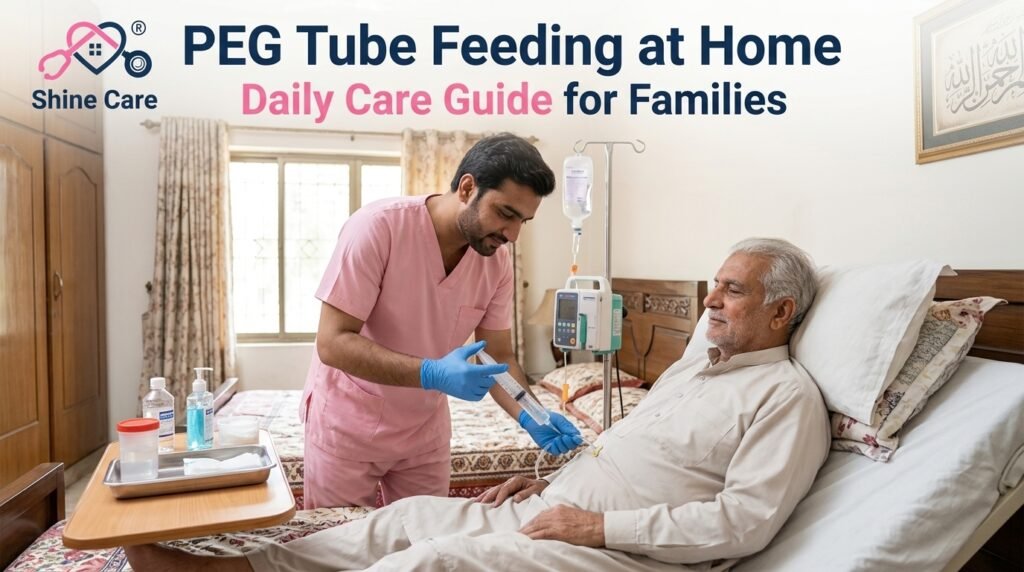
A PEG tube — percutaneous endoscopic gastrostomy — is a small feeding tube passed through the skin of the abdomen directly into the stomach. For patients who cannot swallow safely but have a working digestive system, it is one of the most useful interventions in medicine. For families bringing one home for the first time, it looks terrifying. A plastic tube emerging from the belly of a loved one, syringes of feed every few hours, instructions about flushing and site care that nobody fully remembers once home — most Lahore families call us in the first week with the same questions. This guide is for that first week and the months that follow.
Nothing in this article replaces the gastroenterologist’s or nutritionist’s specific plan for your patient. Feed type, volume, timing and medications all come from the treating team. The point here is to help the family manage the hundreds of small practical decisions that happen between hospital visits.
Who Has a PEG Tube and Why
In Lahore homes, PEG tubes are most commonly placed in:
- Stroke patients unable to swallow safely
- Patients with head and neck cancers during or after radiotherapy
- Advanced dementia patients with severe swallowing difficulty
- Motor neurone disease and other neurological conditions
- Severely malnourished patients needing long-term nutrition support
- Patients with head injury or prolonged ICU stay
- Oesophageal strictures or obstructions where swallowing is unsafe
A PEG is usually chosen over a Ryle’s (nasogastric) tube when feeding will be needed for more than four to six weeks. It is more comfortable long-term, less likely to be dislodged, and allows the patient dignity without a tube visible on the face.
The First Week — What to Expect
The tube is placed during a short endoscopic procedure, usually under sedation. The patient comes home within 24 to 48 hours. The first week is about letting the tract heal and starting feeding gently.
- Mild tenderness around the tube site is normal for a few days
- A small amount of clear or slightly bloody fluid may ooze — report to the doctor if it increases
- The site should be kept clean and dry, with daily inspection
- Feeding usually starts with water for the first few hours, then builds up to full feeds over 24 to 48 hours
- The external bumper (the plastic disc against the skin) should not be too tight — too much pressure causes skin breakdown
- The internal position is checked by the hospital team before discharge
Families often ask when they can “stop being nervous” with the tube. Most become comfortable within two to three weeks. The main anxiety point is the first feed at home — once that goes well, confidence builds quickly.
Daily Feeding Routine
Most PEG patients at home follow one of two feeding patterns — bolus feeding (feeds given in portions through a syringe every few hours) or continuous feeding using a feeding pump overnight or round the clock. The gastroenterologist and nutritionist decide which, based on how the patient tolerates feeds.
Bolus Feeding — Step by Step
- Wash hands with soap and water
- Elevate the head of the bed at least 30 degrees — this reduces aspiration risk
- Check the tube is in position (external length matches the recorded length)
- Flush the tube with 30 to 50 ml of water using a syringe
- Draw the prescribed feed into a large syringe (usually 60 ml)
- Attach the syringe to the tube and allow the feed to flow by gravity — do not push forcefully
- If using a pre-mixed formula, pour slowly rather than pushing with the plunger
- Pause if the patient coughs, retches or shows discomfort
- Flush the tube again with 30 to 50 ml of water after the feed
- Keep the patient’s head elevated for 30 to 60 minutes after feeding
- Record the volume given and any issues
Continuous Pump Feeding
- The feeding pump controls the rate — typically 50 to 100 ml per hour overnight
- The feed bag is hung above the patient at the level the pump requires
- The pump is set to the prescribed rate
- Flush with water every 4 hours during continuous feeding
- Change the feed bag and giving set daily
- Watch for pump alarms — blocked tube, bag empty, air in line
Pump feeding is often more comfortable for the patient than large bolus feeds. For families managing PEG at home with trained nursing care support, the nurse usually sets up the overnight pump before leaving and the family manages the day boluses.
Flushing — The Most Important Habit
A blocked PEG tube is one of the most common problems and almost always preventable with good flushing habits.
- Flush before and after every bolus feed
- Flush before and after every medication
- Flush every 4 to 6 hours during continuous feeding
- Flush at least twice daily even if the tube is not in use
- Use plain water — never carbonated drinks, juice or anything with particles
- Use 30 to 50 ml of water for a routine flush
- Never force water through a blocked tube — pressure can rupture the tube or push a blockage further
If the tube does block, try warm water pulsed gently with a syringe — small push, hold, pull back, small push again. If this does not clear the tube within 15 to 20 minutes, call the home nursing team or the gastroenterology unit. Do not try chemical “unblockers” without medical advice.
Medications Through a PEG Tube
Giving medicines through a PEG tube is slightly different from oral administration and worth getting right.
- Flush the tube with 15 to 30 ml of water before any medicine
- Crush tablets to a fine powder (if the tablet can be crushed — check with the pharmacist)
- Mix the powder with 10 to 15 ml of water until fully dissolved
- Draw into a syringe and give through the tube
- Flush with another 15 to 30 ml of water after each medicine
- If giving multiple medicines, flush with 5 to 10 ml of water between each one
- Never mix different crushed medicines together — reactions and tube blockages result
- Liquid preparations are preferred where available
- Some medicines cannot be crushed — slow-release preparations, enteric-coated tablets, chemotherapy drugs. The pharmacist tells you which.
Families struggling with a long medication list often find it easier to arrange a home nurse near me for twice-daily visits specifically for medications and feeds, rather than carrying the burden alone.
Daily Site Care
The PEG site needs daily care to prevent infection and skin breakdown. This is one of the areas where a trained home nurse makes the biggest difference in the first few weeks.
Daily Routine
- Wash hands with soap and water
- Gently clean around the tube with warm water and mild soap
- Rinse carefully and pat completely dry
- Rotate the external bumper (the disc) a quarter turn once a day — prevents the tube from sticking to the stomach wall
- Check that there is 1 cm of play between the bumper and the skin — not too tight, not loose
- Look at the site for redness, swelling, pus, odour, bleeding, overgrown skin (granulation tissue)
- Dry gauze under the bumper if there is any oozing — change daily
- Note the external length of the tube and compare to the recorded length
Warning Signs
- Spreading redness beyond the tube site
- Pus or foul-smelling discharge
- Fever
- Severe pain at the site
- Tube moving in or out significantly from its recorded position
- Leakage of stomach contents around the tube
- New granulation tissue — pink moist tissue around the stoma
- Hard red lump under the skin
Any of these need prompt review — a home nurse visit, a call to the gastroenterology team, or a hospital check depending on severity.
Feed Choice and Nutrition
The treating team prescribes the feed type. In Lahore the common options are:
- Commercial polymeric feeds — ready-to-use liquid feeds with balanced nutrients. Easiest for families, consistent nutrition, hygienic. Brands available through pharmacies.
- Homemade blenderised feeds — pureed home food (daal, soft chicken, soft vegetables, fruit, dairy) blended to a thin consistency. Needs careful hygiene and nutritional balance. Cheaper. Suitable for stable long-term patients where the family has been trained.
- Combination approach — commercial feeds for consistency plus homemade feeds for variety and taste (yes, PEG patients can taste food that passes through the stomach even without passing through the mouth, in the sense that familiar food smells and textures matter).
A dietitian consultation at the start is one of the most useful things a family can arrange. Major hospitals in Lahore have dietitians who guide feed volume, timing and consistency.
Hydration
- Water through the tube in addition to feeds — most adults need 1.5 to 2 litres a day total
- Flushes count towards daily water intake
- Watch for signs of dehydration — dry mouth, dark urine, low urine output, confusion
- Signs of overhydration — new swelling in legs or around the eyes, breathlessness
Common Problems and What to Do
Blocked Tube
Try warm water flushed gently in pulses. If not clearing within 15 to 20 minutes, call for help. Do not use carbonated drinks or juice — they often make blockages worse.
Diarrhoea
Common causes include too-fast feed rate, feeds too concentrated, infection, lactose intolerance, antibiotic use. Try slower feeds or diluted feeds first. If persistent, speak to the dietitian or doctor.
Constipation
Common with low-fibre feeds, dehydration, immobility. Increase water flushes, consider fibre-containing feeds, prescribed laxatives if the doctor advises.
Vomiting or Reflux
Keep the head elevated during and after feeding. Slower feeds in smaller volumes. If persistent, the doctor may adjust the feed or add a motility-helping medication. Important to prevent aspiration pneumonia.
Tube Falling Out
Emergency. The tract starts to close within hours if the tube is not replaced. Cover the site with a clean dressing and go to the hospital or call the gastroenterology team immediately — a replacement tube is placed through the existing tract if done soon enough.
Leakage Around the Tube
Small amounts occasionally normal. Large amounts or constant leakage means the tube may be loose, the bumper may be too tight, or the stoma has stretched. Needs medical review.
Granulation Tissue
Pink moist tissue growing around the stoma. Common. Not dangerous but can bleed and be uncomfortable. Treatment is simple — silver nitrate application by a nurse or doctor, sometimes a short course of mild steroid cream. Do not pick or scrape.
Daily Hygiene and Patient Comfort
- Full bath or sponge bath each day — the PEG site can get wet after the first week with a shower, but should always be fully dried immediately
- Mouth care twice daily — PEG patients cannot swish water in their own mouths effectively and oral hygiene often slips. Infection and discomfort build up without it.
- Position changes every two hours for immobile patients — prevent bedsores
- Clothing that allows easy tube access — loose kurtas, buttoned fronts
- Keep the tube secured — small adhesive device or soft binder to prevent catching on clothing
- Comfortable room temperature during feeding — some patients feel cold during slow feeds
When Professional Nursing Help Makes Sense
Many families care for a PEG patient entirely themselves after some training. For others, bringing in trained nursing care at least part-time is worth it. Common patterns:
- First 2 to 4 weeks — nurse visits twice a day for site care, feed demonstration, medication administration, family training
- Long-term stable — nurse visits weekly for site inspection, help with feed changes, medication review
- Bedridden patients — 12 or 24-hour nursing covering feeding, positioning, hygiene, suction, medication
- Complex patients — nurse presence for continuous care; complex situations need skilled hands continuously
Reliable health at home around a PEG patient is cheaper and safer than the hospital readmissions that happen when things go wrong. A blocked tube at midnight, a tube that falls out, a wound infection ignored for two days — all of these are preventable with good routines and periodic nursing support.
About Shine Care
Shine Care is Pakistan’s largest home nursing company serving Lahore, Islamabad and Rawalpindi. For PEG tube patients at home we provide trained nurses for site care and feed administration, visiting doctor review when the gastroenterologist’s clinic is far, and coordination with the hospital’s nutrition team. Our team covers DHA (Phase 1 to 10), Gulberg, Model Town, Garden Town, Johar Town, Faisal Town, Wapda Town, Valencia Town, Bahria Town Lahore, Lake City, Cantt, Askari, DHA Rahbar and most other Lahore neighbourhoods, with twin-cities coverage for Islamabad and Rawalpindi.
For related services on this site, see home nursing services in Lahore for general nursing arrangements, registered nurse in Lahore for feeding tube procedures and medication administration, elderly care at home for older PEG patients, ICU care at home for complex patients needing continuous support, and visiting doctor at home for ongoing medical review.
Call or WhatsApp 0344-9226778 to discuss what level of PEG tube home nursing fits your patient’s situation.
Frequently Asked Questions
Most PEG tubes last 6 months to 2 years. Some newer button-type devices last longer. The gastroenterology team schedules replacement when the tube shows wear. A tube that falls out needs replacement within hours.
Sometimes. For patients whose swallowing is improving (recovering stroke, post-radiation head and neck cancer), the oral intake is gradually increased alongside PEG feeds. For patients who cannot swallow at all (advanced neurological disease), oral intake is not safe. The speech and swallowing therapist decides.
Depends on the underlying condition. In some patients (recovering stroke, temporary cancer complication) the PEG is removed once swallowing is safe. In others (advanced dementia, motor neuron disease) it is long-term. The decision is reviewed periodically.
Sponge bath in the first week. From week two, a shower is usually fine if the site is dried fully immediately afterwards. Avoid soaking in a tub or submerging the site in water for the first few weeks.
Yes, usually. The pharmacist advises which can be crushed and which cannot. Some medications need liquid formulations. The doctor adjusts the medication list to the PEG route.
Yes. Visit-based nursing for daily feeds and site care, or 12/24-hour nursing for complex patients. Call 0344-9226778 for a quote based on your patient’s specific needs.
This article is a general guide. It does not replace the gastroenterologist’s or dietitian’s specific plan. For blocked tube, tube falling out, severe pain, high fever or signs of aspiration, contact your doctor or go to the hospital at once. External reference: NHS — PEG feeding.