
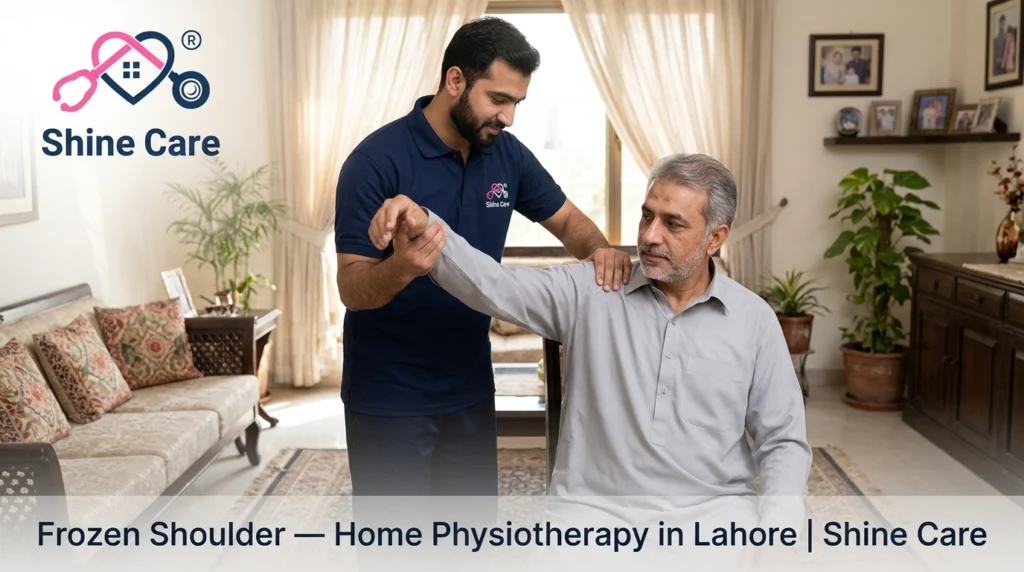
A frozen shoulder tells a specific story. It usually begins with mild pain that no one takes seriously. Over weeks the pain worsens, especially at night. Then the stiffness arrives. The arm will not lift above shoulder height. Combing hair, fastening a bra, reaching for a shelf, putting on a shalwar kameez — all become difficult. By the time most Pakistani patients get to a doctor, the shoulder has been painful for months and already significantly stiff. The medical name is adhesive capsulitis — the lining of the shoulder joint has become inflamed and thickened. It is one of the most common and most misunderstood shoulder conditions in Lahore adults, particularly women between 40 and 60, and particularly those with diabetes. The good news is that it responds well to structured physiotherapy — provided the patient actually does it, consistently, for the months it takes.
This guide covers home physiotherapy for frozen shoulder — the three phases, the exercises, what to expect, and how Shine Care’s physiotherapists support Lahore families. Nothing here replaces direct assessment and prescription from a treating doctor or orthopaedic surgeon.
What Frozen Shoulder Actually Is
The shoulder is held together by a capsule of connective tissue around the joint. In frozen shoulder:
- The capsule becomes inflamed
- The lining thickens and tightens
- Adhesions (sticky bands) form between tissues
- Range of movement reduces dramatically
- Pain accompanies the stiffness, especially at night
- The process runs through three phases over 1 to 3 years in most patients
- Most patients recover fully, but recovery is slow
Frozen shoulder is not torn muscle, not slipped disc of the shoulder, not arthritis — though it can coexist with these. Correct diagnosis is important because treatment differs.
Who Gets It
- Adults between 40 and 60 years, slightly more in women
- Diabetics — significantly higher risk, both type 1 and type 2
- Thyroid problems — hyperthyroid and hypothyroid both
- Previous shoulder immobilisation (sling, cast)
- Post-stroke patients
- Post-surgery patients where the shoulder was not moved
- Post-fracture patients
- History of frozen shoulder in the other shoulder
- Parkinson’s disease
- Heart disease and pulmonary disease
Many Pakistani diabetic women present in their late 40s with frozen shoulder of one side, and go on to develop it in the other side within 2 to 5 years. Blood sugar control slightly improves outcomes.
The Three Phases
Phase 1 — Freezing (Pain Phase)
Duration: typically 2 to 9 months.
- Pain develops gradually
- Pain worse at night, often disrupting sleep
- Pain worse with sudden movement
- Range of movement starts to reduce
- Patient avoids using the arm because of pain
- The arm starts “catching” during normal activity
Goal of treatment in this phase — reduce pain, maintain whatever movement remains, prevent further stiffness. Not forcing movement through severe pain.
Phase 2 — Frozen (Stiffness Phase)
Duration: typically 4 to 12 months.
- Pain reducing but still present
- Stiffness increasing
- Range of movement at its most limited
- Daily activities significantly affected
- Night pain may still be present
Goal — gradual, structured stretching and strengthening. Patient tolerance to movement is now better than in Phase 1, and this is where consistent physio pays off.
Phase 3 — Thawing (Recovery Phase)
Duration: typically 5 to 24 months.
- Stiffness slowly resolving
- Movement returning
- Pain reducing further
- Function gradually improving
Goal — restore full range, build strength, return to normal activities. Most patients recover close to full function over this phase.
How Doctors Diagnose
- Clinical examination — the patient cannot externally rotate the arm (bring hand away from body with elbow at side) actively or passively
- Reduced passive movement — the clue that distinguishes frozen shoulder from rotator cuff problems where passive movement is better than active
- History fits the pattern
- X-ray often normal — frozen shoulder is a soft tissue problem
- MRI not usually needed for diagnosis
- Blood tests to check for diabetes, thyroid if not already known
Most Pakistani patients do not need MRI. If the specialist orders one, it is usually to rule out other conditions.
Treatment Options
Physiotherapy
The foundation of treatment at every phase. Specific exercises adapted to the phase. 2–3 physio sessions a week plus daily home practice.
Pain Relief
- Paracetamol regularly
- NSAIDs (ibuprofen, diclofenac) as advised, with stomach protection and caution in elderly or those with kidney, heart or stomach issues
- Topical gels for localised pain
- Heat before exercises
- Cold after exercises if swelling
Injections
- Steroid injection into the shoulder — can significantly reduce pain in Phase 1 and allow physio to proceed
- Hydrodilatation — a specific procedure where fluid is injected to stretch the capsule
- Decision by the orthopaedic surgeon or specialist
Surgery
- Reserved for severe cases not responding to months of correct physio
- Manipulation under anaesthesia or arthroscopic release
- Followed by intensive physiotherapy
- Not a first-line treatment
Diabetes Control
For diabetic patients, strict blood sugar control slightly improves outcomes and reduces the risk of the condition developing in the other shoulder.
Home Physiotherapy — The Exercises
Specific exercises come from the physiotherapist. General categories by phase:
Phase 1 Exercises
- Pendulum swings — lean forward, let the arm hang, make small gentle circles with the arm’s own weight — no muscle effort
- Passive movements — the physiotherapist or family member gently moves the arm through the pain-free range
- Shoulder shrugs and squeezes — gentle, maintain muscle tone
- Posture work — avoid slouching which worsens shoulder position
- Heat applications before exercise
- Avoid pushing through sharp pain
Phase 2 Exercises
- Wall climbing (finger walk) — walk fingers up the wall slowly, higher each day
- Towel stretch — hold a towel behind the back, one hand up and one hand down, gentle vertical stretch
- Cross-body stretch — use the good arm to gently pull the affected arm across the body
- External rotation stretch — standing with elbow at side, bent 90 degrees, hand moves outward
- Doorway stretch — hand on door frame, body turning slowly away
- Hold each stretch for 20 to 30 seconds, several repetitions, several times a day
Phase 3 Exercises
- Continue stretching
- Progressive strengthening with light resistance bands
- Rotator cuff strengthening
- Return to functional activities
- Weight training as cleared
Little and often works better than long occasional sessions. 5 to 10 minutes of exercises 4 to 6 times a day beats a one-hour session once a week.
Day-to-Day at Home
- Heat pad before stretching — 10 to 15 minutes
- Gentle exercises after heat
- Cold pack if soreness after
- Avoid sudden heavy lifting with the affected arm
- Sleep with a pillow supporting the affected arm, not tucked under
- Side-sleeping on the affected side worsens night pain — avoid
- Modify sleeve-based clothing for ease
- Prayer modifications where the full postures aggravate — specialist and physio can advise
- Avoid prolonged immobilisation — the shoulder worsens if not moved
- Return to driving once pain and movement allow
- Return to office work usually possible with minor modifications
Common Pakistani Patient Mistakes
- Not moving the arm at all because of pain — accelerates the stiffening
- Trying to “break through” the stiffness with force — causes micro-trauma
- Massage from untrained providers — can worsen inflammation
- Chiropractic manipulation without clear diagnosis
- Multiple steroid injections hoping for a cure
- Skipping physio because improvement is slow
- Expecting treatment to work in weeks — frozen shoulder is a months-to-years condition
- Not controlling diabetes
- Not controlling thyroid problems
- Giving up before Phase 3 and remaining stiff for years
- Overdoing on good days — causing flare-ups
Why Home Physio Suits Frozen Shoulder
- Treatment runs for months to years — clinic trips become unsustainable
- Lahore traffic and heat make reliable clinic attendance difficult
- Patient in pain prefers not to travel
- The exercises are done at home anyway
- Family can learn correct technique and support consistently
- Flexible scheduling fits around work and household life
- Physio can observe the home environment and tailor advice
- Reliable in Lahore smog season when going out worsens other conditions
Most frozen shoulder patients benefit from an intensive first 4 to 8 weeks of 2 to 3 weekly physio visits, scaling down to weekly, then fortnightly maintenance checks as the home programme becomes established.
When to Expect Progress
- First 2 to 4 weeks — pain usually reduces with correct management; measurable range change often modest
- 8 to 12 weeks — real range gains in Phase 2 patients
- 3 to 6 months — significant functional improvements
- 6 to 12 months — most patients close to or at full function in Phase 3
- Some patients, particularly diabetics, take longer
- Minority have persistent stiffness long-term — rare with consistent treatment
Pacing matters. Patients who want fast results and skip rest days often flare up. Patients who do little and often progress reliably.
Equipment and Home Setup
- Hot water bottle or electric heat pad
- Cold pack
- Theraband (resistance band) in different strengths for later phases
- Pulley system (small, cheap, attaches to door) for self-stretching
- Light hand weights for Phase 3
- Supportive pillow for sleeping position
- Pain-relief medications as prescribed
Minimal cost. Most Lahore pharmacies stock these items.
Where Home Nursing Fits In
For most frozen shoulder patients, a visiting physiotherapist alone is enough. For some situations, broader support helps:
- Elderly patients with multiple medical issues including frozen shoulder
- Post-stroke patients with coexisting frozen shoulder
- Diabetic patients needing insulin and medication oversight alongside
- Working professionals needing scheduled physio in evenings or weekends
- Overseas family coordinating a parent’s care
- Patients recovering from surgery with associated frozen shoulder
In these cases our wider nursing care team supports the physio with medication help, mobility assistance, and daily routine. Many Lahore patients searching for a home nurse near me for shoulder-related issues actually need a physiotherapist first — but combined care works when the patient has multiple needs. For a comprehensive health at home plan that includes frozen shoulder recovery alongside broader elderly or chronic disease care, our combined service model fits. The physio does the shoulder work; the attendant or nurse supports the rest of the daily patient care.
About Shine Care
Shine Care provides home physiotherapy and home nursing across Lahore. Our physios cover frozen shoulder, back pain, post-stroke rehabilitation, post-surgical recovery, orthopaedic conditions, and sports injury rehabilitation. We cover DHA Phase 1 to 10, Gulberg, Model Town, Garden Town, Johar Town, Faisal Town, Wapda Town, Valencia Town, Bahria Town, Lake City, Cantt, Askari and most Lahore residential areas.
For related services on this site, see our main physiotherapy at home page, home nursing services in Lahore, post-surgery care, stroke care at home, diabetes care, and visiting doctor at home for medical review.
Call or WhatsApp 0344-9226778 to arrange a physiotherapist for frozen shoulder assessment in Lahore. First visit usually within 1 to 3 days.
Frequently Asked Questions
How long does frozen shoulder take to resolve?
Typically 1 to 3 years from onset to resolution. Correct physiotherapy accelerates recovery and improves the final range. Diabetic patients often take longer than average.
Will my shoulder be the same as before?
Most patients recover close to full function with consistent treatment. Some have minor residual stiffness long-term. A minority need surgical release.
Can I get frozen shoulder on the other side later?
Yes, especially if you are diabetic or have thyroid problems. Risk is around 1 in 5 to 1 in 3 for the other shoulder. Early recognition and treatment helps.
Does steroid injection cure frozen shoulder?
It can significantly reduce pain, especially in Phase 1, and allow physio to proceed. It is not a cure — the stiffness still needs working through. Multiple repeated injections are not standard.
Can I do YouTube exercises for frozen shoulder?
Some YouTube content is reasonable, but doing exercises wrong for your phase can worsen the condition. A physiotherapist’s initial assessment identifies the phase and the right exercises; after that, home practice between visits is the goal.
Does Shine Care provide evening or weekend physio in Lahore?
Yes — evening and weekend appointments are available for working patients. Call 0344-9226778.
Can my overseas family coordinate my mother’s physio from abroad?
Yes — overseas family coordination is routine. Payment, progress reports and physio updates handled remotely.
This article is a general guide. All diagnosis and treatment decisions remain with the treating doctor and physiotherapist. For severe shoulder pain with fever, swelling, redness or trauma history, seek direct medical review. External reference: NHS — Frozen Shoulder.