
Knee osteoarthritis is one of the quiet burdens of Pakistani adulthood. It arrives slowly — a dull ache after a long day of standing, a crack and twinge going upstairs, a stiffness on first getting out of bed. Over a few years it steals mobility. Patients stop walking long distances. Stop climbing stairs if they can avoid them. Stop praying in the full postures. Stop visiting relatives on upper floors. Knee replacement surgery is one option for severe cases, but for the vast majority of patients — particularly in the early and middle stages — well-designed physiotherapy plus sensible lifestyle adaptation keeps the knee working for many more years. The trouble is most Pakistani patients never actually do the physiotherapy. They buy painkillers, see three doctors, get three different injections, and then slowly accept the decline as inevitable. It is not. The muscles around the knee can be strengthened. The weight pressing through the joint can be reduced. The flexibility can be restored. The quality of life can be preserved. Most of the work happens at home, done by the patient between physiotherapist visits.
This guide covers home physiotherapy for knee osteoarthritis — what works, what does not, the daily routine, and how Shine Care supports Lahore families. Nothing here replaces direct assessment by an orthopaedic specialist or physiotherapist, which must guide the specific plan.
What Osteoarthritis Is
Osteoarthritis is the wear-and-tear arthritis. The cartilage covering the ends of the bones in the knee wears thin over years. Bone starts rubbing closer to bone. The joint reacts with:
- Pain, especially with activity
- Stiffness after rest
- Reduced range of movement
- Crepitus (crackling or grinding)
- Swelling in flare-ups
- Deformity over time (bowing)
- Reduced walking distance
- Progressive loss of function
Risk factors in Pakistani adults:
- Overweight — far the biggest
- Age — rising sharply after 50
- Female sex — significantly higher incidence
- Previous knee injury
- Specific occupations involving squatting or heavy lifting
- Floor-level activities — eating, praying, housework — strain the knees
- Vitamin D deficiency contributing to joint health
- Family history
- Diabetes
Not every stiff knee is osteoarthritis. Other conditions — rheumatoid arthritis, gout, infection, ligament injury, meniscus tear — need different treatment. An orthopaedic specialist’s assessment identifies the specific problem.
What Physiotherapy Actually Does for Knee OA
- Strengthens the muscles around the knee — particularly quadriceps — reducing load on the joint
- Improves flexibility and range of movement
- Reduces pain through specific techniques
- Reduces swelling
- Improves balance — reducing fall risk
- Teaches the patient how to manage flare-ups at home
- Teaches correct movement patterns during daily activity
- Delays the point at which surgery becomes necessary
- Improves outcomes if surgery eventually happens
- Does all this without medication side effects
Specific research shows structured physiotherapy for knee OA delivers results comparable to many surgical and injection options for many patients — at lower cost, lower risk, and with lasting benefit.
Why Home Physio Works Well for Knee OA
- Lahore traffic makes clinic trips exhausting for patients already in pain
- The exercises are done at home anyway — doing them with the physio present ensures correct technique
- Family can be present and learn
- Progressive loading is designed around the patient’s actual home environment
- Cost comparable or lower than ongoing clinic visits over months
- Consistency is easier — patients rarely miss a scheduled home visit
- Advice adapted to the specific household — stairs, prayer, floor-level activities
- Older patients especially benefit from avoiding clinic travel
The First Visit — What to Expect
- Detailed history — duration, severity, flare pattern, previous treatments
- Review of any X-rays, MRI, blood tests already done
- Physical examination — range of movement, swelling, muscle strength, deformity, gait
- Identification of specific muscle imbalances
- Setting of realistic treatment goals — reduced pain, longer walking distance, prayer postures, specific activities
- Written home exercise programme
- Discussion of lifestyle factors — weight, footwear, activity patterns
- Schedule for follow-up visits
Typical Treatment Programme
Phase 1 — Pain Reduction (Weeks 1 to 3)
- Gentle range of movement exercises
- Pain relief techniques — specific hands-on treatment, heat, cold
- Rest from aggravating activities
- Simple strengthening without aggravating the joint
- Advice on positioning and daily activity
- Education about the condition
- 2 to 3 physio visits per week initially
- Daily home exercises between visits
Phase 2 — Strengthening (Weeks 4 to 8)
- Progressive quadriceps strengthening — the most important muscle group
- Hamstring, calf, hip muscle work
- Core strengthening
- Specific closed-chain exercises (feet on the ground)
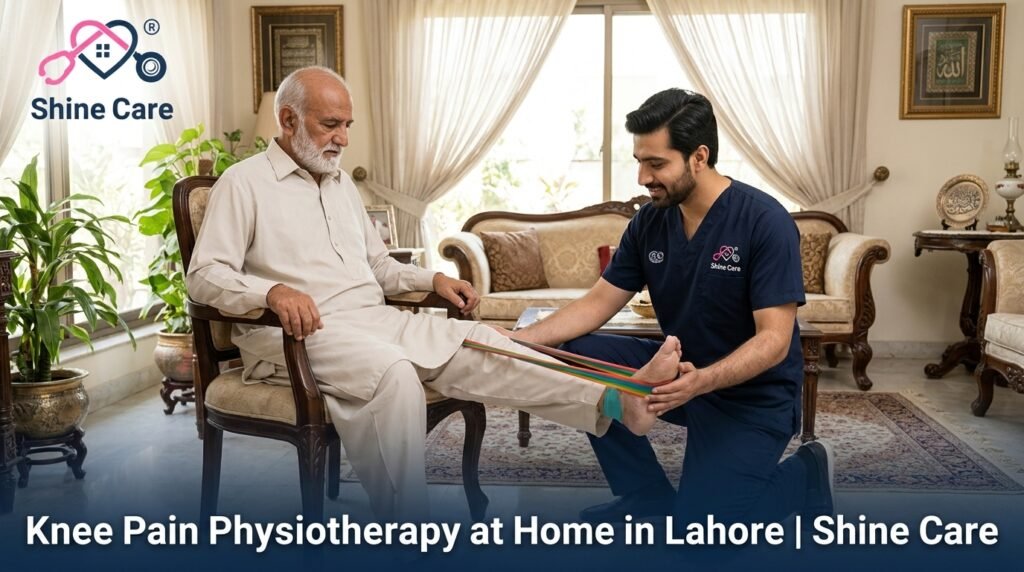
- Theraband resistance work
- Still gentle, pain-free progression
- 2 physio visits per week
- Patient doing 10 to 20 minutes of exercises twice a day at home
Phase 3 — Function and Return (Weeks 8 to 12 and beyond)
- Functional exercises — step-ups, sit-to-stand, balance challenges
- Progressive walking
- Return to specific activities the patient wants (prayer, climbing stairs, going for walks, driving)
- Weekly then fortnightly visits
- Long-term maintenance programme the patient continues indefinitely
Daily Exercises Patients Can Do
Specific exercises come from the physiotherapist. General categories:
Quadriceps Strengthening
- Straight leg raise — lying on back, lift straight leg to 45 degrees, hold, lower. 10 to 15 reps, both sides.
- Static quadriceps — seated, tighten the thigh muscle pushing the back of the knee into the chair, hold 5 to 10 seconds.
- Terminal knee extension — seated with a rolled towel under the knee, extend the knee fully, hold.
- Mini-squats — standing holding support, bend knees slightly, straighten. Pain-free range.
- Progression to wall sits, step-ups, resistance band work as tolerated.
Flexibility
- Knee flexion — seated, slide heel toward buttock, hold, straighten.
- Hamstring stretch
- Calf stretch
- Hip flexor stretch
- Held 20 to 30 seconds, several repetitions
Balance
- Standing on one foot near support
- Tandem stance (one foot in front of the other)
- Progressive challenge — eyes closed, uneven surface — as tolerated
Low-Impact Cardiovascular
- Walking — flat surface, comfortable shoes
- Stationary cycling — excellent for knees if available
- Swimming — ideal, if a pool is accessible
- Avoid high-impact — running, jumping, deep squats
Little and often works better than long sessions. 10 to 20 minutes twice a day beats a one-hour session once a week.
Weight Management
Every kilogram of body weight becomes approximately 3 to 4 kilograms through the knee during walking. Losing 5 kg of body weight can reduce knee stress significantly. For overweight Pakistani adults with knee OA, weight loss is often the single most effective intervention — more effective than many specific knee treatments.
- Reduce portion sizes
- Reduce ghee, oil, fried food
- Less refined sugar and carbohydrates
- More protein, vegetables, pulses
- Gradual progressive weight loss — around 0.5 kg per week is sustainable
- Combined with physiotherapy exercises
- Diabetic patients — strict sugar control also helps
- Dietician review helpful for complex cases
Lifestyle and Home Adaptations
Prayer
- Chair-based prayer where full postures aggravate
- Specific support cushions for sujood
- Low stool for sitting tashahud position
- Discussion with a religious scholar about appropriate adaptations
- Return to full postures gradually as strength returns
Daily Movement
- Avoid long periods of sitting — get up every 30 to 45 minutes
- Avoid squatting for household tasks — use a stool
- Avoid long periods of standing
- Alternate activities
- Walk short distances regularly rather than one long walk
Footwear
- Supportive shoes with good cushioning
- Avoid high heels
- Avoid flat flimsy chappal for long walks
- Specific orthotic insoles where prescribed
- Appropriate shoes for indoor use too
Home Environment
- Non-slip bathroom mats — fall risk higher with knee OA
- Grab rails in bathroom and stairs
- Chair with firm seat and arms for easy standing
- Raised toilet seat if sitting low is hard
- Good lighting
- Clear paths to reduce stumble risk
- Walking stick on the opposite side to the worst knee — reduces load
Managing a Flare-up
- Rest from aggravating activity — not complete bed rest
- Ice pack 15 to 20 minutes, several times a day
- Elevation when sitting
- Paracetamol as prescribed
- NSAIDs (ibuprofen, diclofenac, mefenamic acid) — only short-term and with doctor’s approval. Not for elderly with heart, kidney, or stomach issues without specific agreement.
- Gentle range of movement exercises continue
- Specific topical gels
- Return to full exercise programme as flare settles
- If flare is severe, sudden, hot, swollen — different problem possible (infection, gout, bursitis) — contact doctor
Common Family Mistakes
- Resting completely — stiffens the knee further
- Walking through sharp pain — causes damage
- Relying on painkillers without addressing the cause
- Expecting dramatic results from any single treatment
- Skipping exercises because the pain is not acute
- Over-doing on good days — causing flare-ups
- Buying a knee brace without physiotherapist advice
- Walking in flimsy chappal
- Ignoring weight
- Getting multiple injections hoping for cure
- Stopping physiotherapy after a few weeks when progress is slow
When Surgery Becomes a Consideration
Knee replacement (total or partial) is considered when:
- Severe pain affecting quality of life
- Pain despite several months of correct conservative treatment
- Significant loss of function
- X-ray showing advanced joint changes
- Patient is a surgical candidate (medical fitness, age, expectations)
- Patient willing and able to do the extensive post-operative rehabilitation
Surgery is an option, not an inevitability. Many patients delay or avoid it with structured physiotherapy. For those who do need it eventually, better pre-operative conditioning leads to better outcomes.
Where Home Nursing Support Helps
For most knee OA patients, a visiting physiotherapist is the main service. For some situations, broader support helps:
- Elderly patients with multiple conditions alongside knee OA
- Post-knee-surgery recovery
- Patients also needing medication supervision
- Working families where day-time support is needed
- Overseas family coordinating a parent’s care
- Patients with recent falls or fracture risk
- Patients recovering from injection, aspiration, or minor procedure
For families engaging broader nursing care around an elderly parent, knee OA management is one strand of a wider plan. A visiting physiotherapist handles the knee; a trained attendant handles daily life; a visiting doctor reviews periodically. For families searching for a reliable home nurse near me for an elderly parent whose knees are limiting them, the right combination of physio and daily support makes measurable difference. For comprehensive health at home support around multiple elderly health issues, we build the plan around the patient’s priorities.
About Shine Care
Shine Care provides home physiotherapy, home nursing, trained attendants, visiting doctor services and medical equipment across Lahore. Our physiotherapists cover orthopaedic conditions including knee OA, back pain, frozen shoulder, post-surgical recovery, stroke rehabilitation and sports injury. Coverage spans DHA Phase 1 to 10, Gulberg, Model Town, Garden Town, Johar Town, Faisal Town, Wapda Town, Valencia Town, Bahria Town, Lake City, Cantt, Askari and most Lahore residential areas.
For related services on this site, see our main physiotherapy at home page, home nursing services in Lahore, elderly care at home, post-surgery care, visiting doctor at home, and diabetes care.
Call or WhatsApp 0344-9226778 to arrange a physiotherapist for knee pain assessment in Lahore. First visit usually within 1 to 3 days.
Frequently Asked Questions
How long does physiotherapy take to work?
Early benefit in pain and movement often within 2 to 4 weeks. Significant strength and function improvement over 8 to 12 weeks. Long-term maintenance continues indefinitely for sustained benefit.
Will my mother’s knee need replacement eventually?
Depends on severity, response to conservative treatment, and lifestyle. Many patients manage without surgery for many years. Some eventually need it. Delaying appropriately with good physiotherapy often means better outcomes if surgery does come.
Are steroid injections useful?
Short-term pain relief in some cases. Repeated injections may have specific concerns. An orthopaedic surgeon advises on timing.
What about hyaluronic acid injections?
Available and used in specific cases. Evidence variable — some patients benefit, others do not. Not a substitute for physiotherapy and weight management.
Can my father do yoga for his knees?
Modified yoga with knee-friendly positions, under guidance, can help flexibility and strength. Traditional deep knee postures may aggravate. Discuss with the physiotherapist.
Does Shine Care provide weekend or evening appointments?
Yes — evening and weekend slots available for working patients. Call 0344-9226778.
Can overseas family coordinate physiotherapy for a parent in Lahore?
Yes — overseas family coordination routine. Progress reports, remote payment, scheduling handled.
This article is a general guide. All diagnosis and treatment decisions remain with the orthopaedic specialist and treating physiotherapist. For sudden severe knee pain with redness, heat, fever, or inability to bear weight, seek urgent medical review. External reference: NHS — Osteoarthritis.