
A patient checks their blood pressure at home, gets 160/95, panics, and takes an extra tablet. Two hours later they check again and it reads 128/82, so they conclude the machine is faulty.
The machine was probably fine. The first reading was taken sitting on a sofa, arm resting in the lap, ten minutes after a cup of chai, while talking to a relative. Every one of those adds points — and together they add a great many.
Blood pressure monitoring at home is genuinely valuable, but only when it is done properly. This guide covers the technique, the mistakes that ruin readings, and what to do with the numbers once you have them.
How much technique actually changes the number
Most people assume posture advice is a formality. It is not, and the American Heart Association has put figures on it.
According to guidance summarised by the AHA on the rules for measuring blood pressure, the effect of these factors is not minor:
- A full bladder — up to 33 mmHg higher
- Arm hanging instead of supported at heart level — up to 20 mmHg too high
- Talking during the measurement — up to 19 mmHg higher
- Crossed legs — up to 15 mmHg higher
- No back or leg support — around 5 mmHg higher
And separately, AHA notes that a reading taken over clothing can be off by anywhere from 5 to 50 points.
Add two or three of those together and a patient with normal blood pressure can produce a reading that looks like a crisis. That is how families end up frightened, and how patients end up taking medicine they did not need.
The correct method, step by step
Before you start
- No caffeine, smoking or exercise for 30 minutes. That includes chai, which is the one everybody forgets
- Empty the bladder — the single largest correctable error on the list
- Sit quietly for five minutes beforehand. Not two, not “a moment”
- Roll up the sleeve properly, or remove the arm from it. A tight rolled sleeve above the cuff is its own problem
How to sit
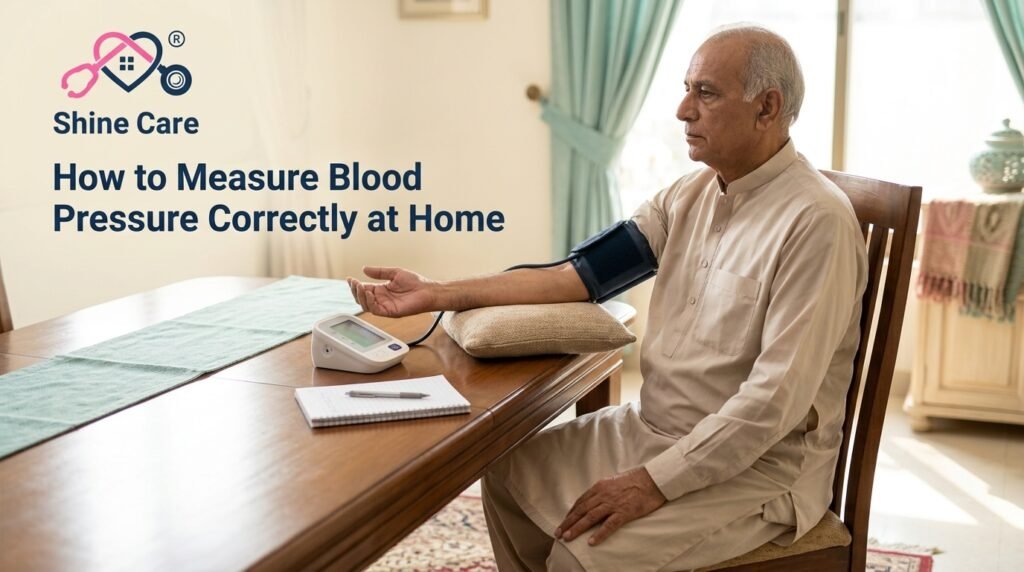
AHA guidance is specific: sit with the back straight and supported — on a dining chair rather than a sofa — with feet flat on the floor and legs uncrossed.
Then the part people get wrong most: support the arm on a flat surface, with the middle of the cuff at heart level. Resting the arm in the lap or letting it hang is what produces those 20-point errors. Use a table, and put a cushion under the arm if the table is too low.
The cuff
- On bare skin, never over clothing
- Bottom edge just above the bend of the elbow
- Snug but not tight — you should be able to slip two fingertips underneath
- Palm facing up, arm muscles relaxed
During and after
- Do not talk or move while it inflates
- Take two readings, one minute apart, as AHA advises, and record both
- Measure at the same time each day
- Write it down — every reading, with the date and time
Cuff size: the mistake nobody checks
AHA is clear that a cuff which is the wrong size gives an inaccurate reading, and specifically that a cuff that is too small artificially raises the number.
Most monitors are sold with a standard cuff that suits an average arm. Patients with larger arms — which includes a great many people with hypertension — need a large cuff, and are frequently never told.
What to do: measure around the widest part of the upper arm with a tape, and check that measurement against the range printed on the cuff itself. If the arm falls outside it, the monitor is producing wrong numbers every single time it is used.
Take the monitor to the next doctor’s appointment and have a reading compared against the clinic’s. That one check settles whether the device and cuff are giving usable results.
Which monitor to buy
AHA recommends an automatic, cuff-style, upper arm monitor — and states plainly that wrist and finger monitors are not recommended because they give less reliable readings.
This matters here, because wrist monitors are widely sold and are cheaper. A patient managing their hypertension on wrist readings may be working from numbers that do not reflect what is actually happening.
Look for a monitor that has been validated, that displays two numbers clearly, and that stores previous readings. Take it with you to appointments so the doctor can see the record rather than a summary.
Which arm?
AHA notes that either arm can be used and there is usually not a big difference between them.
That said, have both arms checked once at a clinic. If there is a consistent difference, the doctor will tell you which arm to use at home from then on.
One absolute exception. If the patient has a dialysis fistula, blood pressure must never be taken on that arm — nor blood samples, drips or injections. Say it out loud at every clinic and lab, because whoever is on duty will otherwise use whichever arm is nearest.
Six habits that ruin home monitoring in our households
1. Checking only when feeling unwell
Hypertension has almost no symptoms. Headaches, dizziness and neck pain are as often caused by something else entirely — and a patient who only checks when they feel bad ends up with a record full of stressed readings and no idea of their actual baseline.
Check on the schedule the doctor set, whether or not the patient feels anything.
2. Adjusting medicine based on one reading
This is the most dangerous habit on the list. Blood pressure varies through the day, and a single high reading is not a reason to take an extra tablet.
Never change, skip or add a dose without the doctor’s instruction. Bring the record to the appointment and let the pattern guide the decision.
3. Stopping medicine because readings are now normal
The readings are normal because of the medicine. Stopping it because things look fine is how patients end up back where they started, and sometimes considerably worse.
4. Measuring immediately after chai
Caffeine within 30 minutes raises the reading. In households where tea appears three or four times a day, this quietly distorts a great many home records.
5. Measuring after an argument or a rush
Sit for five minutes first. A reading taken straight after climbing stairs or a difficult phone call is measuring the moment, not the patient.
6. Not writing it down
A doctor can act on three weeks of recorded readings. Nobody can act on “it was around 150 sometimes”. Keep a notebook, take it to every appointment.
What the numbers mean, roughly
The top number is the pressure when the heart beats; the bottom number is the pressure between beats.
Target ranges are individual. An elderly patient, a diabetic patient and a patient with kidney disease may each be given different targets by their doctor, and a number that is fine for one is not for another.
Ask for this patient’s target range and write it on the wall beside the monitor. Without it, families judge readings against something they read online, which is how unnecessary panic starts.
When to seek help urgently
Seek emergency medical care immediately if a very high reading comes with any of:
- Chest pain or breathlessness
- Severe headache with confusion, or vision changes
- Weakness or numbness on one side of the body, or slurred speech
- Facial drooping
- Severe back or abdominal pain
- Seizure
Those signs matter more than the number itself. Weakness on one side, drooping or slurred speech may indicate a stroke and needs emergency care within minutes — see our guidance on stroke care at home.
Contact the doctor the same day for a reading well above the patient’s usual range that stays high after resting and re-measuring properly, or for readings that are drifting steadily upward over days.
And do not ignore readings that are unusually low, particularly with dizziness on standing — that also needs reviewing.
Support at home in Lahore
Managing high blood pressure
Monitoring is only useful if it feeds into treatment — medicines taken on time, salt reduced, weight and activity managed, and readings reviewed properly. That whole picture is hypertension care at home.
Where diabetes is involved too
Most patients with diabetes also have high blood pressure, and controlling both together protects the kidneys, eyes and heart far more than managing either alone. See diabetes care at home.
Elderly patients who cannot measure alone
Poor eyesight, tremor or arthritis make it difficult to position a cuff correctly or read a display. An attendant who takes and records the reading properly each day is doing something genuinely useful — part of elderly care at home.
Nursing supervision
Where readings are erratic, where the patient is on several medicines, or where somebody needs to check technique and cuff fit, a registered nurse can review it — often solving weeks of confusing numbers in one visit.
Doctor review without the journey
Medicines need adjusting as readings change, and moving a frail patient across Lahore for a short consultation is its own burden. Doctor home visits allow that to happen at home, with the record in front of the doctor.
Frequently asked questions
Follow the schedule the doctor sets. When a diagnosis is being made or medicine is being adjusted, that is often twice daily for one to two weeks. Once stable, less frequently. Checking many times a day causes anxiety without adding useful information.
Very common and usually normal — the first reading often reflects the activity of getting ready. This is exactly why two readings a minute apart are recommended, and why both should be recorded.
AHA does not recommend them, because they give less reliable readings than upper arm cuffs. If a wrist monitor is the only option available, have it checked against a clinic reading before relying on it.
It can be a useful cross-check, but the technique is often rushed and the cuff may not fit. A properly taken home reading, recorded consistently, is usually more useful to a doctor.
Yes, and tell the doctor before Ramadan begins. Fluid intake, meal timing and medicine timing all change during fasting, and blood pressure medicines often need adjusting. Never adjust them yourself.
That is normal — hypertension usually has no symptoms at all, which is exactly why it is dangerous. Rest five minutes, re-measure properly, record it, and follow the doctor’s guidance rather than the patient’s sense of how they feel.
Yes, if they can position the cuff correctly and stay still and quiet. If not, somebody else should take it — and the technique matters more than who is holding the machine.
Arranging support in Lahore
Shine Care provides nursing and daily support for patients with high blood pressure across Lahore, working to the plan set by the treating doctor. If home readings are erratic and nobody can explain why, ask us to review the technique and cuff fit — it is a short visit that often solves the problem.
Contact us to discuss it.
Medical disclaimer: this guide is general information for families and does not replace medical advice. Blood pressure targets and medicines are set individually by the treating doctor — never change, skip or add a dose based on a home reading. If a high reading is accompanied by chest pain, breathlessness, severe headache with confusion or vision changes, weakness or numbness on one side, slurred speech or facial drooping, seek emergency medical care immediately.