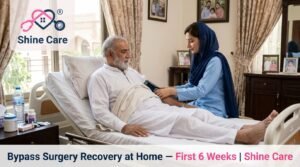
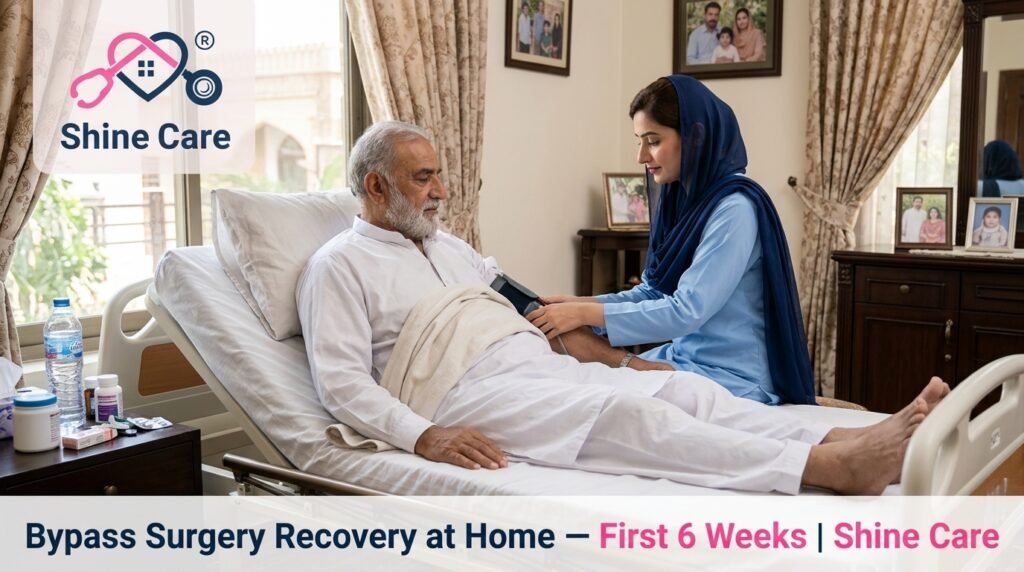
Your father had a triple bypass at a Lahore hospital. The surgery went well. After a week in cardiac ICU and ward, the consultant has cleared him for home. The family is relieved — but also quietly terrified. The chest has a long midline wound. He is breathless walking from the car to the house. He is on a dozen medications. Sleep is broken. Every strange sensation feels like it could be another heart attack. The first six weeks at home after coronary artery bypass graft (CABG) surgery decide a lot — whether the recovery is smooth, whether the wound heals cleanly, whether the medications are taken correctly, and whether the family copes without burning out. This guide walks Lahore families through what to expect, what helps, and when to call for professional support.
Nothing in this article replaces the specific instructions of the cardiac surgeon, the cardiologist, and the discharge summary. It is meant to help families recognise the pattern of recovery around what the medical team has prescribed.
What Bypass Surgery Does and Why Recovery Takes Time
Coronary artery bypass surgery takes healthy blood vessels — usually from the leg (saphenous vein) or chest wall (internal mammary artery) — and uses them to route blood around blocked coronary arteries. The result is better blood supply to the heart muscle. The procedure involves:
- A long midline chest incision through the breastbone (sternum)
- The breastbone wired back together after the surgery
- Hours on a heart-lung machine in most cases
- A graft wound on the leg or arm where the vessel was harvested
- Chest drains that are removed in the first days
- Several days in ICU followed by step-down ward
- A total hospital stay of 7 to 10 days usually
The breastbone takes 6 to 8 weeks to heal. The leg wound often takes longer than the chest wound. The heart itself continues to recover function for months. Energy returns gradually. Patients who try to rush the recovery often set themselves back.
The 6-Week Recovery Pattern
Week 1 at Home
The patient is weak, breathless on minimal exertion, has pain around the chest and leg wounds, and sleeps poorly because any position is uncomfortable. Family focus:
- Medication discipline — exact doses, exact times, no missed doses
- Wound care — keep clean and dry, watch for redness or discharge
- Pain control — regular paracetamol as prescribed, with stronger pain relief if needed
- Breathing exercises every hour the patient is awake
- Short walks indoors — several times a day, even just to the bathroom
- Low sodium, low fat meals
- Avoid lifting anything heavier than 2 kg
- Sleep sitting slightly upright, pillows for support
Week 2
Energy begins to return in small amounts. Walks a bit longer. Sleep slightly better. Family notices:
- Appetite improving
- Mood swings common — tears, irritability, low mood
- Wounds starting to feel itchy as they heal
- Short walks progressing to a few minutes outside
- Continued strict medication routine
Week 3 and 4
More independent. Longer walks. Less daytime nap. Driving still not allowed. Follow-up with the surgeon usually around this time. Breastbone still healing — no lifting, no pushing, no reaching across.
Week 5 and 6
Breastbone approaching healed. Walking longer distances comfortable. Light house activity resuming. Many patients ready for cardiac rehabilitation programme. Still no lifting beyond prescribed limits.
Beyond 6 Weeks
Gradual return to driving (if cardiologist clears), light work, intimate activity. Full return to all activities typically 2 to 3 months post-op. Cardiac rehabilitation continues to build fitness.
Wound Care
Two main wounds need attention — the chest midline incision and the vessel harvest site on the leg (or arm).
Chest Wound
- Keep dry for the first 7 to 10 days — sponge bath only, no shower until surgeon permits
- Once allowed, gentle shower — do not scrub, do not use harsh soap
- Pat dry with a clean towel — do not rub
- No creams, powders or oils unless prescribed
- Watch for redness extending beyond the wound edge, swelling, warmth, pus, bad smell, or opening of the wound — these need urgent review
- Watch for the chest “clicking” or “popping” with movement — report to the surgeon as this may indicate the sternum has not fused properly
- Keep the patient in loose cotton clothing — tight bras or firm clothing over the wound cause irritation
Leg Wound
- Often takes longer to heal than the chest wound
- Keep clean and dry
- Watch for infection signs — redness, swelling, discharge
- Elevate the leg when sitting to reduce swelling
- Compression stocking if prescribed
- Watch for calf pain or swelling — may indicate DVT (blood clot in the leg vein)
Patients with diabetes heal more slowly and are at higher risk of wound infection. Blood sugar control is particularly important in the recovery weeks.
Medication Discipline — Non-Negotiable
Post-CABG patients are usually on a combination of medications, and missing doses can cause serious problems:
- Antiplatelets — usually aspirin plus clopidogrel for a period. Missing these increases risk of graft blockage.
- Statins — cholesterol control, long-term.
- Beta blockers — heart rate control, protect the healing heart.
- ACE inhibitors — blood pressure and heart protection.
- Diabetic medications — insulin or tablets if diabetic.
- Pain relief — paracetamol and sometimes stronger analgesics.
- Stomach protection — proton pump inhibitor, often added for aspirin tolerance.
- Diuretic — sometimes needed in the early weeks to clear fluid.
Families often make these mistakes in the first weeks:
- Stopping aspirin because of mild bruising
- Skipping doses when the patient feels better
- Giving a double dose after a missed one
- Mixing up brand names and generic names of the same drug
- Not reading the discharge summary carefully
A written medication chart on the wall, with time slots and tick boxes, prevents most of these. A trained home nurse giving medications removes the risk entirely during the day shift. This is one of the main reasons families use nursing care at home in the first weeks post-CABG.
Breathing Exercises — Critical in the First Weeks
CABG patients are at high risk of chest infection in the first weeks because:
- They were on a ventilator during surgery
- The chest wound makes deep breathing painful, so they take shallow breaths
- They cough less because coughing hurts
- Secretions pool at the lung bases
Prevention is simple but needs discipline:
- Incentive spirometer (the plastic device from hospital) — 10 breaths every hour while awake
- Deep breathing exercises — breathe in deeply, hold 3 seconds, breathe out slowly, 10 times every hour
- Supported coughing — hold a folded towel or small pillow firmly against the chest wound while coughing. Reduces pain and prevents sternal strain.
- Sit up rather than slouch
- Short walks several times a day
- Chest physio by a physiotherapist if secretions are a problem
A patient who develops pneumonia in the first weeks post-CABG often ends up back in hospital. Prevention is cheap and simple.
Walking and Activity Progression
Days 1 to 7 at home
- Walk to the bathroom, around the room
- Short indoor walks several times a day
- Avoid stairs if possible, or take them very slowly, pausing
- Rest between activities
Week 2
- Walk a bit further — around the house, into the courtyard
- Short outdoor walks if weather allows and wound is healing well
- Still frequent rest
Week 3 and 4
- Longer outdoor walks — 10 to 15 minutes building up
- Flat ground preferred, no uneven surfaces
- Pace yourself — the goal is sustained progress, not daily records
- Stop and rest if breathless, chest pain, or dizzy
Week 5 and 6
- Walking 20 to 30 minutes most days
- Light house activity
- Preparation for cardiac rehabilitation
- Still no heavy lifting or straining
The patient should NOT:
- Lift anything heavier than 2 kg in the first 6 weeks
- Push or pull doors, drawers, car doors
- Carry groceries, children, or household items
- Reach behind to put on seat belt — ask for help
- Drive for 4 to 6 weeks (surgeon clears)
- Do push-ups, lift weights, or any upper body strain
The breastbone is held together by surgical wires while bone fusion happens over 6 to 8 weeks. Lifting and straining can disrupt the healing — a complication that is painful and sometimes requires further surgery.
Warning Signs — Call Immediately
- Chest pain — new, severe, or like the original heart pain
- Severe shortness of breath
- Fast or irregular heartbeat
- Fainting or near-fainting
- Chest wound red, swollen, warm, with discharge, pus, or opening
- Chest “clicking” or sternum feeling unstable with movement
- Fever above 38°C
- Severe calf pain, swelling, or new redness in the leg
- Blood in urine, stool, or coughed up
- Severe or new confusion
- Weakness on one side of the body, slurred speech (stroke signs)
- Significant weight gain over a few days (fluid retention — heart failure sign)
Call the cardiac surgeon, the cardiologist, or 1122. Do not wait and watch.
Diet in the First 6 Weeks
- Low salt — no added salt, minimal processed food, no pickles, no fast food
- Low fat — minimal ghee, oil, fried food, red meat
- Plenty of vegetables, fruits, dal, pulses
- Lean protein — fish, chicken breast, egg white, low-fat dairy
- Whole grains — brown bread, chapati with chokar, oats
- Water adequate but not excessive if on diuretics
- If diabetic — strict blood sugar control
- No smoking, no sheesha, no gutka
- Alcohol — avoid for 6 weeks and discuss with cardiologist beyond that
- Small frequent meals rather than large meals — large meals strain the heart
A dietician review in the first weeks helps the family adapt old eating patterns. Many Lahore families underestimate the salt and fat in traditional cooking — a careful review protects the new grafts.
Emotional and Sleep Issues
Post-cardiac-surgery depression and anxiety are common and often underestimated:
- Low mood, tears without clear reason
- Anxiety about every chest sensation
- Fear of dying, fear of another heart attack
- Irritability toward family
- Memory and concentration problems (“pump head” — some patients notice brief cognitive effects after heart-lung machine use)
- Interrupted sleep for weeks
- Vivid dreams or nightmares
Most of this improves on its own over the first 2 to 3 months. Family patience helps. If the low mood is severe, lasting, or interfering with recovery, the cardiologist or a mental health professional should be involved.
Sleep improves gradually. Early weeks are hard — sleeping sitting slightly upright, pillows for support, pain management before bed, and a calm bedtime routine all help. For many Lahore families finding reliable home nurse near me for the first 2 to 4 weeks is what gets them through the broken-sleep period without burning out.
How Home Nursing Supports CABG Recovery
Many families manage the recovery themselves with family support. The situations where professional help earns its place:
- Elderly patients where family is also elderly
- Patients with multiple health conditions (diabetes, CKD, lung disease)
- Overweight patients who are hard for family to help physically
- Families where everyone works — can’t be at home all day
- Overseas families — parent is in Lahore, children abroad
- First-time families with no experience of post-surgery care
- Patients discharged with wound issues already visible
- Patients needing injections or complex medication regimens
At Shine Care, a typical CABG home-nursing engagement looks like:
- Trained attendant or nurse at home for 2 to 4 weeks post-discharge
- 12-hour day shift most common, with family covering nights
- 24-hour cover for elderly patients living alone
- Trained nurse rather than attendant for complex medication regimens and wound care
- Physiotherapist visits 2 or 3 times a week in the early weeks
- Visiting doctor review as needed
- Equipment rental — adjustable bed, bedside commode, nebuliser, blood pressure monitor — through our group
- Coordination with the treating cardiac surgeon
About Shine Care
Shine Care is Pakistan’s established home nursing group serving Lahore, Islamabad and Rawalpindi. For CABG and other cardiac surgery recoveries, our focus is health at home that reduces readmission risk — correct medications, early infection detection, breathing exercises done daily, graded activity, and emotional support for family and patient.
We cover DHA Phase 1 to 10, Gulberg, Model Town, Garden Town, Johar Town, Faisal Town, Wapda Town, Valencia Town, Bahria Town, Lake City, Cantt, Askari and most of Lahore’s residential areas.
For related services on this site, see our main home nursing services in Lahore page, trained registered nurse in Lahore for complex medication cases, post-surgery care for the broader surgical recovery service, physiotherapy at home for chest and mobility work, visiting doctor at home for scheduled review, and elderly care at home for patients who need longer-term support.
Call or WhatsApp 0344-9226778 to arrange support for a bypass surgery patient coming home in Lahore. Ideally we set the home up before the patient leaves hospital so the first days are smooth.
Frequently Asked Questions
When can my father bathe normally after bypass surgery?
Usually 7 to 10 days after surgery, when the wound is sealed and the surgeon permits. Short gentle showers only in the first weeks, no soaking in a bathtub, no scrubbing of the wound.
How soon can he climb stairs?
Slowly from the first week, pausing as needed. By week 3 or 4 most patients handle stairs without pause. Avoid rushing or straining — slow and steady is correct.
Is it normal to feel breathless walking across the room?
Yes, in the first week or two. Breathlessness should improve week on week. Breathlessness that is worsening, or associated with chest pain, swelling, or fast heart rate, needs urgent review.
When can he fly after bypass surgery?
Most cardiologists advise waiting at least 6 to 8 weeks, with specific clearance for longer flights. Overseas Pakistani patients should plan accordingly.
Does Shine Care provide dedicated night cover for a bypass patient?
Yes, where families need it. Call 0344-9226778 for day, night, or 24-hour arrangements.
How soon should cardiac rehabilitation start?
Typically 4 to 6 weeks post-op, after the breastbone has mostly healed. The cardiologist’s clearance is specific. Many Lahore hospitals offer structured cardiac rehab programmes.
This article is a general recovery guide. Your father’s specific recovery depends on his surgery, overall health, and the cardiac team’s plan. For any warning signs — chest pain, severe breathlessness, infected wound, fever — call the surgeon or 1122. External reference: American Heart Association — CABG.