In Lahore cardiac centres, a heart attack patient is now often discharged within 3 to 5 days of admission. Angioplasty, stent placement, and modern medications have changed the acute phase from a six-week hospital stay to a brief admission and a rapid return home. What has not changed is the vulnerability of the first weeks after discharge. The heart is healing. Medications are being titrated. New habits are being learned. The risk of a second cardiac event is highest in this early period. Depression, poor sleep, and medication confusion are common. The family, relieved that the acute crisis is over, often underestimates how much work the recovery period actually requires. Those first 6 to 12 weeks at home decide a lot — whether the patient returns to good function, whether they take their medications long-term, whether they develop the habits that reduce further events, and whether the next trip to hospital is for a routine check or for another heart attack.
This guide covers home care in the first weeks after a heart attack — the daily routine, warning signs, medication discipline, activity progression, and how structured home nursing fits in for Lahore families. Nothing here replaces direct instructions from the treating cardiologist, whose specific prescription and recovery plan must guide every decision.
What Happened — Brief Reminder
A heart attack (myocardial infarction, MI) happens when blood flow to a part of the heart muscle is blocked, usually by a clot forming on a diseased coronary artery. Modern treatment includes:
- Angioplasty with stent to open the blocked artery (primary PCI)
- Clot-busting drug (thrombolysis) in some cases
- Specific cardiac medications started in hospital
- Monitoring and recovery in the cardiac ward
- Discharge usually 3 to 5 days after primary PCI if uncomplicated
- Follow-up in a week or two, then at intervals
Part of the heart muscle that did not get blood during the attack may be permanently damaged. The rest heals and adapts over weeks and months.
The First Day at Home
- Patient is tired, often emotionally shaken
- Pain usually controlled with simple analgesia
- Access site (groin or wrist from the angiography) may be tender
- Full written prescription in hand
- Follow-up appointment date set
- Specific activity instructions from the cardiologist
- Family often anxious about every chest sensation
First-day tasks for the family:
- Quiet rest environment
- Medications laid out — pill organiser filled for the week
- Written chart of doses and times
- Emergency contacts visible — cardiologist, cardiac hospital, 1122
- Light meal, adequate fluids
- Avoid visitors on day 1 — allow rest
Medications — The Non-Negotiable Backbone
Post-heart attack patients are usually on a specific combination. Dropping any of these significantly raises the risk of another event:
- Dual antiplatelet therapy — usually aspirin plus a second antiplatelet (clopidogrel, ticagrelor, prasugrel). Critical for the first months to prevent stent clotting. Do not stop any of these without the cardiologist’s agreement.
- Statin — high-intensity dose, cholesterol lowering, long-term
- Beta blocker — slows heart, reduces workload, protects the healing muscle
- ACE inhibitor or ARB — protects heart function, blood pressure
- Nitrates — rescue for chest pain or scheduled dose
- Diabetic medications if applicable
- Stomach protection often alongside dual antiplatelet
- Other specific drugs per individual case
Common mistakes:
- Stopping aspirin because of mild bruising
- Skipping the second antiplatelet after a week — stent clotting risk shoots up
- Reducing beta blocker because of tiredness
- Stopping statin because the patient “feels fine”
- Over-the-counter painkillers (ibuprofen, diclofenac) which raise cardiac risk — avoid unless the cardiologist approves
- Herbal remedies that interact with cardiac medications
A pill organiser plus a wall chart and consistent timing prevents most of this. Families looking for broader nursing care around a recovering patient often engage trained support specifically to get the medication round reliably right for the first weeks.
The Activity Pattern
Week 1
- Short walks indoors — 5 to 10 minutes at a time, several times a day
- No stairs if avoidable; if necessary, slowly
- Rest periods
- No heavy lifting (anything more than a few kg)
- No driving
- No strenuous activity
- No sauna, hot tub, very hot shower
- Access site care — keep clean and dry, watch for bleeding or swelling
- Avoid straining — manage constipation with hydration and fibre
Weeks 2 to 4
- Longer walks — 15 to 30 minutes building up, flat ground
- Stairs manageable with pauses
- Light household activity
- Follow-up with cardiologist usually in this window
- Still avoid heavy work
- Return to seated office work often possible from week 2 or 3
- Still no driving until cardiologist clears (typically 1 to 4 weeks depending on case)
Weeks 4 to 8
- Cardiac rehabilitation programme usually recommended
- Structured exercise under supervision
- Progressive increase in activity
- Return to most normal activities
- Intimate activity after cardiologist’s clearance
Beyond 8 Weeks
- Full return to work for most patients
- Gradual return to sports — walking, swimming, light cycling
- Specific contact sports or heavy exertion — discuss with cardiologist
- Long-term exercise habit — one of the main protective factors
Diet
- Low salt — no added salt at the table, minimal in cooking
- Low saturated fat — minimal ghee, oil, fried food, red meat
- Lean protein — fish, chicken breast, egg white, pulses
- Whole grains — chapati with chokar, brown bread, oats
- Plenty of fruits and vegetables
- Oily fish (if available and affordable) 1 to 2 times a week
- Nuts in moderation
- Reduce sugar and sugary drinks
- Avoid processed food — biscuits, chips, instant noodles
- No fast food during recovery
- No pickles, achaar, papad
- Diabetic control if applicable — tighter control for cardiac patients
- Alcohol — avoid for 6 weeks and discuss with cardiologist beyond
- Small frequent meals rather than large
- Adequate water unless on fluid restriction
Pakistani cooking adaptations need deliberate effort. Many families underestimate the salt and oil in their traditional recipes. A dietician visit in the first weeks helps the family adapt.
Smoking — Non-Negotiable
For a heart attack patient who smoked, stopping is the single most protective thing they can do. Benefits begin within hours. Within a year the risk of another heart attack drops significantly. Specific cessation support — nicotine replacement, counselling, specific prescription drugs — can be discussed with the cardiologist. Sheesha, gutka, and other tobacco forms carry similar risk and should also stop. No smoking by anyone in the household around the patient.
Warning Signs — Act Fast
Call 1122 or go to hospital immediately:
- Chest pain or heaviness — new, severe, lasting more than a few minutes, or similar to the original attack
- Pain radiating to arm, jaw, back, or neck
- Severe shortness of breath
- Fast, slow, or irregular heartbeat with symptoms
- Fainting
- Severe sweating with weakness
- Confusion
- Access site heavy bleeding, large swelling, or severe pain
- One-sided weakness or slurred speech (stroke signs)
Mild chest discomfort may be musculoskeletal or anxiety — but any significant or persistent chest pain is cardiac until proved otherwise. Do not wait.
Daily Monitoring at Home
- Pulse — note rate and whether regular
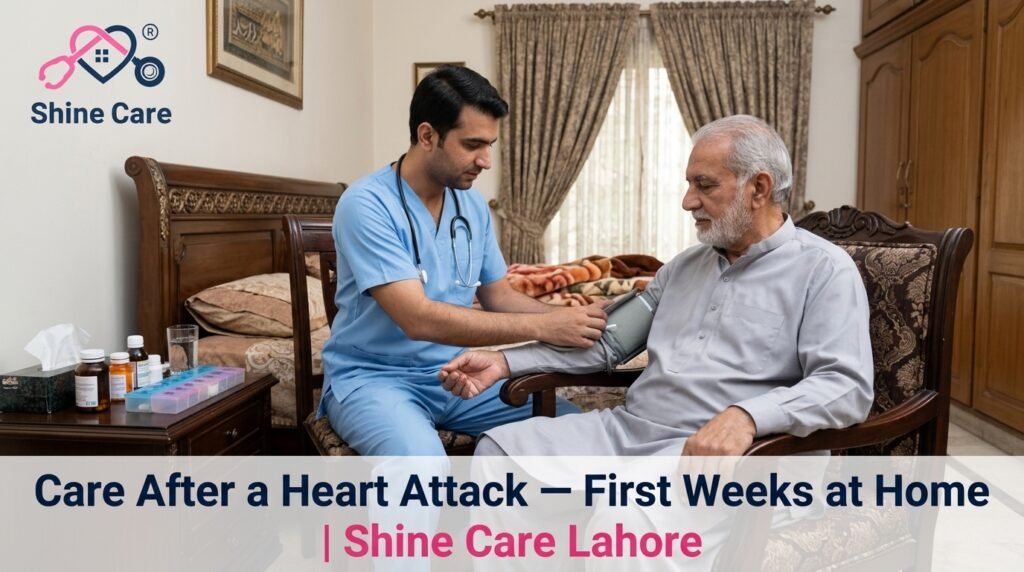
- Blood pressure — morning and evening
- Weight daily, same scale, same time
- Any new swelling of legs or breathlessness lying flat (heart failure signs)
- Any chest discomfort, type and duration
- Sleep quality
- Appetite
- Mood
- Access site daily for the first 2 weeks
- Written log for the cardiologist to review
The Mental Side
After a heart attack many patients develop:
- Fear of dying — intense in the first weeks
- Anxiety about every chest sensation
- Depression — loss of previous sense of health
- Poor sleep
- Avoidance of activity (wrongly, since activity is protective)
- Family tension
- Changes in intimate relationships
Most of this improves gradually. Talking about it helps. If severe, persistent, or interfering with recovery, the cardiologist can discuss specific support. Cardiac rehabilitation programmes often include psychological support.
Cardiac Rehabilitation
Structured programmes available at major Lahore cardiac centres — supervised exercise, education, dietary advice, psychological support. Highly effective — reduces repeat events, improves fitness, improves quality of life. Many patients skip it; those who attend consistently have better outcomes. Discuss availability with the cardiologist and arrange around work and life.
Follow-Up Schedule
- First follow-up — usually 1 to 2 weeks after discharge
- Next — around 4 to 6 weeks
- Then every 3 to 6 months initially
- Specific tests — ECG, echocardiogram, blood tests for cholesterol, HbA1c, kidney function
- Specific cardiac imaging in some patients
- Risk factor review at each visit
- Medication adjustment as the patient stabilises
Where Home Nursing Support Helps
Many heart attack patients recover well with family support alone. Trained home nursing or attendant support earns its place when:
- Elderly patient with multiple other conditions
- Diabetic patient with insulin or complex regimen
- Family all working — no one at home during the day
- Overseas family coordinating care
- Patient living alone or with elderly spouse
- Complex medication list where adherence is likely to slip
- Patient struggling with the mental side — withdrawn, anxious, poor sleep
- Patient needing physiotherapy coordination
- Patient with access site issues or other complications
- Specific need for daily blood pressure and monitoring documentation for the cardiologist
Our typical engagement for a Lahore heart-attack recovery includes:
- Trained attendant or registered nurse 12-hour day shift for 2 to 6 weeks
- Daily medication administration and documentation
- Daily BP, pulse, weight, symptom tracking
- Diet oversight — ensuring the low-salt low-fat plan is followed
- Activity support — walking encouragement
- Access site care
- Coordination with the treating cardiologist
- Physiotherapy visits if prescribed
- Visiting doctor review if cardiologist travel is difficult
- Family training
- Equipment supply — BP monitor, pulse oximeter, weighing scale, as needed
For families searching for a reliable home nurse near me for a parent discharged after heart attack, the clinical quality of the trained nurse matters — recognising signs of deterioration early is what prevents the readmission. For families looking at the broader health at home set-up around recovery, we combine nursing, physio and cardiologist liaison into a complete package.
About Shine Care
Shine Care provides home nursing, trained attendants, physiotherapists, visiting doctor services and medical equipment across Lahore. For cardiac recovery patients, our teams focus on medication discipline, activity progression, diet oversight, monitoring, and early recognition of warning signs. Coverage spans DHA Phase 1 to 10, Gulberg, Model Town, Garden Town, Johar Town, Faisal Town, Wapda Town, Valencia Town, Bahria Town, Lake City, Cantt, Askari and most Lahore residential areas.
For related services on this site, see our main home nursing services in Lahore page, post-surgery care, registered nurse in Lahore, elderly care at home, visiting doctor at home, physiotherapy at home, and diabetes care.
Call or WhatsApp 0344-9226778 to arrange support for a cardiac recovery patient in Lahore.
Frequently Asked Questions
When can my father return to normal activity after a heart attack?
Depends on the specific case. Most patients return to seated work in 2 to 3 weeks and to normal activity in 6 to 12 weeks. The cardiologist clears specific activities. Cardiac rehabilitation accelerates safe progression.
Is it safe to climb stairs?
Slowly and with pauses from the first days. Faster by week 2 to 3. By week 6 most patients handle stairs without difficulty. If climbing causes significant chest discomfort or breathlessness, contact the cardiologist.
Can we give pain-relief tablets at home?
Paracetamol is generally safe. Avoid NSAIDs (ibuprofen, diclofenac, mefenamic acid) — they raise cardiac risk. Ask the cardiologist before giving anything stronger.
What foods should we strictly avoid?
High-salt (pickles, processed food, fast food), high-saturated-fat (ghee, deep fried, red meat in large amounts), sugar-heavy snacks and drinks. Reduce rather than eliminate traditional dishes by cooking with less salt and oil.
Does Shine Care provide trained nurses for cardiac recovery?
Yes — trained attendants and nurses experienced in cardiac post-discharge care across Lahore. Call 0344-9226778.
How soon can an attendant start after my father’s discharge?
Usually within 24 hours. For planned discharges we set up before the patient leaves hospital.
Can overseas family coordinate recovery care in Lahore?
Yes — daily WhatsApp updates, direct cardiologist liaison, remote payment. Routine.
This article is a general guide. All medication, activity and diet decisions follow the treating cardiologist. For warning signs — new chest pain, severe breathlessness, fainting, stroke signs — call 1122 or go to hospital. External reference: American Heart Association — Life After a Heart Attack.