

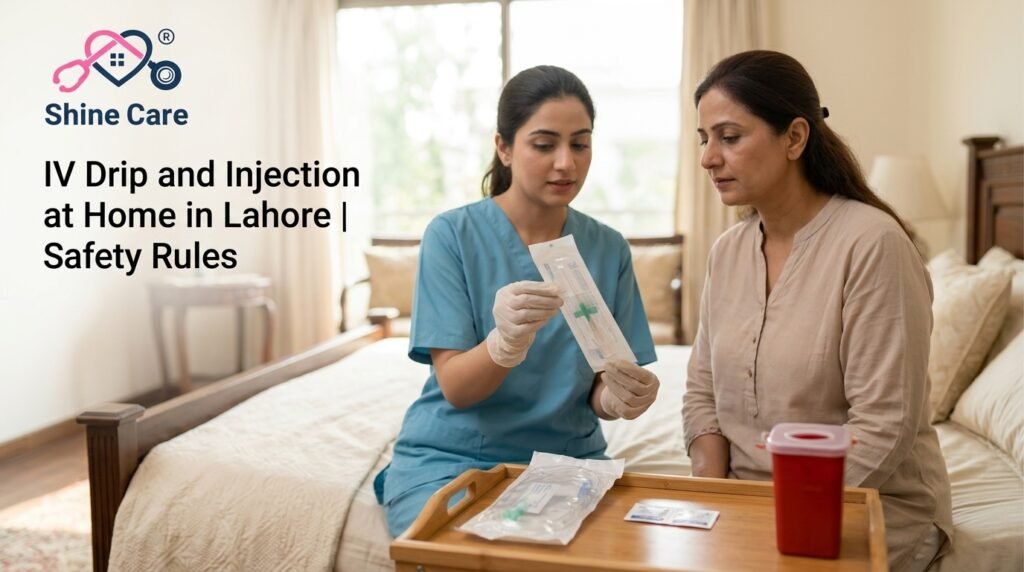
Somebody in the family is weak, or has had fever for three days, or simply feels drained after Ramadan. And the sentence that follows in almost every Lahore household is the same: drip laga do, foran theek ho jayenge.
Drip service at home in Lahore is genuinely useful — for the right patient, prescribed by a doctor, given by a trained nurse. It is also one of the easiest ways to cause real harm, and Pakistan has paid a very high price for treating it casually. This guide covers when a drip is actually needed, who should give it, and the rules that protect the patient.
First question: does the patient actually need one?
Start here, because most of the risk disappears with this one question.
A drip is a medical treatment, not a tonic. It is appropriate when a patient cannot take fluids or medicine by mouth, is genuinely dehydrated, needs a medicine that only works intravenously, or needs a controlled rate of delivery that tablets cannot provide.
It is not appropriate for general weakness, tiredness, “kamzori”, or the feeling that something stronger than tablets is needed. A patient who can drink water and keep it down will usually get the same benefit from drinking water — without a needle, a cannula, or the infection risk that comes with breaking the skin.
Nobody should be prescribing themselves a drip. Not the family, not a friend who is a medical student, not the person at the pharmacy who suggests it. If a doctor has not assessed the patient and written it, the answer is no.
Who is allowed to give it
Two conditions, both required. There must be a doctor’s prescription specifying what is being given, how much and at what rate. And it must be administered by a registered nurse.
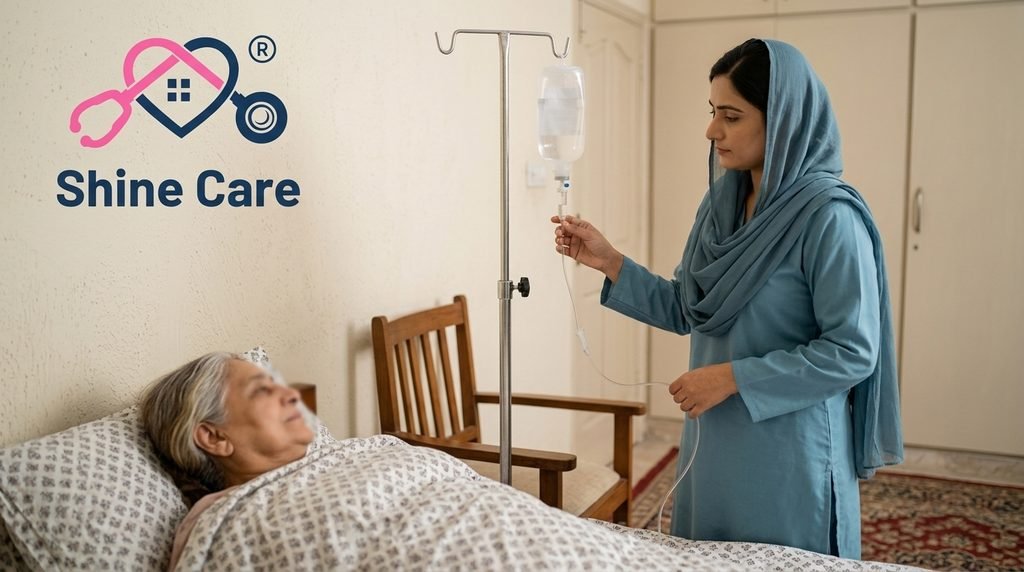
Not a family member who has watched it done. Not a dispenser or compounder. Not somebody who does it cheaply and quickly in your street. The saving is a few hundred rupees. The risk is a bloodstream infection or a reaction with nobody present who knows what to do.
The rule that matters more than any other
Everything — the syringe, the needle, the cannula, the IV set, the fluid bag — must be new, sealed, and opened in front of you. Not “cleaned”. Not “boiled”. Not “only used for this same patient earlier”.
The US Centers for Disease Control and Prevention puts the principle simply in its guidance on preventing unsafe injection practices: a safe injection does not harm the person receiving it, does not put the provider at risk, and does not create hazardous waste for the community. Unsafe practice transmits hepatitis B, hepatitis C and HIV, and causes outbreaks of bacterial and fungal infection.
Two facts are worth holding onto. The IV tubing, syringe and other components are treated as a single connected unit — none of it is ever reused, not even for the same patient on a different day. And hepatitis B survives in the environment on used needles, surfaces and contaminated waste for up to a week.
This matters in Pakistan more than almost anywhere. Unsafe injections are among the leading routes by which hepatitis B and C spread here. Watching the packet being opened takes three seconds, and any properly trained nurse will expect you to.
Before the drip starts
What should happen, every time:
- The prescription is checked — patient’s name, what is being given, the dose, the rate, and how long it should run
- Allergies are confirmed out loud, even if they were mentioned last week
- Hands are washed properly with soap and water, and gloves put on
- Packets are opened in front of the family — cannula, IV set, fluid bag
- The fluid bag is checked for expiry, cloudiness or particles, and that the seal is intact
- The site is cleaned and the cannula secured properly with a dressing
- The rate is set as prescribed — not adjusted to finish faster because the nurse has another appointment
During the infusion — somebody stays
This is the rule families break most, and it is the one that turns a routine treatment into an emergency.
The patient is not left alone while a drip is running. The nurse should remain for the duration, or at minimum through the first period and then be reachable and nearby. Setting up a drip and leaving is not acceptable practice, whatever the reason offered.
The reason is simple. If a reaction is going to happen, it usually happens in the first several minutes — and it needs somebody present who can stop the infusion immediately and get help.
Warning signs during a drip — stop and get help
Stop the infusion and seek emergency medical care immediately if the patient develops:
- Difficulty breathing, wheezing, or a tight throat
- Swelling of the face, lips or tongue
- A spreading rash, hives or sudden severe itching
- Sudden dizziness, collapse, or the patient becoming grey or clammy
- Chest pain or a racing heartbeat
- Shivering with a sudden high fever shortly after the drip begins
These can indicate a serious allergic or transfusion-type reaction. Do not wait to see whether it settles, and do not restart the infusion.
Problems at the cannula site
Less dramatic, more common, and worth checking regularly during and after the infusion.
- Swelling around the cannula — fluid is going into the tissue instead of the vein. The infusion should be stopped and the cannula resited
- Pain, burning or stinging at the site during the infusion
- Redness travelling up the vein from the cannula, or a hard, cord-like feeling under the skin
- Coolness of the skin around the site compared with the other arm
- Leaking around the dressing
- Fever in the days after, particularly with redness at the site
A cannula that hurts is a cannula that needs looking at. It is not something to tolerate until the bag finishes.
After the drip
Two things that families frequently get wrong once the nurse has left.
Sharps disposal. Used needles and cannulas go into a puncture-proof container with a lid, and are taken away for proper disposal. Never into the household bin, never loose in a bag, never left on a bedside table where a child might reach them.
The cannula does not stay in “for next time”. Leaving a cannula in the arm for days so it can be reused for tomorrow’s drip is a common shortcut and a direct route to infection. If further doses are prescribed, the treating team decides how the access is managed — not the household.
What families should never do
- Never arrange a drip without a doctor’s prescription.
- Never reuse leftover fluid or medicine from a previous session, or a bag opened for someone else.
- Never adjust the drip rate to make it run faster or slower. Rate is part of the prescription.
- Never allow a used syringe, cannula or IV set to be reused for any reason, on anybody, including the same patient.
- Never accept a packet that is already open when the person arrives.
- Never let a drip run unattended overnight in the belief it will be finished by morning.
Injections at home: the same rules, shorter
Most of the above applies equally to injections given at home. New sealed syringe and needle every single time, opened in front of you. A doctor’s prescription. Hands washed and gloves worn. Proper sharps disposal afterwards.
Two additions specific to injections. The site is rotated where a patient is receiving repeated injections, so the same spot is not used again and again. And the patient should stay where they are for a few minutes afterwards rather than being left alone immediately — reactions to injected medicines appear quickly.
Arranging drips and injections properly in Lahore
Families across DHA, Gulberg, Johar Town and Model Town usually need this in one of two ways.
Where the patient needs a specific task done — a course of injections, a prescribed drip, a dressing change — a nurse visits, does it properly, checks the patient and leaves. That is a short procedure at home, and it saves moving a weak or elderly patient to a clinic for something that takes twenty minutes.
Where the drip is part of a wider situation — a patient recovering at home, on several medicines, needing monitoring and daily support — a registered nurse manages the infusion alongside everything else the recovery needs.
In both cases, ask two questions before anybody starts: can I see the prescription this is based on, and can I see the packets being opened?
Frequently asked questions
No. General weakness has a cause — anaemia, infection, thyroid problems, poor nutrition, depression, or simply not eating and drinking enough. A drip does not treat any of those. It masks the feeling briefly while leaving the actual problem undiagnosed, which is the real harm.
For appropriate cases, yes — prescribed by a doctor, given by a trained nurse, with somebody present throughout. What is not safe is a drip arranged without assessment, given by someone untrained, or left running unattended.
Ask for it to be opened in front of you, every time. A sealed packet opened in your presence is the only assurance that counts. Nobody qualified will object to the request.
It depends entirely on what is being given and the rate prescribed — anywhere from twenty minutes to several hours. It should never be sped up to save time.
That is a decision for the treating team based on the type of access and how long it has been in place, not a convenience arranged at home. Leaving a cannula in for days to save re-inserting it is a common and avoidable route to infection.
No. Shivering, particularly with a rising temperature shortly after an infusion starts, needs the drip stopped and medical assessment. Report it rather than covering the patient with a blanket and continuing.
For some long-term treatments, patients or families are formally trained by clinicians — insulin being the common example. That training is specific, supervised and signed off. It does not extend to giving other injections or running drips.