

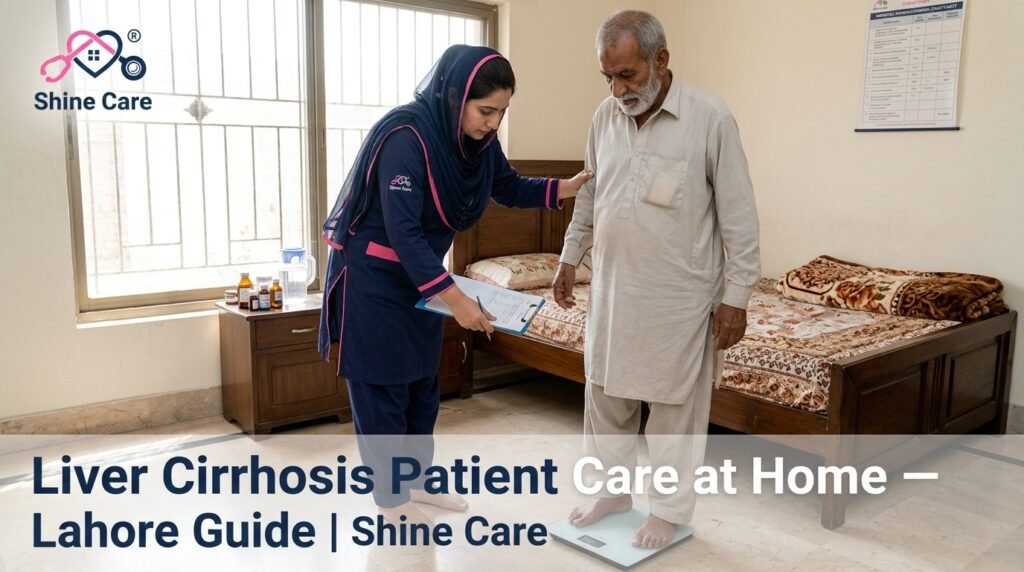
Hepatitis C has shaped liver disease in Pakistan more than any other single factor. For decades, re-used syringes in clinics, unsafe barber tools, poorly screened blood transfusions and inadequate infection control have left Pakistan with one of the highest hepatitis C rates in the world. The quiet result shows up two or three decades later as cirrhosis — the end-stage scarring of the liver, usually diagnosed in adults between 50 and 70. Hepatitis B contributes too. Alcohol-related liver disease is less common in Pakistan but present. Fatty liver disease is rising fast with the diabetes and obesity epidemic. Thousands of Lahore families end up looking after a parent or spouse with cirrhosis — and the care at home is more complex than it looks. Fluid overload, confusion, bleeding risk, infection risk, nutrition, medication care, careful watching for complications. This is one of the conditions where trained nursing at home genuinely changes how many months a patient keeps their quality of life.
This guide covers home care for liver cirrhosis patients — what to watch, what to do daily, when to call for help, and how Shine Care supports Lahore families through it. Nothing here replaces the specific instructions of the treating hepatologist or gastroenterologist. Specific medications, diet instructions, and procedures depend on the stage of liver disease and other individual factors.
What Cirrhosis Is
The liver is a resilient organ. It can handle a huge amount of damage before symptoms show. In cirrhosis the liver cells have been replaced by scar tissue over years, and the liver can no longer do its usual work properly:
- Producing proteins (including those needed for blood clotting)
- Clearing toxins from the blood
- Handling bilirubin
- Breaking down medications
- Managing fluid and salt balance
- Supporting immunity
Two broad stages:
- Compensated cirrhosis — scarring is present but the liver still does most of its work. The patient may feel largely well, with occasional tiredness and mild symptoms. Managed with regular review, treatment of the underlying cause, lifestyle, and surveillance.
- Decompensated cirrhosis — the liver can no longer compensate. Complications begin — fluid in the abdomen (ascites), confusion (encephalopathy), bleeding from varices, jaundice, kidney problems, infections. This is the stage requiring intensive home care.
The Main Complications Families Need to Understand
Ascites — Fluid in the Abdomen
Fluid builds up in the abdominal cavity. The abdomen becomes distended. Patient becomes breathless, cannot eat much, has difficulty moving. Weight rises. Legs swell.
Management:
- Strict low-salt diet — the main daily task
- Diuretic medications (water pills) as prescribed
- Daily weight tracking — same scale, same time, written down
- Sometimes paracentesis — a procedure where fluid is drained in hospital or clinic
- Fluid restriction in some patients
- Avoiding NSAIDs (ibuprofen, diclofenac) — damaging to kidneys in this group
Hepatic Encephalopathy — Confusion From Toxin Buildup
Toxins (particularly ammonia) that the liver would normally clear build up and affect the brain. The patient becomes:
- Confused
- Drowsy during the day, awake at night
- Agitated or aggressive
- Poor concentration
- Slurred speech
- Flapping tremor of the hands (asterixis)
- Eventually unconscious if severe
Management:
- Lactulose syrup — doses that cause 2 to 3 soft bowel movements a day — clears ammonia from the gut
- Rifaximin antibiotic in some patients
- Treating any triggering event — infection, bleeding, dehydration, constipation, sedative medications
- Protein not routinely restricted — modern guidance supports adequate protein with specific protein sources
Variceal Bleeding — Vomiting Blood
Scarred liver pushes blood back through other veins which swell dangerously — around the stomach and oesophagus. These can burst and bleed heavily.
Warning signs:
- Vomiting blood — bright red or dark “coffee ground”
- Passing black tarry stools (melaena)
- Sudden weakness, fainting
- Fast heartbeat, low blood pressure
This is a medical emergency — call 1122 or get to hospital immediately.
Prevention:
- Beta blocker medications as prescribed
- Endoscopic banding of varices as scheduled
- Avoid aspirin, NSAIDs unless specifically prescribed
- Treating constipation gently
Spontaneous Bacterial Peritonitis — Infected Ascites Fluid
Patients with ascites can develop infection of that fluid. Signs — fever, worsening ascites, new abdominal pain, confusion worsening. Needs same-day medical review and often hospital admission.
Hepatorenal Syndrome
Kidneys deteriorate in late cirrhosis. Monitored by the treating consultant with specific blood tests.
Jaundice
Yellowing of eyes and skin as bilirubin builds up. Dark urine, pale stools. More noticeable as cirrhosis progresses.
Hepatocellular Carcinoma — Liver Cancer
Cirrhosis patients have significantly higher risk of liver cancer. Six-monthly surveillance scans and alpha-fetoprotein blood tests are usually recommended by the hepatologist.
Daily Care at Home
Weight and Fluid Tracking
- Daily weight — same scale, same time, same clothes
- Written chart on the wall
- Weight rise of more than 1 kg in a day or 2 kg over 2 to 3 days usually means fluid overload
- Early detection means medication adjustment at the clinic rather than hospital admission
- Fluid intake and output monitored where the consultant has prescribed restriction
Diet
- Low salt — the single most important intervention for ascites. No added salt, minimal cooking salt, no pickles, no processed foods, no fast food
- Adequate protein — eggs, chicken, fish, dal, dairy. Protein is not restricted in modern guidance for most cirrhosis patients
- Small frequent meals rather than two or three large meals
- Late-night snack often recommended — helps with muscle preservation
- Fluid — specific restriction only if the consultant has prescribed
- Avoid alcohol
- Diabetic management if applicable — many cirrhosis patients have diabetes
- Vitamin supplementation often needed — the consultant prescribes
- Avoid raw seafood and uncooked foods carrying infection risk
Medication Discipline
- Multiple medications common — diuretics, lactulose, beta blockers, vitamins, diabetic medications, hepatitis-specific drugs
- Written medication chart
- Pill organiser
- Strict timing
- Report side effects promptly — some medications accumulate in liver failure
- Avoid NSAIDs — ibuprofen, diclofenac, mefenamic acid
- Avoid traditional herbal remedies — many are liver-toxic
- Any new medication from any doctor should be checked against the current list
Bowel Routine
- Lactulose titrated to produce 2 to 3 soft bowel movements a day — core for encephalopathy prevention
- Constipation triggers confusion in late cirrhosis
- Diarrhoea causes dehydration — adjust lactulose if too loose
- Written log of bowel movements
Infection Prevention
- Hand hygiene by all household members
- Vaccinations as advised (flu annually, pneumonia, hepatitis A and B if not immune)
- Prompt reporting of fever, UTI symptoms, chest symptoms
- Skin care — cirrhotic patients heal slowly
- Dental care
- Avoiding visitors with respiratory infections during flares
Watching for Complications
Daily inspection and reporting:
- Weight change
- Abdominal distension
- Leg swelling
- Confusion, drowsiness, personality change
- New fever
- Any bleeding — nose, gums, bruising, blood in vomit, dark stools
- Jaundice level
- Appetite
- Breathing
- Urine output and colour
A written log is useful. Trends matter more than single readings.
Hepatic Encephalopathy — Family Response
When confusion worsens:
- Check lactulose has been given and is working
- Check for infection — temperature, UTI, chest symptoms
- Check for constipation
- Check for recent sedative medications
- Call treating consultant
- If severe — not able to be roused, aggressive, severely confused — hospital
- Avoid sedatives at home — may worsen
- Safety at home — risk of falls when confused
Many episodes are triggered by a specific cause that can be treated at home with the consultant’s phone guidance.
Pakistani Context — What Makes This Harder
- Patients often presenting late — hepatitis undiagnosed for decades
- Multiple family members with hepatitis — relatives need screening too
- Hepatitis C is now treatable with direct-acting antivirals — significant benefit even in cirrhotic patients
- Transplant availability very limited in Pakistan — most patients managed medically
- Smog and Pakistani environment increase infection load
- Lahore summers increase dehydration risk
- Family-prepared food is salty by habit — a significant mindset change needed
- Traditional remedies for jaundice are common and often harmful
- Alcohol disclosure difficult in Pakistani families — honest history matters for diagnosis
Hepatitis C Treatment Even in Cirrhosis
Modern direct-acting antivirals cure hepatitis C in most patients, including many with cirrhosis. For a Pakistani patient with hepatitis C-related cirrhosis, treatment should be discussed with the hepatologist. The treatment courses are shorter and better tolerated than older regimens. Even cured patients remain at risk of liver cancer and need surveillance.
Vaccinations Specific to Cirrhosis
- Hepatitis A vaccine if not immune
- Hepatitis B vaccine if not immune and not hepatitis B-related cirrhosis
- Annual flu vaccine
- Pneumonia vaccine as advised
- Other vaccines per infectious disease specialist advice
Vaccinations reduce the number of hospital admissions in this group.
When Home Nursing Becomes Essential
Compensated cirrhosis — family can manage with regular hepatologist visits.
Decompensated cirrhosis often needs structured support. Situations where trained nursing care at home earns its place:
- Multiple episodes of hepatic encephalopathy
- Large ascites needing diuretic management and watchful care
- Variceal bleeding history
- Multiple medications requiring daily oversight
- Patient also diabetic or on insulin
- Family working, elderly patient alone during day
- Overseas family coordinating care
- Palliative care phase — comfort-focused support
- Patients post-paracentesis or recent admission
- Patients awaiting or being evaluated for transplant
Families looking for the right home nurse near me for a cirrhotic patient benefit from clinical training over price. The nurse must recognise the early signs of encephalopathy, infection, bleeding and fluid overload. Untrained attendants can give daily medications and keep the patient company, but recognising problems early needs training.
At Shine Care, a typical cirrhosis home nursing engagement covers:
- Trained attendant or nurse at home, hours matched to need
- Daily weight, BP, pulse, symptom tracking
- Strict low-salt diet oversight
- Medication administration and documentation
- Bowel routine (lactulose) tracking
- Early recognition of complications
- Coordination with the treating hepatologist
- Visiting doctor review when clinic visits are difficult
- Physiotherapy where muscle wasting is significant
- Equipment through our group — adjustable bed, air mattress, commode as needed
For a cirrhotic patient, the right health at home set-up often prevents several hospital admissions each year. The cost of structured home nursing is usually less than the cost of those admissions.
About Shine Care
Shine Care provides home nursing across Lahore with experience in liver, cardiac, renal and other complex chronic conditions. For cirrhosis patients, our trained team focuses on patient care that prevents the common complications — fluid overload, encephalopathy, infection, bleeding — through daily discipline and early recognition. We cover DHA Phase 1 to 10, Gulberg, Model Town, Garden Town, Johar Town, Faisal Town, Wapda Town, Valencia Town, Bahria Town, Lake City, Cantt, Askari and most Lahore residential areas.
For related services, see our main home nursing services in Lahore page, registered nurse in Lahore for clinical shift cover, elderly care at home, visiting doctor at home, palliative care for advanced cases, and injection at home for specific prescribed injections.
Call or WhatsApp 0344-9226778 to arrange support for a cirrhosis patient at home in Lahore.
Frequently Asked Questions
Can my father recover from cirrhosis?
Scarring itself does not reverse. However, treating the cause (hepatitis C eradication, stopping alcohol, treating hepatitis B, managing fatty liver) significantly slows further damage, and some improvement in liver function is possible in early cases. Modern treatment allows many patients to live many years with manageable symptoms.
Is protein restriction needed?
Modern guidance says no — adequate protein is important for muscle preservation and overall health in cirrhosis. Specific sources (dairy, eggs, pulses) are often preferred to red meat. The consultant advises specifics.
How often should the hepatologist review?
Compensated cirrhosis — every 3 to 6 months with scan and labs. Decompensated — more frequently, often monthly. Immediately after any complication.
Can traditional herbal medicine help the liver?
Many Pakistani herbal “liver tonics” are either ineffective or actively harmful. Specific compounds have caused acute liver failure. Do not take any herbal remedy without the hepatologist’s clearance.
Does Shine Care provide home nursing for cirrhosis patients?
Yes — trained attendants and nurses for cirrhosis care at home across Lahore, with hepatologist coordination. Call 0344-9226778.
Can overseas family coordinate a parent’s cirrhosis care from abroad?
Yes — overseas family coordination is routine. Daily WhatsApp updates, remote payment, direct hepatologist liaison.
This article is a general guide. All diagnostic and treatment decisions for cirrhosis remain with the treating hepatologist. For warning signs — vomiting blood, black stools, severe confusion, severe abdominal pain, fever — call 1122 or go to hospital. External reference: NHS — Cirrhosis.