Every year from around October to February, Lahore turns grey. The Air Quality Index climbs into the hazardous zone. Schools close, flights get diverted, and hospital OPDs fill up with wheezing children and breathless elderly patients. For families with an elderly parent or a lung patient at home, this is not a matter of inconvenience — it is a serious health crisis that lasts four months of the year.
This guide explains the smog effects on elderly Lahore residents and the practical steps families can take to protect vulnerable patients during smog season. The focus is on what you can actually do at home — indoor air quality, when to leave the house, what to watch for, and when to call for professional care in the home. Nothing here replaces your doctor’s advice, but it will help you make smog season safer for the person you love.
Why Elderly and Lung Patients Are Hit Hardest
Smog is not just “bad air” — it is a mixture of fine particulate matter (PM2.5 and PM10), nitrogen dioxide, sulphur dioxide, ozone, and carbon monoxide. These particles are small enough to pass deep into the lungs and, in some cases, into the bloodstream.
Elderly people are hit harder because their lung capacity has already reduced with age, their immune response is slower, and many already have chronic conditions — hypertension, heart disease, COPD, diabetes — that smog quietly worsens. Patients with existing lung disease are the most vulnerable of all: what causes a young adult to cough for a day can put a COPD patient in hospital for a week.
In our experience arranging care for elderly patients across Lahore, admissions for breathing difficulty, uncontrolled blood pressure, and chest infections rise noticeably during the smog months — even in patients who were stable through the summer. This is why families need a plan, not just for the patient’s usual condition, but specifically for smog season.
First, Understand the Team You Need at Home
Managing a vulnerable patient through smog season is not a one-person job. The roles are:
- Pulmonologist / Physician: Adjusts the medication plan for the smog months — often stepping up inhalers, adding a rescue inhaler, or changing the frequency of nebulisation. Any medication change comes from the doctor, not the family.
- Registered Nurse / Home Nurse: Handles clinical work — nebulisation, oxygen setup, vitals monitoring, injections if prescribed. A trained home nurse visiting the house on a schedule can catch worsening symptoms days before they become an emergency.
- Caretaker / Patient Attendant: Supports daily routine, keeps the patient indoors, ensures medication is taken on time, and knows the warning signs to escalate.
- Family: Manages the indoor environment, tracks symptoms in a diary, and coordinates with all the above.
Families with a bedridden or high-risk elderly parent often benefit from structured care for elderly at home during smog season specifically, even if they manage on their own the rest of the year. The four smog months are the hardest for vulnerable patients, and this is when professional presence at home makes the biggest difference.
Indoor Air: The Most Important Battle
Here is the uncomfortable truth about Lahore smog: even indoor air in your home is significantly polluted during smog days, unless you take active steps. Fine particulate matter drifts in through every window gap, door frame, and exhaust fan. The goal is not to eliminate it (impossible in Lahore in November) but to reduce it as much as you reasonably can.
1. Close Windows Strategically
Keep windows and doors closed during peak smog hours — usually late evening through mid-morning. Ventilate briefly in the early afternoon if the AQI has dropped a little. Use door draft stoppers and check window seals. A single loose window in the patient’s room can raise indoor PM2.5 by a large amount.
2. Consider an Air Purifier
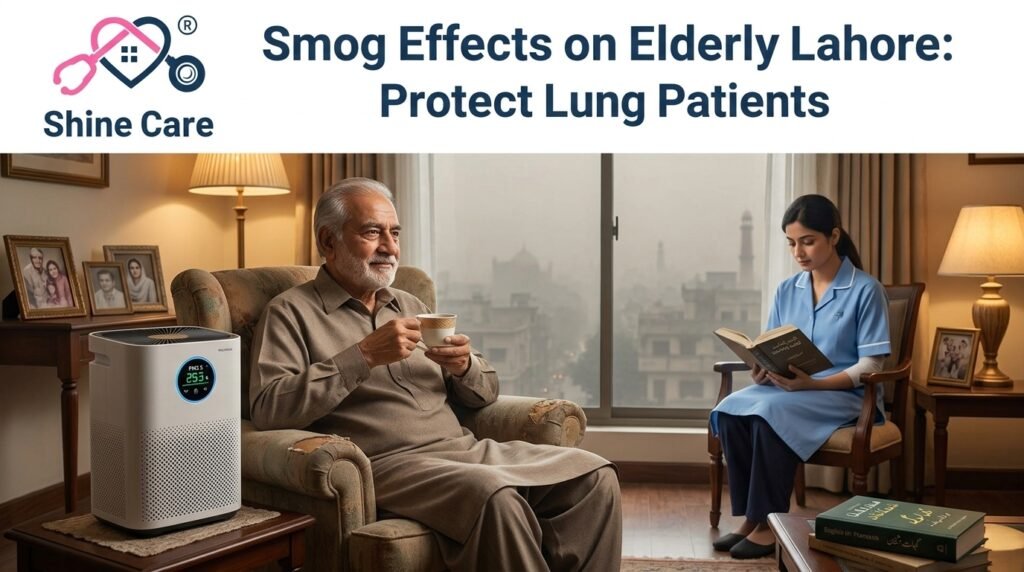
A good HEPA air purifier in the room where the patient spends most of their time makes a measurable difference. It does not need to be an expensive imported model — a mid-range unit with a genuine HEPA filter, sized to the room, is enough. Run it 24 hours a day during smog season. Change filters as recommended, otherwise you are just circulating dirty air.
3. Do Not Smoke Indoors
Cigarette smoke, agarbatti, wood-burning heaters, and even certain scented candles add to indoor pollution. During smog season, all of these should be kept away from the patient’s room. This is not the season for a hookah in the drawing room.
4. Watch the Kitchen
Cooking, especially frying, releases a lot of particulate matter. Use the exhaust fan every time and keep the kitchen door closed. If possible, move the patient to a room further from the kitchen during meal preparation.
5. Damp Mopping, Not Sweeping
Dry sweeping raises settled dust back into the air. Damp mopping traps it. Do this at least once a day in the patient’s room during smog season.
Personal Protection When Leaving the House
Some outings cannot be avoided — a hospital visit, a lab test, a family emergency. When the patient must leave the house on a smog day:
- Wear a properly-fitting N95 or KN95 mask, not a cloth mask or surgical mask. Fit matters — a mask with gaps around the nose does very little.
- Keep the outing short. Every extra hour outdoors on a hazardous-AQI day adds to the burden on the lungs.
- Roll up the car windows and switch the AC to recirculate mode.
- Change clothes and wash the face and hands as soon as the patient gets home.
For scheduled appointments during smog months, consider whether they can be replaced by a home visit. Many routine checkups, blood tests, and follow-ups no longer need a hospital trip. Coordinated visiting doctor and home lab sampling services keep the patient safely indoors while still keeping their medical care on track.
Medication and Monitoring During Smog Season
Inhalers and Nebulisers
Ask your doctor to review the patient’s inhaler plan before smog season starts. Many pulmonologists step up controller inhalers by one level from October to February, or add a short-term steroid inhaler. Keep the rescue inhaler within reach at all times.
For patients on regular nebulisation, having a working nebuliser at home — with backup medication in stock — is essential. Do not wait to run out at 11 PM on a Sunday.
Blood Pressure and Sugar
Smog worsens blood pressure and glucose control, especially in elderly patients. Both should be checked more often during smog season — daily BP monitoring is not excessive. Any patient with existing high blood pressure benefits from close attention to hypertension care during these months, because uncontrolled BP plus air pollution is a common trigger for stroke and heart attack.
A Simple Home Diary
A school notebook works. Note down each day:
- Morning BP and pulse
- Oxygen saturation on a fingertip oximeter (if the patient has any lung condition)
- Blood sugar (for diabetics)
- Any new cough, wheeze, or breathlessness
- How well the patient slept
- Medications taken
This diary is what allows the doctor to see patterns at the next visit, and it is what makes escalation decisions easier when something changes.
When Home Care Is Not Enough: Clinical Support
For patients whose lungs are already compromised — COPD, pulmonary fibrosis, post-COVID lung damage, advanced heart failure — smog season sometimes needs more than good indoor air and inhalers. This is where a trained home nurse becomes valuable, either for scheduled visits or continuous cover.
The kind of clinical support that becomes useful during smog season includes:
- Nebulisation done correctly and at the right intervals
- Supplemental oxygen setup and monitoring
- Injections and IV medications if prescribed
- Wound care, catheter care, or NG tube care if the patient already has these needs
- Early identification of worsening symptoms
Some families are surprised to learn how much genuine health at home support is now available in Lahore — patients who previously would have needed hospital admission for a smog-triggered flare-up can often be managed safely at home with the right team.
Equipment That Often Becomes Necessary
Depending on the patient’s condition and how badly smog affects them, families sometimes need to arrange:
- Home nebuliser — for regular delivery of prescribed inhaled medications
- Fingertip pulse oximeter — a cheap and essential tool for anyone with lung disease
- Oxygen concentrator — for patients whose saturation drops during smog days
- BiPAP machine — for advanced COPD or overlap sleep apnoea and COPD
- Blood pressure monitor — an automatic upper-arm cuff is more reliable than a wrist device
- Air purifier with HEPA filter — for indoor air quality in the patient’s room
Renting rather than buying makes sense for some of these, especially the ones needed seasonally. Families can arrange medical equipment on rent for the smog months and return it when the season ends.
Common Mistakes Families Make in Smog Season
Waiting Too Long to Escalate
“He is just coughing a bit more, we will see how tomorrow goes.” Tomorrow, the patient is in the ER. In smog season, a new cough or a new breathlessness in an elderly lung patient is a signal to act, not to wait.
Skipping Medications on “Good Days”
The AQI drops slightly on a Sunday and the patient feels better, so the family cuts a dose. Then Monday’s smog spikes and the patient crashes. Controller medications work over time; do not adjust them based on how a single day feels.
Believing Cloth Masks Are Enough
A cloth mask does very little against PM2.5. If the patient must go outdoors, they need a properly-fitting N95 or KN95, or they should not go.
Overestimating Home Remedies
Kaadha, honey, ginger, steam — all fine as comfort measures, none of them replace prescribed treatment for a smog-triggered flare-up. Do not delay real medical care to try a few more days of home remedies first.
Ignoring the Mental Impact
Four months indoors is hard on elderly patients — depression, sleep disturbance, and reduced appetite are common. Schedule video calls with relatives, keep the room bright and pleasant, and pay attention to mood as well as lungs.
Red Flags: When to Stop and Call for Help
If any of the following happen during smog season, contact the doctor or take the patient to the nearest emergency room. Call 1122 if the situation is serious:
- Sudden severe shortness of breath, especially at rest
- Chest pain, chest pressure, or heaviness
- Lips, fingertips, or face turning bluish or grey
- Oxygen saturation dropping below the doctor’s target and not recovering
- New confusion, unusual drowsiness, or difficulty waking
- Wheezing or breathing not settling with the rescue inhaler and nebuliser
- Coughing up blood or pink frothy sputum
- Fever above 38°C (100.4°F) with new cough — possible chest infection
- Sudden weakness on one side of the body, slurred speech, or facial droop — stroke signs
These are hospital problems, not home problems. Escalate immediately.
For patient-friendly background on how air pollution affects health, the WHO fact sheet on ambient air quality and health is a reliable reference. For your patient’s specific condition, always follow your own doctor’s advice.
FAQs
Yes, a genuine HEPA air purifier sized correctly for the room can significantly reduce indoor particulate matter. It will not clean the whole house, but running one continuously in the patient’s room and closing the door makes a real difference over hours.
Not necessarily. Some days have better AQI than others, and short outings when air quality is manageable are fine. The key is checking the AQI before going out, avoiding early morning and late evening peaks, and wearing a properly-fitting mask if the patient must be outside on a bad day.
Yes, and encouraged. Gentle exercise inside the house — walking around the rooms, chair-based exercises, or a home physiotherapy session — helps maintain muscle strength and lung function without exposing the patient to outdoor pollution.
A properly-fitting N95 or KN95 with head straps rather than ear loops (head straps give a better seal). Elderly patients with weaker breathing may find N95 tiring for long periods — for short outings it is fine, for longer outdoor stays it is worth asking the doctor.
Long-term exposure to high pollution is associated with the development and worsening of lung disease. For an elderly person who has spent a lifetime in Lahore, some background lung damage may already exist without symptoms. This is why protection during smog season matters even for people who feel healthy.
Consider a home nurse if the patient has known lung disease, if they have needed hospital admission in previous smog seasons, if they are on oxygen or BiPAP, or if the family cannot manage nebulisation, injections, or vitals monitoring safely at home. Even a few scheduled visits per week can catch problems early.