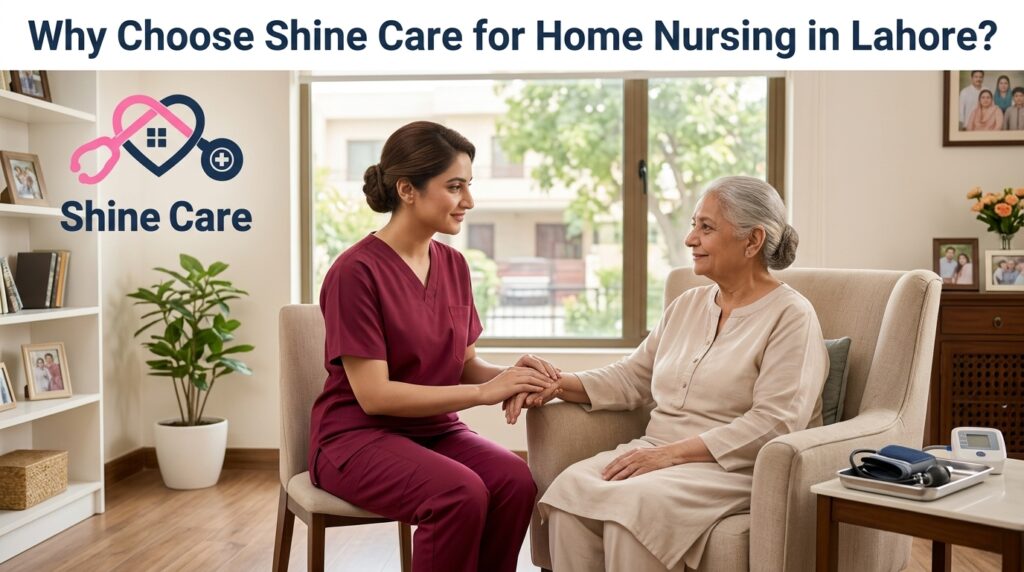
Shine Care provides home nursing and patient-care support for families in Lahore, including professional nursing, ICU-level support where medically appropriate, elderly care, caregivers, post-surgery assistance, physiotherapy, doctor home visits, and coordination for medical equipment needs. The right combination of support depends on the patient’s specific condition, and families are encouraged to discuss their exact requirements before arranging any service.
A parent who’s had a fall, a father discharged after cardiac surgery, a grandmother whose memory has started slipping these situations rarely announce themselves with a clear instruction manual. Families searching for home nursing services in Lahore are usually trying to solve a genuinely specific problem, not looking for a generic solution that applies to everyone equally.
Choosing a provider involves more than checking who’s available this week. Staff suitability, how clearly a provider communicates, whether a care plan actually reflects the patient’s situation, and whether the person receiving care is treated with genuine dignity these factors shape whether an arrangement actually works, sometimes more than the service list itself. This article walks through how Shine Care approaches home nursing in Lahore, what’s involved, and what families should think through before arranging support.
What Makes Shine Care Different?
Shine Care aims to provide patient-focused support by understanding each patient’s individual care needs, coordinating suitably qualified healthcare professionals, maintaining clear communication with families, and helping arrange services according to what the patient’s situation actually requires rather than a fixed package applied uniformly.
This starts with a professional care approach that treats every case as genuinely specific. A family managing post-surgical recovery has different priorities than one managing long-term dementia care, and the conversation with Shine Care reflects that difference from the outset. Patient-focused support means the starting point is always the patient’s actual condition, not a predetermined service tier.
Personalized care planning follows from this building an arrangement around the patient’s routine, medical needs, and family preferences, rather than expecting the family to adapt to a rigid structure. Clear communication runs throughout, since families managing a loved one’s care, particularly those juggling this alongside work or distance, need to trust that they’re getting an honest, current picture of the situation.
Family involvement remains part of the process rather than something that happens around the edges of professional care. Service coordination — matching the right combination of nursing, caregiving, physiotherapy, or equipment support happens based on the specific case, and respect for patient dignity shapes how every interaction is handled, not just the clinical tasks. Flexible care arrangements may be available depending on the specific service, though availability may depend on the requested service, staff schedules, patient requirements, and location.
Qualified Healthcare Professionals for Home-Based Care
Home healthcare typically involves different types of professionals, and which ones a specific case needs depends entirely on the patient’s condition, required level of monitoring, and the care plan established with medical guidance.
ICU-Trained Nurses
Critical-care experience may be important for patients whose condition requires closer, more continuous monitoring than standard home nursing typically provides. ICU nursing requirements depend on the specific care plan established for the patient, not a general assumption about what “critical” cases need.
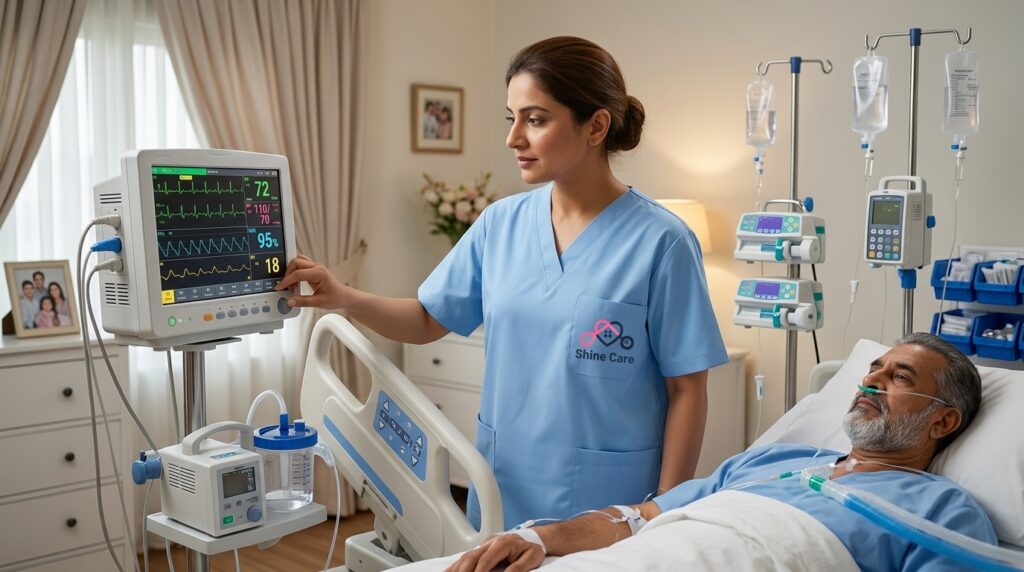
Equipment alone a monitor, an oxygen concentrator, a ventilator does not replace professional monitoring. The appropriate level of nursing support for any given case should be determined according to medical guidance, ideally in direct coordination with the patient’s treating doctor.
Registered Nurses
Registered nurses provide nursing support according to their qualifications and the approved care plan, covering patient observation, clinical support within their professional scope, and communication with the family and broader healthcare team where appropriate. This level of support suits a wide range of home nursing situations that don’t require intensive-care-level monitoring.
Professional Caregivers
Caregivers focus on daily living support mobility assistance, personal care, companionship, and general routine support that keeps a patient’s day manageable. This role doesn’t involve clinical responsibilities, and a caregiver isn’t a substitute for a nurse when genuine medical needs are present.
Patient Attendants
Patient attendants provide non-clinical assistance focused on daily routine, mobility, and comfort. This support suits patients who need consistent physical assistance without an active medical condition requiring nursing oversight, and it also extends practical support to the family managing the broader situation.
Physiotherapists
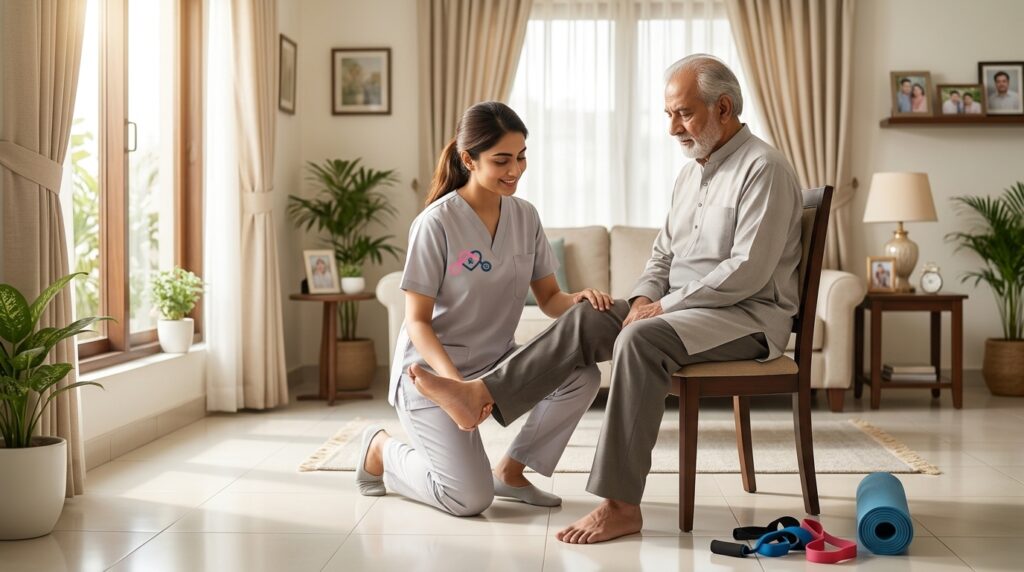
Home physiotherapy may be arranged according to the patient’s specific needs and a professional assessment of their condition. Rehabilitation goals regaining strength after surgery, supporting recovery from a stroke, managing a chronic mobility issue depend entirely on the individual patient’s situation and the care plan developed for them.
Doctor Home Visits
Doctor home visits may be arranged when clinically appropriate and available, offering a practical option for patients who find travel to a clinic difficult. Medical assessment and treatment decisions remain the responsibility of the qualified doctor conducting the visit, not something a nursing or caregiving arrangement can substitute for.
Complete Home Healthcare Services Under One Care Network
Families often need different forms of support depending on where a patient is in their recovery, whether they’re managing a long-term condition, navigating elderly care, or coordinating complex medical needs — and these needs frequently shift over time rather than staying fixed.
Home Nursing covers general nursing support for patients managing recovery, chronic conditions, or ongoing daily medical needs, provided according to an established care plan.
ICU Nursing at Home may be arranged for patients whose condition requires closer monitoring, when this has been determined appropriate through medical assessment and coordination with the treating doctor.
Elderly Care supports aging patients with daily assistance, medication reminders, and general wellbeing monitoring, suited to those managing age-related needs without necessarily requiring intensive clinical care.
Dementia Care involves caregivers and, where relevant, nurses trained in the specific communication approaches dementia patients benefit from, with suitability depending on the patient’s stage and specific behavioral needs.
Stroke Care supports patients recovering from a stroke with mobility assistance, feeding support where needed, and coordination with physiotherapy, tailored to the severity and stage of recovery.
Cancer Patient Care may include daily support, symptom monitoring, and comfort-focused assistance, with the specific arrangement shaped by the patient’s treatment plan and current needs.
Parkinson’s Care addresses the specific daily challenges Parkinson’s brings — medication timing, mobility support, and patience with the condition’s physical symptoms matched to the patient’s current stage.
Palliative Care focuses on comfort and quality of life for patients managing a serious or advanced condition, coordinated closely with the patient’s medical team and family wishes.
Post-Surgery Care supports patients through the recovery window following an operation, covering wound monitoring, mobility support, and medication reminders appropriate to the specific procedure.
Wound Dressing Support may be provided by qualified nursing staff following proper technique, with frequency and approach guided by the treating doctor’s instructions.
Injection Services are provided within a nurse’s professional scope, administered according to the prescribing doctor’s instructions.
IV Drip Services follow the same principle administered by qualified nursing staff according to the specific treatment plan established by a doctor.
Home Physiotherapy supports recovery and mobility goals through sessions arranged according to a professional assessment of the patient’s condition.
Doctor Home Visits round out the network, offering medical assessment for patients who benefit from care delivered at home rather than a clinic setting.
Suitability for any of these services depends on an individual assessment of the patient’s needs — none of them should be assumed necessary simply because a patient falls into a general category like “elderly” or “recovering.”
Medical Equipment Support for Home Patient Care
Some patients require specific medical equipment at home, and the right equipment depends on the patient’s medical needs, the space available at home, how long the equipment will likely be needed, and professional guidance from the treating doctor.
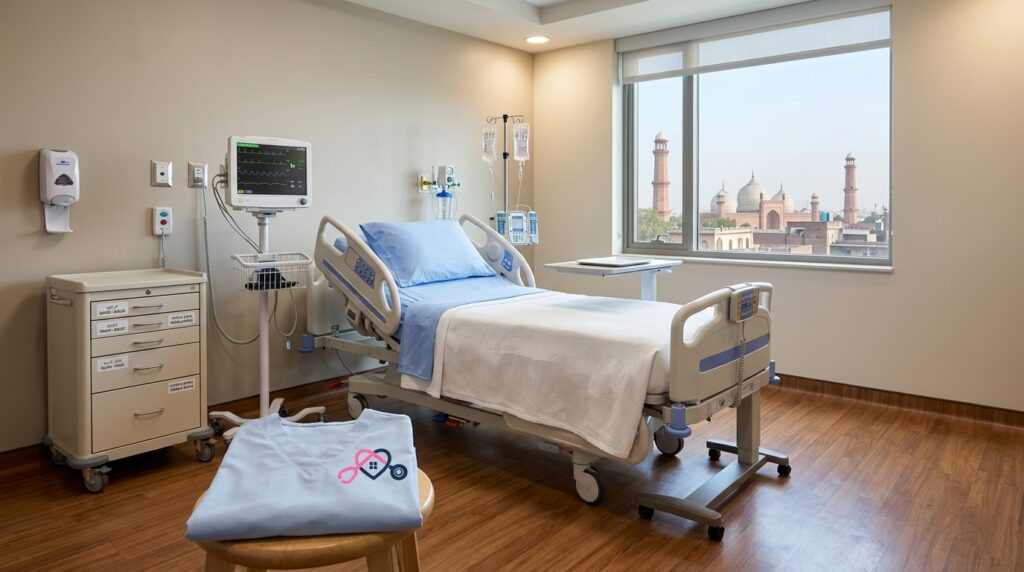
Commonly needed items include hospital beds both electric and manual models along with oxygen concentrators and oxygen cylinders for patients with prescribed respiratory support needs. Wheelchairs support mobility for patients who can’t walk independently, while suction machines assist patients unable to clear their own airway secretions.
CPAP and BiPAP machines support specific respiratory conditions, and ventilators provide mechanical breathing support for patients who need it, always under appropriate medical supervision. Patient monitors track vital signs for closer observation, and air mattresses help reduce pressure sore risk for bedridden patients.
None of this equipment should be selected based on settings recommended here oxygen flow rates, ventilator settings, and similar clinical parameters should always come from the patient’s treating doctor, not general guidance. For families in Lahore, Islamabad, and Rawalpindi specifically needing to arrange equipment rental or purchase, Shine Medical Equipment provides dedicated medical equipment rental and sales services covering exactly this kind of need. Current equipment availability and suitability should be confirmed before arranging rental or purchase, since not every item is available at every time.
Areas in Lahore Where Shine Care Provides Support
Service availability across Lahore depends on the requested service, staff availability, patient requirements, the care schedule involved, and the exact location in question, so coverage isn’t automatically identical for every service in every area.
Shine Care supports families across areas including DHA Lahore, Johar Town, Gulberg, Model Town, Bahria Town Lahore, Lahore Cantt, Wapda Town, Faisal Town, Valencia, and Garden Town. Service availability should be confirmed directly when contacting Shine Care, since staffing and scheduling can vary based on the specific service requested and the current situation.
Why Families Choose Shine Care for Home Patient Support
Families weighing home nursing options in Lahore tend to look for a provider whose approach genuinely centers on the patient, not just service availability. Patient-centered planning means the care arrangement starts with the specific person’s situation rather than a generic package.
Professional staff coordination, clear communication, and genuine family involvement matter throughout the arrangement, not just during the initial setup conversation. Respect for privacy and patient dignity shapes how care actually gets delivered day to day, and care continuity the same, consistent approach over time rather than a disjointed handoff between different people supports better outcomes for patients managing longer-term needs.
Service flexibility, where available, allows arrangements to adjust as a patient’s situation changes, and regular care updates, where applicable, help families stay genuinely informed. Clear expectations, set from the beginning, reduce the confusion that otherwise complicates home care arrangements, and support extends to both temporary situations a defined recovery period and longer-term needs that continue for months or years.
Benefits of Professional Home Nursing
Professional home nursing may offer several practical advantages for patients and families, depending on the specific situation and care plan involved.
- Care delivered in a familiar home environment, which many patients find more comfortable than an unfamiliar clinical setting
- Family involvement that continues naturally, rather than being limited to scheduled visiting hours
- Personalized attention focused on one patient’s specific needs
- Greater privacy and comfort during recovery or ongoing care
- Support during recovery periods that would otherwise fall entirely on family members
- Flexible scheduling where available, matched to the household’s actual situation
- Depending on the patient’s condition and care plan, home-based support may reduce the need for some routine travel to appointments or facilities
- Continuity of daily routines that supports patients managing chronic or long-term conditions
- Support specifically suited to elderly or mobility-limited patients managing daily life at home
How Shine Care’s Home Nursing Process Works
Arranging home nursing through Shine Care generally follows a structured process, starting with an initial conversation and moving through assessment, planning, and ongoing care review as the patient’s needs are understood and addressed.
Step 1: Contact Shine Care. Families can share the patient’s age, general care requirement, the specific service being considered, a preferred schedule, location, and any relevant medical information that helps shape the conversation.
Step 2: Understand the Patient’s Care Needs. Service suitability gets discussed based on the patient’s mobility, daily support needs, clinical requirements, expected duration of care, and preferred schedule.
Step 3: Create a Suitable Care Plan. This covers specific care responsibilities, timing, family expectations, communication preferences, and what level of professional support the situation actually requires.
Step 4: Staff Assignment. Which staff member gets assigned depends on the required service, the patient’s specific needs, relevant staff qualifications, current availability, and scheduling.
Step 5: Service Begins. Clear responsibilities guide the actual care delivery, alongside attention to patient comfort, respectful communication, and consistent adherence to the agreed care plan.
Step 6: Ongoing Communication and Care Review. Families receive updates where applicable, and the arrangement gets reviewed as the patient’s needs change, with coordination extending to relevant healthcare professionals where appropriate.
Who May Benefit From Home Nursing and Patient Care?
Home nursing and patient care support a range of situations, though whether a specific person needs this kind of support depends on an individual assessment rather than a general category they might fall into.
Elderly patients managing daily life with reduced mobility, memory changes, or chronic conditions often benefit from consistent daily support. Stroke patients recovering from a cerebrovascular event may need mobility assistance, feeding support, and coordination with physiotherapy during recovery.
Patients requiring ICU-level support at home, when this has been determined medically appropriate by the treating team, need close monitoring and specialized equipment coordination. Cancer patients managing treatment or recovery may benefit from daily support and symptom monitoring suited to their specific treatment stage.
Bedridden patients need consistent physical care, including repositioning and hygiene support, to manage the risks associated with limited mobility. Dementia patients benefit from caregivers and, where appropriate, nurses trained in the specific communication approaches their condition calls for.
Parkinson’s patients managing the condition’s physical symptoms often need help with medication timing and daily mobility. Post-surgery patients need support during the critical recovery window following an operation, while patients with mobility limitations more broadly benefit from consistent assistance navigating daily life safely.
Patients requiring temporary recovery support following an illness, a fall, or a short hospital stay represent another common situation families bring to Shine Care, distinct from longer-term or chronic care arrangements.
How to Choose the Right Home Nursing Provider in Lahore
Selecting a home nursing provider involves checking several practical factors rather than relying on general reputation alone, since the right fit depends on your specific situation.
| Factor | What Families Should Check |
|---|---|
| Staff suitability | Relevant qualifications and experience for the patient’s specific condition |
| Care plan | Clear responsibilities and patient-specific needs, not a generic template |
| Communication | How updates and concerns are actually shared with the family |
| Schedule | Availability for the required care period, confirmed directly |
| Patient dignity | Respect, privacy, and attention to personal preferences |
| Clinical support | Appropriately qualified professionals assigned where clinical needs exist |
| Equipment | Suitability and current availability for any required medical equipment |
| Care review | How the provider handles changing patient needs over time |
Families searching for the best home nursing in Lahore often compare staff qualifications, service suitability, communication, availability, and the level of personalized support a provider actually offers, rather than choosing based on advertising alone.
Frequently Asked Questions About Shine Care Home Nursing
Shine Care focuses on understanding each patient’s specific condition before arranging care, coordinating appropriately qualified staff, and maintaining clear communication with families throughout the arrangement. The right fit depends on discussing your family member’s actual situation directly rather than assuming a standard package applies.
Staff are matched according to their relevant qualifications and experience for the specific care required, whether that involves general nursing, ICU-level support, or elderly care. Families are welcome to discuss specific staff qualifications directly when arranging service.
Yes, both male and female nursing staff may be available depending on current staffing and the specific request, and this preference can be discussed directly when arranging care.
Yes, families living abroad can contact Shine Care remotely to discuss a relative’s care needs, arrange services, and stay updated on the patient’s situation through ongoing communication with the care team.
Care can generally be arranged across different shift lengths, including 12-hour or 24-hour coverage, depending on the patient’s needs and current staff availability for the requested schedule.
Shine Care supports families across areas including DHA, Johar Town, Gulberg, Model Town, Bahria Town, Cantt, Wapda Town, Faisal Town, Valencia, and Garden Town, though service availability should be confirmed directly for your specific location.
ICU-trained nursing support may be arranged for patients whose condition requires this level of care, based on medical assessment and the treating doctor’s guidance, rather than assumed necessary for every case.
Yes, equipment needs can be discussed as part of the care planning process, with current availability and suitability confirmed before finalizing anything, including through coordination with dedicated equipment providers where relevant.
Home nursing may include patient observation, medication support, wound care, mobility assistance, and coordination with the treating doctor, with the exact scope depending on the specific care plan developed for the patient.
Families can contact Shine Care directly to discuss the patient’s condition, required service, preferred schedule, and location, after which a suitable care plan and staff assignment can be arranged based on that conversation.
Choose Home Healthcare Support That Fits Your Family’s Needs
Every family’s situation looks different once you get past the general category “elderly parent,” “post-surgery recovery,” “long-term condition” and into the actual daily reality of what a specific patient needs. That specificity is exactly what should shape any home nursing arrangement, rather than a fixed service package applied the same way to everyone.
If your family needs professional home nursing or patient-care support in Lahore, reach out to Shine Care to talk through the patient’s specific requirements, the service that might genuinely fit, preferred scheduling, location, and any equipment needs and find out what’s currently available for your situation.
Conclusion
Understanding why choose Shine Care for home nursing ultimately comes down to how well a provider’s approach matches your family’s actual situation, not a generic list of services. Home nursing services in Lahore can involve very different combinations of support nursing, caregiving, physiotherapy, equipment, doctor visits — and getting this right depends on the patient’s specific needs guiding every decision, not the other way around.
Qualified staff matter, but so does personalized care planning, honest family communication, and genuine attention to patient dignity throughout the arrangement. Medical equipment coordination, where needed, should follow the same principle matched to what’s actually prescribed and appropriate, not assumed based on general categories. And because patient needs rarely stay completely static, ongoing review matters just as much as the initial care plan. Families considering home healthcare support in Lahore are best served by a direct conversation about their specific situation, rather than assumptions about what a “typical” arrangement should look like.