
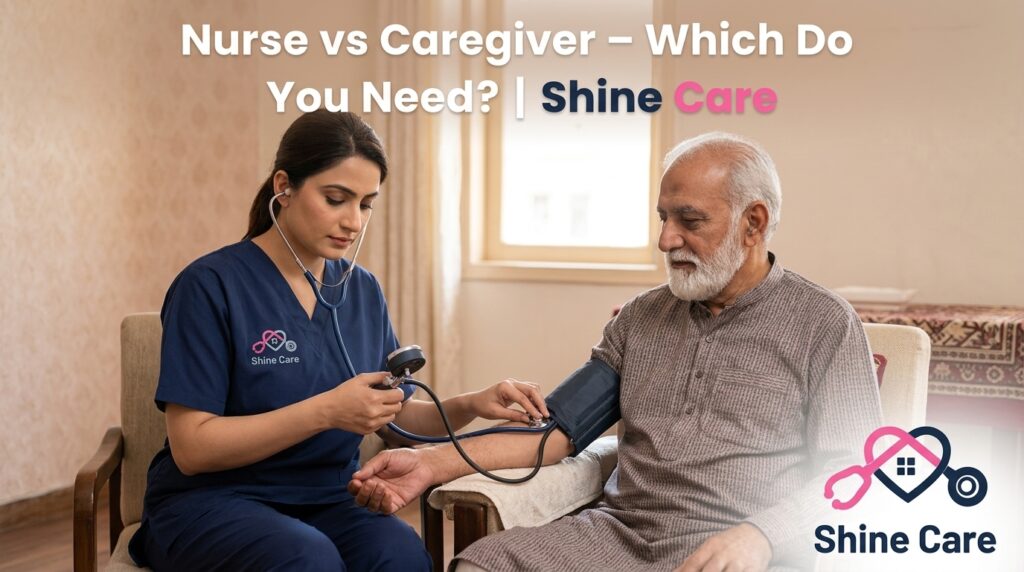
Your father just came home from the hospital, and everyone in the family is asking the same question in different words: does he need “a nurse,” or would someone to just help him around the house be enough? It’s a genuinely confusing decision, made harder by the fact that people in Lahore often use “nurse” and “caregiver” almost interchangeably in conversation, when the two roles are actually quite different in training, responsibility, and cost.
This article walks through that difference plainly, so you can make a decision based on what your loved one actually needs rather than guessing.
What’s the Real Difference Between a Nurse and a Caregiver?
A nurse is medically trained and handles clinical tasks — giving medications, managing wounds, monitoring vital signs, and recognizing when something is medically wrong. A caregiver, by contrast, supports daily living — bathing, dressing, meals, mobility, and company — without medical training or clinical responsibility.
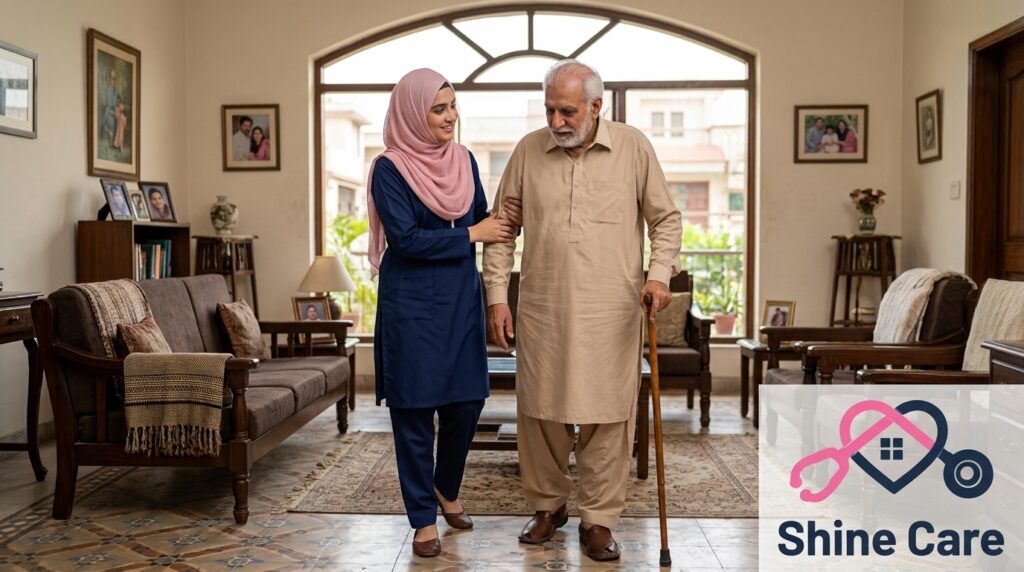
Think of it this way: a caregiver helps someone live their day more safely and comfortably. A nurse manages the medical side of a patient’s condition. Some patients genuinely need both at once, and that’s common, not unusual.
Comparing Responsibilities, Qualifications, and Duties
| Nurse | Caregiver | |
|---|---|---|
| Formal medical training | Yes | No |
| Medication administration | Yes | Reminders only |
| Wound care | Yes | No |
| Monitoring vital signs | Yes | Basic awareness only |
| Recognizing medical complications | Trained to identify | Not clinically trained for this |
| Bathing, dressing, mobility support | Yes | Yes, core focus |
| Companionship | Yes | Yes |
| Typical working hours | Scheduled shifts or 24-hour rotation | Daytime, overnight, or full shifts |
| Best suited for | Active medical needs | Stable patients needing daily support |
Qualifications differ considerably too. A nurse has completed formal nursing education and clinical training. A caregiver’s preparation is generally more practical — experience with daily care tasks, patience, and reliability matter more here than formal medical credentials.
When Does a Patient Need a Nurse Instead of a Caregiver?
Post-surgery patients often need a nurse, at least in the first stretch of recovery, since wound care and monitoring for complications requires clinical judgment a caregiver isn’t trained to provide.
Patients with chronic conditions requiring regular medication management — insulin timing, blood pressure monitoring, complex prescription schedules — generally need a nurse’s involvement, since errors here carry real medical risk.
Bedridden patients with any active medical complexity, such as wound risk or a condition requiring monitoring, usually need a nurse involved, even if a caregiver also helps with daily repositioning and hygiene.
Patients requiring medical procedures at home — injections, catheter care, tube feeding, dressing changes — need a nurse, full stop. These aren’t tasks a caregiver is trained or permitted to perform safely.
When Might a Caregiver Be Sufficient?
Elderly care for a parent who is medically stable but struggling with daily tasks — walking safely, remembering to eat properly, general loneliness — is often well served by a caregiver alone, without the added cost or complexity of nursing care.
Patients who are simply frail, recovering from a minor issue with no active medical risk, or who mainly need supervision and company during the day, typically don’t need a nurse’s clinical training. The deciding factor isn’t age or a general sense of “needing help” — it’s whether the patient has an active medical need requiring clinical judgment.
What About Bedridden and Chronic Condition Patients Specifically?
These two categories deserve a slightly closer look, since they’re often where families get the decision wrong in both directions. A bedridden patient without an active medical complication — say, someone who’s simply lost mobility due to age or general weakness — can often be well supported by a caregiver handling repositioning, hygiene, and feeding, with occasional nursing check-ins if needed.
A bedridden patient with a wound, a feeding tube, or a condition requiring regular monitoring needs a nurse as the primary caregiver, since the medical risk here is genuinely serious if missed. Chronic conditions follow similar logic — diabetes that’s well-controlled and stable might only need a caregiver with medication reminders, while diabetes with fluctuating levels or complications needs a nurse actively managing it.
So, Which One Does Your Loved One Need?
Ultimately, this comes down to the patient’s actual condition and their doctor’s guidance, not a general assumption based on their age or diagnosis alone. According to the National Institute on Aging, in-home care needs typically fall into a few categories — health care from a licensed professional, and personal or companion care that doesn’t require medical training — and matching the right one to your family member’s actual situation matters more than defaulting to whichever sounds more reassuring.
If you’re still unsure, that’s a completely normal place to be. Families in Lahore looking into home nursing services in Lahore or a caregiver at home in Lahore often start exactly here — uncertain, and wanting an honest answer rather than a sales pitch. Shine Care works through this exact question with families regularly, helping match a nurse, a caregiver, or a combination of both to what the patient genuinely needs, based on their specific condition and daily routine.
Frequently Asked Questions
Sometimes a single caregiver handles daily support while a nurse visits separately for medical tasks, rather than one person doing both roles, since the training required for each is genuinely different.
Often yes, if they’re medically stable and mainly need help with daily tasks and company. If there’s an active medical condition needing monitoring, a nurse should be involved as well.
This depends on the severity and stage of recovery. Early stroke recovery often needs a nurse for monitoring and mobility support, while later stages may shift toward caregiver-level support alongside physiotherapy.
If his blood sugar is stable and well-managed, a caregiver providing medication reminders may be enough. If levels fluctuate or he’s on complex insulin schedules, a nurse should be actively involved.
No, these are clinical tasks that require a nurse. A caregiver can assist with related daily comfort and hygiene, but tube or catheter care itself needs trained medical handling.
Yes, this is genuinely the best starting point. The doctor understands the patient’s actual medical risk and can guide whether clinical nursing support is necessary or whether daily caregiver support is sufficient.
A Quick Word From Shine Care
If you’re weighing this decision for someone in your family, you don’t have to figure it out alone. Shine Care helps families across Lahore work through exactly this question — nurse, caregiver, or both — based on the patient’s real condition, not a generic package. Reach out to talk through your family member’s situation and figure out what actually fits.