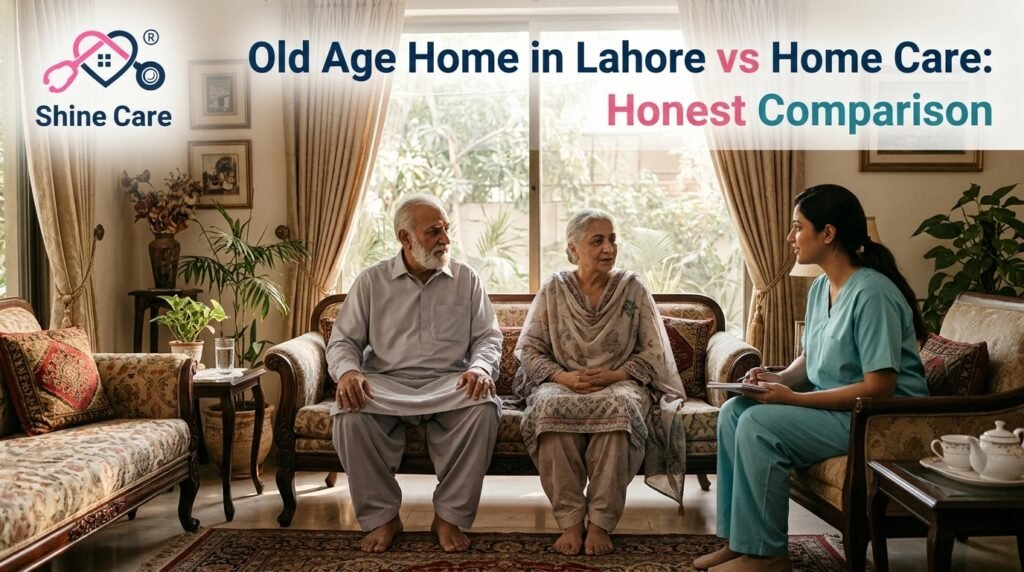
One of the hardest conversations in a Pakistani family starts with a sibling asking: “Should we put Ammi in an old age home?” The question itself feels wrong to say out loud. For most families the idea of sending a parent anywhere other than home is painful, often guilt-laden, and almost always a last resort. But as parents age, as medical conditions pile up, and as children’s lives spread across cities and countries, the question starts being asked anyway.
Lahore has a small number of old age homes and a growing home care sector. The two options are not interchangeable — they suit different situations, different budgets, and different family circumstances. This guide walks through an honest comparison, so families can decide based on facts rather than guilt or defensiveness. Nothing here replaces the treating doctor’s advice for a specific patient.
Looking for a Nursing Home in Lahore?
In Pakistan, “nursing home” can mean two things: a residential facility where an elderly or sick person moves in, or nursing care delivered in the patient’s own house. Residential options in Lahore are limited, and medical staffing varies a lot from one facility to the next. Many families therefore bring the nursing care home instead.
| Residential nursing home or old age home | Nursing care at home | |
|---|---|---|
| Where | A facility | The patient’s own home |
| Family time | Visiting hours | All day |
| One-to-one staff | Rarely | Yes |
| Medical care | Varies by facility | Matched to the patient, from caretaker to ICU nurse |
Questions to ask any nursing home or old age home in Lahore: Is a registered nurse on site 24 hours? Which hospital do they transfer to in an emergency? How many residents does one staff member cover at night?
The Honest Comparison in One Table
| Factor | Old Age Home | Home Care |
|---|---|---|
| Where the patient lives | Facility, with other residents | Their own home |
| Family visits | Scheduled or restricted visiting hours | Unlimited |
| Familiarity | New environment, strangers | Lifelong familiar surroundings |
| Clinical staff available | On-site, variable quality | Comes to the house as needed |
| Cost | Monthly facility fee | Depends on nursing level needed |
| Infection risk | Higher (shared facility) | Lower (own home, controlled visitors) |
| Social company | Other residents | Family, caregiver, visitors |
| Dignity perception | Culturally often felt as abandonment | Culturally respected |
| Flexibility | Facility rules apply | Household sets the routine |
| Suitable for complex medical cases | Mixed — depends on facility | Yes, with trained nursing |
For most Pakistani families, home care wins on nearly every measure that matters — cultural fit, patient dignity, infection safety, and family involvement. The main reason old age homes get considered is usually something else: the family cannot physically be present and does not know that structured home care is possible.
Old Age Homes in Lahore — The Reality
Lahore has a limited number of old age homes, run mostly by welfare organisations such as Edhi Foundation and some private facilities. The reality on the ground:
- Capacity is limited — waiting lists are common for the better-known facilities
- Quality varies significantly between facilities
- Staff ratios are often lower than families expect
- Medical capability is usually basic — not equipped for complex cases
- Monthly costs vary from heavily subsidised (welfare homes) to high (private facilities)
- Culturally, placing a parent in a home still carries stigma for most Pakistani families
- Visitor policies and daily routines are set by the facility, not the family
For patients with no family at all, or where the family simply cannot arrange care in any form, old age homes serve a real purpose. For most families with options, home care arrangements provide better outcomes.
Home Care — What It Actually Looks Like
Home care in Lahore has grown significantly in recent years. Options range from a trained caretaker visiting a few hours a day to full 24-hour trained nursing in the home. The common patterns:
- Visit-based nurse: Nurse comes 2–3 times a week for BP, sugar, medication review, wound care
- Part-time caretaker: Trained attendant for 6 to 12 hours a day — personal care, meals, company
- 12-hour nurse or caretaker: Day or night shift, with family covering the other side
- 24-hour single-staff caregiver: One caregiver living in, suitable for stable elderly patients
- 24-hour nursing (two nurses): Full clinical cover for complex cases
The right pattern depends on the patient’s medical needs, family availability, and budget. Shine Care offers home care arrangements across all these patterns — including trained attendants, registered nurses, ICU-trained nurses, physiotherapy, and doctor home visits — but we do not operate an old age home. Our focus is keeping elderly and recovering patients in their own homes with proper care around them.
When Home Care Clearly Wins
- Patient has a workable home environment (not a safety hazard)
- Family can afford at least part-time paid care
- The patient wants to stay at home
- Family can be present for emotional support, even if remotely
- Medical condition can be managed with home nursing
- Infection risk is a concern (immunocompromised, post-chemo, etc.)
For most of these cases — which covers the majority of elderly Pakistani patients — home care is the clearly better choice.
When an Old Age Home May Be Considered
- Patient has no family at all
- Family cannot arrange or afford even basic home care
- The home environment is dangerous (unsafe stairs, no electricity, poor sanitation)
- The patient is at risk from family members (financial exploitation, physical abuse)
- Advanced dementia with safety needs the family cannot meet
- Specific facility offers specialised care the family cannot replicate
Even in these cases, exploring whether home care can be arranged — perhaps with help from extended family, welfare support, or community resources — is usually worth the attempt first.
Cost Reality — Honest Comparison
Many families assume an old age home will be cheaper than home care. For stable elderly patients needing basic support, this is often not true.
Old Age Home Monthly Cost
- Facility fees (room, meals, basic care)
- Medical consultations as needed
- Any additional nursing or special requirements
- Occasional transport, miscellaneous
Home Care Monthly Cost (for a stable elderly patient)
- 12-hour daytime caretaker — significantly cheaper per month than most private old age homes
- Weekly nurse visit for clinical review
- Family contribution: food, utilities (which the parent would be using anyway at home)
- Occasional doctor visits, medications, equipment
For a case where the parent would be living in the family home anyway, the marginal cost of adding paid home care is often lower than the all-in monthly cost of a private old age home — and the patient stays in their own familiar environment.
The Cultural and Emotional Picture
Pakistani culture places a high value on caring for parents at home. Sending a parent to an old age home is still seen by many as a failure of family duty. This is not just about guilt — it affects:
- Extended family perception and relationships
- Social standing in the biradari
- Children’s own future expectations of how they will be cared for
- The patient’s dignity and sense of belonging
- Visits from grandchildren and the richness of family life
These factors matter. They are not reasons to avoid rational conversation about the right care arrangement — but they are reasons to seriously consider home care before considering a facility.
Common Family Situations and What Fits
Overseas Children, Parents in Lahore
Home care almost always fits better. Set up a 24-hour caregiver or 12-hour daytime arrangement with weekly nurse visits. One local family member or trusted friend as coordinator. Daily WhatsApp updates to the overseas family. The parents stay at home; the family remains central to decisions.
Working Children in Lahore, Parent Alone During Day
Daytime caretaker 8 am to 6 pm. Children present evenings and weekends. Weekly nurse visit for clinical review.
Elderly Couple, One Needs Significant Help
12-hour daytime caregiver supporting the more dependent spouse. Nurse visits for medication and vital checks. The healthier spouse stays supported rather than exhausted.
Advanced Dementia Patient
24-hour cover becomes necessary — usually 12-hour caregiver + 12-hour family or second caregiver. Home environment adapted for safety.
Post-Discharge Patient Needing Nursing
12-hour or 24-hour registered nurse at home for the first weeks, stepping down as recovery progresses.
Patient With No Family Available
If a trusted neighbour, friend, or welfare organisation can coordinate, home care may still work. If not, this is one case where an old age home becomes the realistic option.
What Home Care Covers That an Old Age Home Often Does Not
- Specific one-to-one attention from the assigned caregiver
- Meals cooked to the patient’s taste in their own kitchen
- Prayer and religious practice at familiar times
- Family routine — grandchildren visiting, familiar visitors
- Own bed, own belongings, own memories around
- Flexibility to adjust routine as needed
- Doctor visits coordinated to the patient’s own treating team
- Equipment rental scaled to actual need
These are not small things. Together they often make the difference between an elderly patient fading or thriving.
Setting Up Home Care Instead of an Old Age Home
If the family is weighing an old age home because home care feels overwhelming to arrange, the sensible first step is a conversation with a reputable home care provider. A good elderly care at home provider will:
- Visit the home to assess the patient
- Recommend the right level of care — not the maximum package
- Explain monthly costs transparently
- Set up a trained caregiver or nurse matched to the case
- Provide reliever cover for weekly off and leave
- Give the family a clear escalation plan for problems
- Review the arrangement as the patient’s condition changes
Home care is a managed service, not just a staffing arrangement. Done properly, it provides most of what families imagine an old age home offers — and does so in the parent’s own home.
Combining Services for a Complete Home Arrangement
For long-term care at home, families often combine:
- A trained caregiver or 12-hour caretaker for daily support
- A visiting home nurse near me for clinical tasks
- Scheduled doctor home visits for patients who cannot travel
- Physiotherapy for mobility and chest care
- Equipment rental as the condition requires
- Weekly family meetings or video calls to review
The pieces fit together naturally once the family coordinator sets the structure. Good health at home providers handle this coordination so the family does not have to — ongoing hypertension care and diabetes care for chronic cases included in the plan.
What to Confirm Before Choosing Home Care
- Caregiver’s qualification and experience with your type of case
- Background verification
- Scope of work in writing
- Monthly package with all inclusions
- Reliever cover for weekly off and sudden leave
- Replacement policy if the match is not working
- Supervision and escalation route
- Communication pattern with the family
These same questions apply whether you are evaluating home care or comparing it to a facility.
Red Flags Either Way
Whichever option the family considers, watch for:
- Vague answers about staffing qualifications
- Pressure to decide quickly without visiting or meeting staff
- No written contract or scope
- Reluctance to let the family visit frequently
- Hidden fees or extras not disclosed upfront
- No clear plan for what happens if the patient’s condition changes
Facilities or providers with these signs are the ones families end up moving away from a few months in.
Frequently Asked Questions
Yes. Pakistani culture places a strong expectation on children to care for parents at home. For most families, old age homes carry negative connotations. This is one of the main reasons home care has grown so quickly as the preferred option.
No. Shine Care provides home care — nursing, caregivers, elderly care, physiotherapy, and doctor visits delivered in the patient’s own home. Our focus is keeping elderly patients at home with proper support, not operating a residential facility.
For most patients, yes — and usually better. One-to-one attention from a trained caregiver, clinical nursing as needed, familiar home environment, and family involvement combine into care that is typically richer than a shared facility can offer.
Scale the arrangement. Many families start with a 12-hour daytime caregiver plus weekly nurse visits, which is often significantly cheaper than private old age home fees. Add more hours only as the patient’s condition requires.
Home care with a 24-hour single-staff caregiver can work very well in this situation. A trusted local friend or extended family member as coordinator makes it sustainable. Overseas family stays involved through regular updates.
Yes, with the right arrangement — usually 24-hour cover (12-hour caregiver plus family or second caregiver), a home environment adapted for safety, and a specific plan for medications and behavioural challenges. Many families find this better than a facility that may not have specialist dementia staff.
The Simple Version
For most Pakistani families, home care is the right choice — culturally, medically, financially, and emotionally. Old age homes serve a narrow set of situations where no family or home option is realistically available. Before considering a facility, talk to a reputable home care provider and get an honest proposal. Match the arrangement to the patient’s needs. Keep the parent at home where they belong, with proper professional support around them.