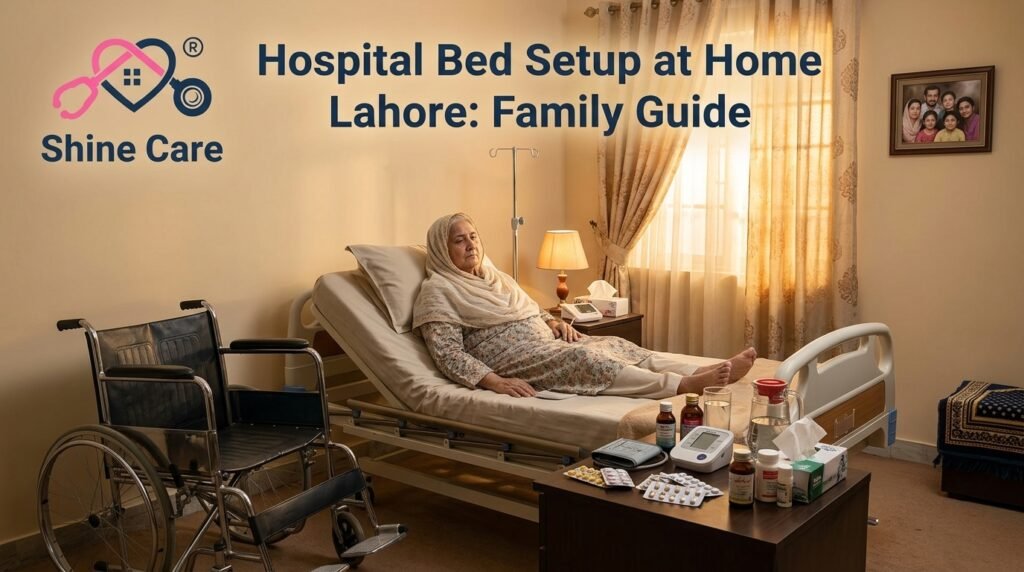
The doctor said the elderly father would be bedridden for months, maybe longer. The family, still processing, went home and looked at the flat. The obvious room would be the master bedroom — but it is on the first floor and the father cannot climb stairs. The drawing room is on the ground floor but has no attached bathroom. The small guest room downstairs has a bathroom but is barely large enough for an ordinary bed, let alone a hospital bed plus a wheelchair plus space for a nurse to work. Somewhere between “he is coming home tomorrow” and figuring out where his bed will actually go is a set of decisions the family had never expected to make.
This guide walks families in Lahore through hospital bed setup at home Lahore realities — how to choose the right room, arrange it safely, plan for equipment access, and prepare for the daily reality of caring for a bedridden patient. Nothing here replaces the physiotherapist’s or nurse’s specific advice for your patient; this is the practical layer that decides how the daily care actually works.
Why Room Setup Matters More Than Families Expect
A poorly set up room means every daily task is harder than it needs to be:
- Transfers become risky when there is not enough space
- Caregivers’ backs suffer from awkward angles
- Bedsores develop when repositioning is difficult
- Bathroom trips fail because the wheelchair does not fit
- Load-shedding leaves the patient without essential equipment because there is no UPS space
- Chest infections develop because ventilation is poor
- Family exhaustion accelerates because nothing is efficient
Getting the room right once, at the start, saves months of daily friction later.
Who Does What at Home
- Doctor / Physician: Confirms the level of care needed at home, prescribes any specific equipment, and identifies medical considerations that affect setup (need for oxygen, positioning restrictions).
- Physiotherapist: Advises on transfer needs, positioning, and mobility considerations. Often the best source of practical setup input.
- Occupational Therapist: Where available, does a home walkthrough identifying specific hazards.
- Registered Nurse: Advises on daily care needs, alerts the family to what will actually happen in the room, sets up medication storage. A structured home nurse arrangement usually starts with a room walkthrough before any equipment is delivered.
- Caretaker / Attendant: Will spend the most hours in the room. Consider their comfort and workflow too.
- Equipment Supplier: Delivers, installs, and demonstrates equipment. Not clinical — do not accept a supplier telling you which room is best.
- Family: Runs the setup, coordinates the team, and adapts household life around the new arrangement.
For families planning long-term care in the home for an elderly parent, structured care for elderly arrangements from a coordinated provider usually include room assessment as part of the setup phase.
Choosing the Right Room
Ground Floor Access
The single most important criterion. A bedridden patient does not use stairs, and neither does most of the equipment that supports them. If the family is currently living upstairs, the ground floor room needs to become the patient’s room. Rearranging the household is easier than negotiating stairs daily.
Attached or Nearby Bathroom
Wheelchair or commode chair transfers to the bathroom happen multiple times a day. A bathroom on a different floor or across the house does not work. Nearby is essential.
Size
Minimum practical dimensions:
- Room should accommodate the bed plus at least 90 cm clear on at least one side (preferably both) for transfers and care
- Space for a wheelchair to enter and turn
- Space for a bedside table and equipment
- Space for at least one seat for a caregiver or family member
- Roughly 3 m by 3.5 m as a rough minimum for basic setup
Doorway Width
Most hospital beds and wheelchairs need doorways of at least 75–80 cm. Standard Pakistani doors usually meet this, but measure to confirm — especially any narrow interior doors on the route.
Ventilation
Windows that open. Fresh air matters for patient comfort, prevents smells building up, and reduces infection risk. Rooms without ventilation are not suitable for long-term bedridden care.
Natural Light
Daylight for the patient matters — for mood, for circadian rhythm, for vitamin D. Windows that let in daylight without direct summer sun heating the room.
Power Supply
Multiple wall sockets. Not one overloaded outlet. Adequate capacity for medical equipment plus AC or fan plus lights.
Family Proximity
Close enough to the household life that the patient does not feel isolated. Far enough that noise from the household does not disturb rest. A ground floor room with a door to the drawing room works well for many families.
Emergency Access
Ambulance would need to reach this room in an emergency. Consider the route from the front door.
The Essential Equipment List
Hospital Bed
The centrepiece. Types:
- Manual hospital bed: Adjustments via hand cranks. Cheaper, no electricity needed, but slow to adjust. Suitable for shorter-term needs or budget-limited setups.
- Semi-electric: Head and foot electric, height manual. Middle ground.
- Fully electric: All adjustments via a hand pendant. Transformative for long-term care — protects caregivers’ backs, allows patient independence where possible, easier positioning changes throughout the day.
- Bariatric: Reinforced for heavier patients (usually needed above 135 kg).
For long-term bedridden patients, fully electric usually pays off within weeks in reduced caregiver strain and better positioning consistency.
Pressure-Relief Mattress
Non-negotiable for genuinely bedridden patients. Options:
- High-density foam — for patients who can still shift some weight
- Alternating-pressure air mattress — for patients who cannot shift; dramatically reduces pressure sore risk
- Low air loss mattress — for patients at very high pressure sore risk
The basic mattress that arrives with the bed is usually not adequate for long-term bedridden use. Upgrade at setup, not after the first bedsore appears.
Side Rails
Full-length or half-length. Prevent falls out of bed. Half-length allows easier patient movement in and out; full-length gives more protection for confused patients. Both have safety considerations — confused patients can become trapped in badly designed rails.
Bedside Commode Chair
For patients who cannot walk to the bathroom easily but can transfer to a chair. Preserves dignity compared to bedpans and reduces bathroom-trip complications.
Wheelchair
Even for mostly-bedridden patients, a wheelchair for transfers to the doctor, to the drawing room, or to the garden makes a big difference to quality of life.
Overbed Table
Adjustable table that fits over the bed. Transforms mealtimes and any activity the patient does sitting up. Cheap and high impact.
IV Stand
For patients receiving IV medications or feeds. Even for those not currently on IV, having one available for occasional needs is useful.
Suction Machine
For patients with weak cough, tracheostomy, or persistent secretions. Kept within arm’s reach of the bed.
Oxygen Concentrator
If supplemental oxygen is prescribed.
Patient Monitor
For patients requiring continuous vital signs monitoring — usually higher-level care needs.
Pulse Oximeter
For spot checks. Cheap and useful for any patient.
Backup Power
UPS for essential equipment. Generator or solar backup for extended outages. Not optional for patients on continuous equipment.
Arranging the Room
Bed Placement
- Not against a wall on both sides — access from at least one side (ideally two) needed for care
- Head of bed near a wall socket for equipment
- Patient facing the door — so they can see who is coming in
- Away from direct sun
- Away from cold drafts
Bedside Table
Within arm’s reach for water, medications, glasses, phone, tissues, call bell. On the side opposite where transfers happen.
Equipment Trolley or Shelves
Suction machine, tubing, sterile supplies, dressings, gloves — organised on a nearby shelf or trolley rather than trips to another room every time.
Wheelchair Position
Where the transfer will happen. Not across the room.
Commode Chair
Near the bed but not in the way of routine care.
Caregiver Seat
A comfortable chair for whoever is spending long hours in the room. Prevents caregiver back pain and fatigue.
Storage
Cabinets or cupboards for supplies, medications (locked if any risk), clean linen, clothing. Organised, not piled.
Bin
Separate bins if needed — general waste, medical waste. Sharps container for injections.
Waste Route
Clear path from the room to the toilet or waste disposal area for emptying commodes and disposing of soiled items without carrying them through common areas.
Power Setup
Multiple Sockets
Hospital bed motor, patient monitor, oxygen concentrator, suction machine, nebuliser, feeding pump if used — each with its own socket. Multi-outlet strips are workable but for critical equipment prefer separate wall sockets.
Voltage Stabiliser
Pakistani voltage fluctuates. Stabilisers protect medical equipment from surges and drops.
UPS
For patients on continuous oxygen or other essential equipment, UPS backup is essential. Sizing depends on equipment load and expected outage duration.
Generator or Solar Backup
For long outages. Autostart generator kicks in automatically. Manual-start needs someone available to start it — not always practical at night.
Fire Safety
Wiring adequately rated for equipment loads. No overloaded circuits. No smoking anywhere with oxygen equipment.
Lighting
Overhead
Bright enough for care activities during the day.
Task Lighting
Focused lighting for medication preparation, dressing changes, and other detailed tasks.
Bedside Lamp
Patient can operate — for reading, adjusting light without calling for help.
Night Light
Enough to see during night care without being disruptive to sleep. Motion-activated lights work well.
Dimmable Options
Where possible, adjustable brightness for different activities.
Temperature and Air Quality
Cooling
Air conditioning or evaporative cooler for summer. Bedridden patients cannot easily move to cooler spots, so ambient temperature matters more than for the mobile.
Heating
Warm room in winter. Elderly and bedridden patients feel cold more easily. Electric heaters kept safely away from oxygen equipment.
Ventilation
Windows opened regularly for fresh air. Exhaust fans in attached bathrooms.
Air Filtration
During smog season in Lahore, an air purifier in the room helps significantly for patients with respiratory conditions.
Humidity
Very dry air (winter, air-conditioned rooms) can worsen respiratory symptoms. Humidifiers help. Very humid air breeds mould — dehumidify if needed.
Hygiene and Infection Control
Handwashing
Sink within easy access, or hand sanitiser stations at the doorway.
Cleaning Routine
Daily surface cleaning. Weekly deeper cleaning. Immediate cleaning of any spills or waste.
Waste Disposal
Prompt removal of soiled items. Separate handling for medical waste where needed.
Linen Changes
Regular changes even for stable patients. Immediate change if soiled.
Visitor Hygiene
Handwashing before touching the patient. Visitors with cough or cold should not visit.
Making the Room Feel Like the Patient’s Own
A bedridden patient spends most of their life in this room. Small choices matter for dignity and mood:
- Family photographs visible from the bed
- Familiar objects — a favourite blanket, familiar books, prayer beads
- Sound — radio for cricket, TV for favourite programmes, Quran recitation for prayer times
- A view — bed positioned so the patient can see out the window or watch household life through an open door
- Personal items where the patient can reach them
- Freshness — flowers, plants, or simply fresh air rotation
- Privacy — curtain or screen for personal care moments
Rooms that feel institutional erode mood. Rooms that feel personal support recovery and dignity.
Managing Coexisting Conditions
Most bedridden patients have multiple conditions to manage. The room setup should support ongoing care:
- Storage and organisation for daily medications
- Space for regular hypertension care monitoring (BP cuff, log)
- Adequate light for diabetes care — blood glucose checks and insulin preparation
- Table for scheduled visiting doctor reviews and examinations
- Chart or notebook for daily observations that the nurse and family both use
Specific Situations
Post-Stroke Bedridden Patient
Setup should support rehabilitation — space for physiotherapy exercises, mirror for speech and swallowing therapy where indicated, wheelchair access for gradual mobilisation.
Post-ICU Recovery
May need continuous monitoring initially. Structured room setup handles the transition from full ICU-level equipment to gradually reducing needs.
End-of-Life Palliative Patient
Comfort priority. Familiar surroundings, quiet, family access. Structured health at home arrangements for palliative patients often focus on room setup that supports peaceful care.
Advanced Dementia Bedridden Patient
Familiar objects, consistent caregivers, simple uncluttered room. Reduces confusion.
Long-Term Ventilator-Dependent Patient
Full home ICU setup — bed, ventilator, monitor, backup ventilator, oxygen, suction, power redundancy. Requires substantial space.
Post-Surgical Recovery
Temporary setup — hospital bed for a few weeks, wound care supplies, gradual mobilisation planning.
Common Mistakes Families Make
Choosing a Room That Is Too Small
The bed fits but nothing else. Caregivers cannot work efficiently. Wheelchair transfers become dangerous. Choose bigger where possible.
Keeping the Patient Upstairs
Sentimental reasons — “this has always been his room”. Practical reality — stairs make everything harder, ambulance access is difficult, and family serving the room several times a day exhausts quickly.
Skipping Pressure-Relief Mattress
The basic mattress that came with the bed is not adequate for genuinely bedridden patients. Upgrading after bedsores develop is much more expensive than upgrading at setup.
Pushing the Bed Against Two Walls
Access from only one side means the caretaker cannot rotate the patient, cannot provide care on the far side, and cannot manage transfers safely.
Inadequate Power Planning
One socket for multiple pieces of equipment. Extension cords running across walkways. No UPS for critical equipment. Any one of these is a real hazard.
Not Planning for the Caregiver
The caretaker spends 12 hours in this room. A hard chair, poor lighting, no seat for tea breaks — leads to burnout.
Sourcing Equipment Piecemeal
Bed from one supplier, mattress from another, wheelchair from a third — nothing quite matches, delivery days spread out, no coordination. Coordinated setup from a single provider usually works out better in every way.
Making the Room Purely Clinical
All medical equipment and no personal touch. Erodes patient mood over months. Balance function with dignity.
Red Flags: When to Adjust the Setup
Reassess the room setup and contact the doctor or nurse for advice if any of the following:
- Repeated near-falls or falls during transfers
- Caregiver back pain or injuries from bed height, positioning, or lack of space
- New pressure sores despite regular repositioning
- Equipment repeatedly failing due to power issues
- Patient’s condition changing — needs more equipment or a different level of care
- Chest infections or complications suggesting inadequate positioning or ventilation
- Patient becoming isolated or depressed in the current setup
Contact the doctor or take to the emergency room / call 1122 for any of the following medical issues that surface in a home setting:
- Falls with injury
- Equipment failure leaving the patient without essential oxygen or ventilation
- Sudden severe deterioration
- Signs of sepsis, pneumonia, or serious infection
For patient-friendly background on preventing bedsores and safe bed positioning, the NHS guide to pressure sores is a reliable reference. For your patient’s specific setup, always follow the treating team’s advice.
FAQs
Roughly 3 m by 3.5 m as a working minimum. Larger if wheelchair transfers happen in the room, or if ventilator and multiple equipment items are needed. Attached bathroom access is a strong preference.
For long-term bedridden patients, yes — it protects caregivers’ backs and allows more frequent position changes. For shorter-term recoveries a manual or semi-electric bed may be adequate.
Possible but adds daily difficulty — climbing stairs multiple times a day for care, equipment access, ambulance access. Where practical, rearranging so a ground-floor room becomes available is usually the sensible option.
Air purifier in the room during high AQI periods. Windows closed at peak smog times. Nebuliser and inhalers as prescribed by the doctor. Structured monitoring of oxygen saturation.
Not for every patient. A hospital bed can be used with family and trained attendant care. The need for a nurse depends on the patient’s medical complexity, medications, and clinical requirements.
Rooms and setups adapt over time. Adding a UPS as equipment needs grow, upgrading the mattress as skin issues develop, adding a hospital-grade bed if a basic one becomes limiting — all normal. Reassess every few months.