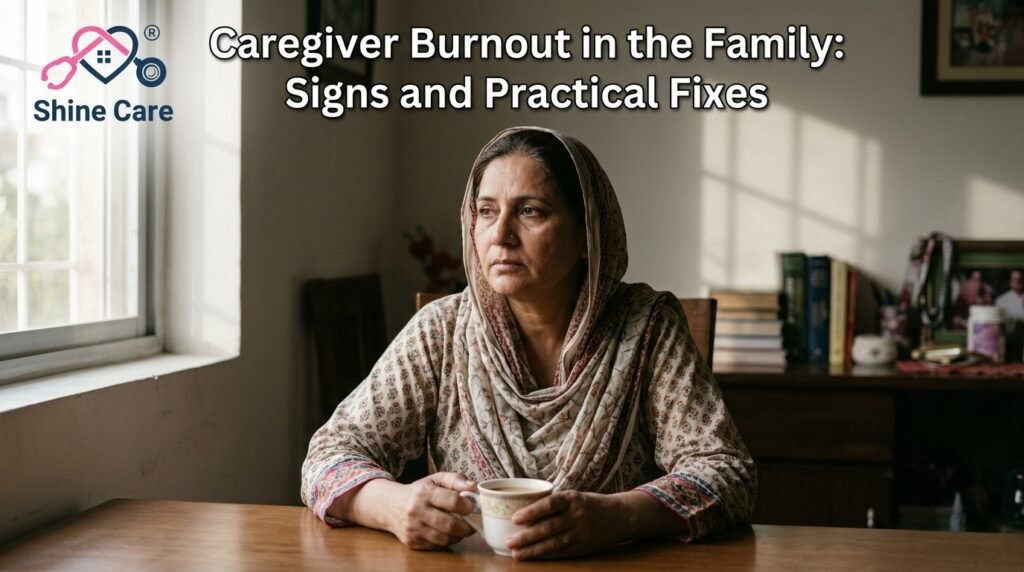
Six months in, the daughter who moved back home to look after her father cannot sleep. The son who quit his evening job to sit with his mother snaps at the driver over nothing. The wife who has bathed her stroke-affected husband every morning since March cries alone in the kitchen. Nobody has said the word “burnout” out loud yet, but it is already in the room.
Family caregiver burnout is not weakness. It is what happens to normal people who do abnormal work — physical, emotional, and financial — for months without a break. This guide covers what burnout actually looks like inside a Pakistani household, what to do about it before it turns into a bigger problem, and where a home nurse, attendant, or short break can save the family. Nothing here replaces a doctor’s or counsellor’s advice — if you are already at the point of not coping, please speak to one.
What Caregiver Burnout Really Is
Burnout is a state of physical, emotional, and mental exhaustion caused by prolonged caregiving stress. It does not arrive in one bad afternoon. It builds over weeks and months of interrupted sleep, cancelled plans, financial pressure, and the quiet loss of one’s own life to someone else’s illness.
In Pakistani homes it often goes unnamed because caring for parents and family is expected. The daughter who is exhausted feels guilty for feeling exhausted. The son who is tired says nothing because “yeh to farz hai.” The problem is that a burnt-out caregiver is a worse caregiver — mistakes with medications, short temper with the patient, missed warning signs of deterioration.
The Signs You Should Not Ignore
Physical Signs
- Constant tiredness that sleep does not fix
- Frequent headaches, back pain, or stomach problems
- Weight loss or weight gain within a few months
- Getting sick more often — colds, flu, infections that linger
- New or worsening blood pressure or blood sugar problems in the caregiver
Emotional Signs
- Feeling numb, empty, or disconnected
- Crying easily or feeling on the edge of tears often
- Snapping at the patient, other family, or staff over small things
- Feeling resentful of the patient, then guilty for feeling resentful
- Losing interest in things that used to matter — friends, food, TV shows, prayer routine
Behavioural Signs
- Skipping meals or overeating
- Drinking more chai, coffee, or in some cases starting or increasing smoking
- Not seeing friends for weeks or months
- Not attending own doctor appointments
- Not sleeping in own bed anymore — always with the patient
- Not being able to make simple decisions
Three or four of these signs together, lasting more than two weeks, is burnout. It needs a change in the caregiving pattern — not a stern lecture to “stay strong.”
Why Families Do Not Notice Until It Is Bad
A few reasons this creeps up unnoticed in Pakistani households:
- Cultural expectation: Caring for parents is seen as duty, not work. Asking for help feels like admitting failure.
- Uneven distribution: One family member — often a daughter, daughter-in-law, or unmarried son — ends up with 90% of the load while others say “let us know if you need anything” and never call again.
- Slow build: Nobody notices day-to-day changes. When a cousin visits after three months and says “you look terrible,” the caregiver has been like that for six weeks.
- Nobody talks about it: The topic feels shameful. Support groups are rare. Even doctors rarely ask the caregiver how they are doing.
The Five Practical Fixes That Actually Work
1. Share the Load Fairly Among Family
One person cannot do this for months. Sit the whole family down — even the ones who live abroad — and split the tasks into rotas. Overnight duty this week, medications next week, doctor visits fortnightly. The person doing more should not have to ask twice.
If overseas family cannot physically help, they should be paying for the paid help that fills the gap. Sending prayers and long WhatsApp voice notes does not clean a bedsore.
2. Bring in Trained Help — Even Part Time
Twelve hours of a trained attendant during the day, or a nurse for wound and medication rounds, buys the family caregiver time to sleep, shower, and think. This is not weakness — it is basic nursing care. A properly hired home nurse near me handles the clinical tasks and lets the family return to the emotional role only they can play.
For elderly patients, structured elderly care at home with a paid attendant is often the piece that saves the family’s mental health.
3. Protect Sleep at All Costs
The single biggest driver of burnout is broken sleep, night after night. Fix this first, before anything else. Options:
- Hire an overnight attendant even three nights a week
- Rotate the night with a sibling so each of you gets four uninterrupted nights
- Move the patient to a bed with side rails so night checks are less frequent
- Use a baby monitor or intercom to sleep in the next room instead of on a mattress on the floor
Seven hours of connected sleep for the caregiver is not a luxury. It is the foundation of everything else working.
4. Keep Your Own Health Appointments
Caregivers routinely cancel their own doctor visits, dental cleanings, and eye tests because there is no time. Then the caregiver’s blood pressure spikes, back gives out, or they collapse and the patient is worse off than before. Book your own appointments and keep them. Get another family member or the paid attendant to sit with the patient during that hour.
5. Get Two Hours Out of the House, Weekly
Not two hours to run errands for the patient. Two hours for yourself — a walk in a park, tea with a friend, sitting alone with a book, going to prayer at the mosque or dargah. The patient survives without you for two hours. Skipping this “just this week” every week for two months is how burnout deepens.
What to Say to Family Members Who Are Not Helping
The hardest conversation. Some suggestions that work better than most:
- “I need you to take one specific task from Monday. Which one will you take?”
- “I have not slept a full night in five weeks. From next week, you are doing Wednesdays.”
- “We can afford a night nurse if you and I each contribute this amount monthly. Please confirm.”
- “Ammi’s care is not one person’s job. Here is the list — write your name against three items.”
Vague requests (“come help sometime”) get vague answers. Specific asks get action.
How to Talk to Your Employer
Many caregivers are trying to do this alongside a full-time job. If you can, have one honest conversation with your employer:
- Ask about flexible hours or work-from-home for the next two to three months
- Explain what you can and cannot commit to
- Line up a paid attendant to cover the hours you are at work — do not try to be present at both places
- Take a few days of leave when the patient’s condition changes, then return with a new plan
Trying to hide the situation from work usually ends with worse job performance and no support. Employers respect a clear conversation more than mysteriously missed deadlines. For patients recovering from surgery, tightly scheduled post-surgery care at home lets you predict which days you must be at the bedside.
Emotional Load: What Is Normal and What Is Not
Normal caregiver emotions include grief, frustration, guilt, and even brief anger toward the patient. These come and go. What is not normal:
- Thoughts of harming yourself or the patient
- Sustained feeling that life is not worth living
- Constant panic attacks
- Not being able to function — cannot get out of bed, cannot cook, cannot make basic decisions
Any of these means the caregiver needs professional support now — a psychiatrist, a psychologist, or at minimum the family doctor. Support in Pakistan is limited but growing. Umang, Rozan, and hospital psychiatry departments (Aga Khan, Shifa, Pakistan Kidney and Liver Institute counselling teams, private psychologists) all take calls.
If someone in the family is at immediate risk, call 1122 or take them to the nearest hospital emergency room.
Money as a Cause of Burnout
Financial pressure quietly worsens every other stress. Some steps that help:
- List the actual monthly cost of care — nurse, equipment, medications, diapers, food — so the whole family sees it in one place
- Split contributions among earning family members based on capacity, in writing
- Check if the patient qualifies for any welfare or NGO support (Bait-ul-Maal, Sundas, Shaukat Khanum for cancer patients, Al-Shifa for eye patients)
- Choose which care is essential (medicines, nurse visits, wound supplies) and which is deferrable
- Ask home care agencies for a clear monthly package price rather than daily rates that add up unpredictably
Money conversations feel awkward but are much less painful than a caregiver quietly going into debt to keep the household running.
Small Daily Habits That Reduce Burnout
- Eat one proper meal a day sitting at the table — not standing over the patient’s tray
- Step outside for five minutes of sunlight, morning or evening
- Turn off the phone for one hour a day
- Say one honest sentence to a trusted person daily — even by voice note
- Write down three things you got right today, even small ones
- Stretch for five minutes before bed
None of this fixes the situation. All of it makes the situation more survivable.
Who Does What: Freeing the Family Caregiver’s Time
- Doctor: Reviews the patient, adjusts medications, decides on new interventions.
- Registered nurse: Wound care, injections, tube feeds, oxygen management, vitals monitoring.
- Caretaker or patient attendant: Bathing, feeding, turning, cleaning, keeping the room orderly.
- Physiotherapist: Regular exercises, movement, preventing joint stiffness.
- Family: Emotional presence, big decisions, coordinating everyone above. Not doing all the physical work themselves.
Every task the family caregiver still does that a trained person could do is one more brick on the burnout pile. Reserve the family’s energy for the parts only family can give — company, familiarity, decisions about care.
When the Patient Is Also Difficult to Care For
Sometimes the patient adds to the load — refuses medicines, shouts, insists only one particular family member help them, rejects paid help repeatedly. This is common in dementia, depression, and end-stage illness. It is exhausting and it is not personal.
A few things that help:
- Give the paid nurse or attendant a two-week trial with the patient — most rejection eases once the routine is set
- Use short, calm sentences with a difficult patient — arguments waste energy on both sides
- Rotate who is present when possible so no single person becomes the target
- Speak to the doctor if the behaviour is new — pain, infection, or medication side effects often cause sudden changes in temper. Where the family cannot easily bring the patient to a clinic, arrange doctor home visits or a check on hypertension care at home
When to Consider a Respite Break
A respite break is a short period — a weekend, a week — when the family caregiver stops caregiving completely. Someone else takes over full-time. This is not abandonment; it is maintenance.
Options for respite in Pakistan:
- A trained 24-hour nurse or attendant covering the whole shift for a week
- Another family member moving in for a week specifically
- Very rarely, admission to a private nursing facility for short-stay (still uncommon in Pakistan but growing)
Take one respite break every two to three months if the caregiving is expected to be long-term. Coming back rested actually improves the care.
Red Flags: When to Get Help Immediately
- Thoughts of self-harm or of harming the patient
- Sudden severe chest pain, breathlessness, or fainting in the caregiver
- Not eating or drinking for more than a day due to distress
- Uncontrollable crying or panic that will not settle after a few hours
- New severe hopelessness — feeling that nothing will ever get better
- Making mistakes with the patient’s medications repeatedly
Any of these calls for immediate help — call a trusted family member to come over, contact a doctor or counsellor, or go to a hospital emergency room. This is not overreacting.
Frequently Asked Questions
No. It is essential maintenance for both of you. A rested caregiver gives better care. A caregiver who collapses stops giving care at all. Wanting a break is a sign of clarity, not selfishness.
Enough that you get seven hours of continuous sleep and two hours a week to yourself. That might be a night attendant three nights a week, or a daytime helper for six hours daily, or a mix. Start smaller and scale up if needed.
Introduce the nurse gradually — visits first, then longer shifts. Have the family caregiver present during early visits so the patient sees continuity. Most refusals soften within one to two weeks once the routine feels normal.
Put the monthly cost in writing, then propose a specific split based on income. A family WhatsApp group is fine for the first conversation — a proper family meeting locks in the commitment.
If you can afford it and access it, yes. Even one session every few weeks with a good psychologist gives you a place to unload that is not family. If a therapist is out of reach, a trusted friend, imam, or family doctor who will listen can help.
No. What families regret is not the paid help they hired; it is the years of their own health, work, and relationships they lost trying to do it alone. Sharing the work does not reduce your love or your role — it protects them.
Burnout is real and preventable. Protect your sleep. Bring in paid help early, even part-time. Split the load with family in writing. Keep your own health appointments. Take two hours a week for yourself. Get proper support if you are already struggling. The patient needs you well — not just present. Good health at home depends as much on a healthy family caregiver as on the nurse or medications.