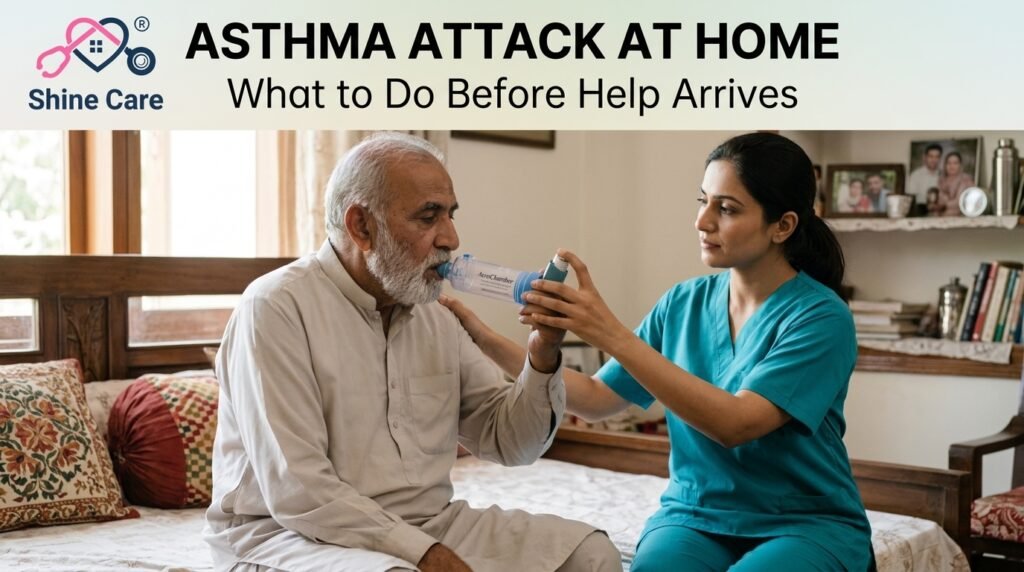
Your father’s wheeze gets worse. He is sitting bolt upright, struggling to get a full sentence out, grabbing for his inhaler every few minutes. Your mother is calm but worried, your sister is on the phone to the doctor, and nobody in the house has ever managed a severe asthma attack before. The next 15 to 30 minutes decide whether this ends at home or in a Lahore hospital emergency room.
Asthma attacks are one of the most common respiratory emergencies in Pakistani homes — made worse by Lahore’s smog season and spring pollen. The medications and techniques to control an attack are well established, but most families have never been taught them properly. This guide walks through what to do when an asthma attack starts at home, how to recognise a severe one, and when to stop managing at home and get to hospital. Nothing here replaces the treating doctor’s advice — follow their specific asthma action plan first.
Recognise an Asthma Attack Early
- Wheezing — a whistling sound on breathing out
- Shortness of breath, especially on exertion or lying flat
- Chest tightness or pressure
- Cough, often worse at night
- Difficulty speaking in full sentences
- Rescue inhaler needed more often than usual
- Peak flow reading dropping below the patient’s normal
Mild attacks respond quickly to rescue inhaler. Moderate attacks need stronger action. Severe attacks need hospital. Knowing the difference is what keeps families from either panicking too early or acting too late.
Severity at a Glance
| Severity | What You See | Action |
|---|---|---|
| Mild | Wheeze with activity, speaking normally, oxygen 95%+ | Rescue inhaler, continue monitoring |
| Moderate | Wheeze at rest, short sentences, oxygen 92–94%, peak flow 50–80% of best | Rescue inhaler every 20 min, call doctor |
| Severe | Breathless, cannot complete sentences, oxygen below 92%, peak flow below 50% | Rescue inhaler + call 1122 — go to ER |
| Life-threatening | Silent chest, exhaustion, blue lips, drowsy, unable to speak | 1122 immediately — do not wait |
What To Do Right Away — Step by Step
- Help the patient sit upright — not lying down. Leaning slightly forward with hands on knees often helps
- Loosen tight clothing around the chest and neck
- Give the rescue inhaler (salbutamol / Ventolin) — 4 puffs through a spacer if available, one puff at a time with a breath between each
- Wait 4 minutes. If no improvement, give 4 more puffs
- Call the doctor or 1122 if the attack is severe or not improving after 10 minutes
- Continue rescue inhaler every 20 minutes while waiting for help
- Stay calm — panic worsens breathing
- Do not leave the patient alone
A spacer (plastic chamber the inhaler plugs into) delivers the medication to the lungs more effectively than the inhaler alone. Every asthma patient should have one.
Rescue Inhaler Technique — The Right Way
Many patients get the medicine wrong because the technique is wrong. The right way:
- Shake the inhaler well
- Attach to a spacer if available
- Breathe out gently away from the inhaler
- Place lips around the mouthpiece (or mask)
- Press the inhaler once
- Breathe in slowly and deeply through the mouth
- Hold the breath for 5 to 10 seconds if possible
- Breathe out slowly
- Wait 30 seconds before the next puff
Elderly patients often struggle with inhaler timing — a spacer makes this much easier. Children should always use a mask with the spacer.
When to Call 1122 or Rush to Hospital
- Rescue inhaler not working after 10 to 15 minutes
- Breathlessness getting worse rather than better
- Patient cannot speak in full sentences
- Oxygen saturation below 92%
- Lips or fingertips turning blue
- Patient becoming drowsy, confused, or exhausted
- Silent chest (wheeze that disappears can mean airways are closing)
- Chest pain developing
- Severe attack with no inhaler available
Do not drive the patient yourself if the attack is severe — call 1122. Oxygen in the ambulance improves outcomes significantly.
Preparing the House for Asthma
- Rescue inhaler always within reach — not in a drawer the patient has to search
- Spacer in the room
- Written asthma action plan on the wall
- Peak flow meter and daily log
- Pulse oximeter
- Nebuliser with prescribed medications (salbutamol, budesonide, ipratropium as advised)
- Emergency numbers — treating doctor, 1122, nearest hospital ER
- Air purifier for Lahore smog season
- Mask for outdoor exposure during pollen or smog peaks
Preparation turns a terrifying situation into a manageable one.
After the Attack Settles
- Continue monitoring for a few hours — attacks can rebound
- Note peak flow and oxygen every hour
- Call the treating doctor the same day — the regime may need adjustment
- Review what triggered this attack and plan around it
- Do not reduce controller medications on your own
An attack that needed rescue inhaler more than once in a few hours means the control is not good enough. Changes are needed.
Common Triggers in Lahore Homes
- Smog (November–February)
- Spring pollen
- Dust mites in old mattresses, carpets, soft toys
- Cold air
- Smoke — including incense, cooking smoke, cigarette smoke
- Pet dander
- Viral infections (common cold, flu)
- Specific food allergens for some patients
- Exercise in polluted air
- Strong perfumes and chemical cleaners
Identifying and reducing the main triggers in your home prevents many attacks.
Managing Severe Asthma Between Attacks
Patients who have frequent severe attacks benefit from:
- Daily controller inhaler (steroid or combination), taken every day without fail
- Written asthma action plan from the pulmonologist — “if this happens, do this”
- Peak flow tracking
- Flu vaccination each winter
- Avoiding known triggers
- Air purifier at home
- Weight management if overweight
- Treatment of allergic rhinitis if present
A good home health care plan for an asthma patient includes regular doctor review and nurse monitoring during flare seasons.
Children With Asthma
Children can go downhill fast. For a child with an asthma attack:
- Keep calm — children mirror the parent’s anxiety
- Sit the child upright, often on a parent’s lap
- Use a mask with the spacer
- 4 puffs, wait 4 minutes, repeat
- Call 1122 or go to the ER if not improving within 10 minutes
- Any child with severe difficulty breathing — do not delay
Children’s airways are smaller, so attacks escalate quickly. Err on the side of hospital evaluation.
Elderly Patients With Asthma or COPD
Elderly asthma overlaps with COPD. Both respond to similar rescue measures. Additional care:
- Watch for new confusion — low oxygen often shows this way in elderly first
- Oxygen saturation measurement is more important than wheeze
- Beta-blocker heart medications can worsen asthma — review with the doctor
- Steroid courses are often part of attack management — follow exactly
- Structured elderly care at home during pollen and smog seasons prevents many admissions
The Home Nurse’s Role
For patients with frequent or severe asthma, a visiting home nurse during flare seasons adds meaningful safety:
- Daily peak flow and oxygen checks
- Correct inhaler technique coaching
- Nebulisation on schedule
- Medication compliance
- Early recognition of worsening symptoms
- Coordination with the treating doctor
A trained home nurse near me during the worst four to six weeks of smog season often prevents repeated ER trips. Combined with ongoing nursing care around other chronic conditions, this stops asthma from dominating the household.
Red Flags: Immediate Hospital
- Blue lips or fingertips
- Silent chest
- Drowsiness, confusion, or exhaustion
- Oxygen saturation persistently below 90%
- Rescue inhaler used repeatedly with no improvement
- Difficulty speaking even single words
- Chest pain
- Loss of consciousness
Call 1122 and go to the ER of the treating hospital where possible.
Specific Situations
Post-Surgery Asthma Patient
Chest care matters. Combine inhalers with physiotherapy. See post-surgery care.
Diabetic Asthma Patient on Steroids
Steroid courses raise blood sugar significantly. Monitor sugar more often. See diabetes care.
Hypertensive Patient With Asthma
Avoid non-selective beta-blockers. Some decongestants raise BP. See hypertension care.
Pregnant Asthma Patient
Attacks during pregnancy need the obstetrician plus pulmonologist. Many asthma medications are safe in pregnancy — do not stop controllers without medical advice.
Elderly Living Alone
Needs reliable daily check-ins. Consider daily nurse visit or part-time caregiver during flare seasons.
Roles Around Asthma Care
- Pulmonologist or GP: Prescribes controller and rescue, sets the action plan, adjusts after attacks
- Home nurse: Daily monitoring, inhaler technique, early recognition, reporting to the doctor
- Caregiver or attendant: Keeps the environment clean, triggers reduced, inhalers in reach
- Family: Knows the action plan, calls early, maintains calm during attacks
Frequently Asked Questions
4 puffs every 4 minutes, repeated if needed. Beyond 8 puffs with no improvement means hospital. Overuse itself is a sign of a severe attack.
Yes. Spacers improve delivery of the inhaler medication to the lungs significantly — especially for children and elderly who struggle with coordination.
During a bad attack, nebulization can be more effective. For most mild to moderate attacks, inhaler with spacer works equally well.
Ask the doctor or nurse to watch and correct. Most patients learned wrong technique years ago and never had it rechecked.
Yes — severe attacks can be fatal. Early rescue, timely hospital visit for severe cases, and good daily control dramatically reduce the risk.
Significantly. Smog-season admissions for asthma rise every winter in Lahore. Air purifiers, masks for outdoor use, closed windows during peak smog hours, and daily controller discipline all help.
The Simple Version
Sit upright. Rescue inhaler with spacer, 4 puffs. Wait 4 minutes. Repeat. Call 1122 if severe or not improving. Watch for red flags. Keep the house prepared — inhaler, spacer, pulse oximeter, nebuliser, action plan on the wall. Call the doctor after any attack. Do these seven things and asthma attacks at home become manageable, not frightening.