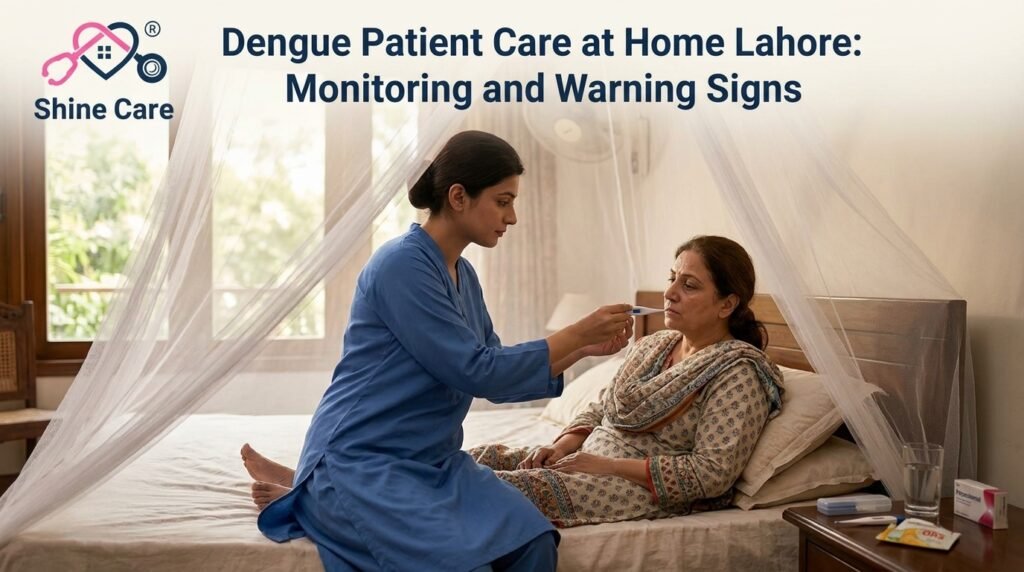
The doctor at the hospital OPD says: “Platelets are 90,000 — go home, drink fluids, come back if things get worse.” The family drives home to Model Town or DHA with a fever chart, three medicines, and a knot in the stomach. What exactly does “if things get worse” look like at 2 am? What do you check, and how often? When do you call the ambulance and when do you wait until morning?
Lahore sees dengue every year, mostly in the monsoon and post-monsoon months. Most dengue patients recover at home safely. A small number slip from ordinary fever into a dangerous phase within hours — and families who miss the warning signs pay heavily. This guide walks through practical home care for a dengue patient in Lahore, what to monitor, and the exact signs that mean the patient should be back in hospital.
Nothing here replaces your treating doctor’s advice for your specific patient. Follow their instructions first, and if in doubt at any hour, go to the hospital.
The Three Phases of Dengue
Every dengue case moves through three phases. Understanding which phase your patient is in changes what you watch for.
| Phase | Timing | What Happens | Home Focus |
|---|---|---|---|
| Febrile (fever) phase | Day 1–3 | High fever, body ache, headache, eye pain, mild rash | Fluids, rest, paracetamol, comfort |
| Critical phase | Day 3–7 (often around fever settles) | Highest risk phase — plasma leak possible, platelets drop | Watch warning signs carefully every 2–4 hours |
| Recovery phase | Day 7–10 | Appetite returns, energy improves, rash may reappear | Rebuild strength, watch for fluid overload |
The danger is that many families relax when the fever finally settles on day 4 or 5. This is exactly when the critical phase begins. Do not stop monitoring just because the temperature is down.
Warning Signs That Mean Go Back to Hospital Now
These are the WHO-recognised warning signs. Any one of them, at any hour, means the patient goes back to the emergency room without waiting for the treating doctor’s opinion first.
- Severe abdominal pain, especially in the upper right or middle of the abdomen
- Persistent vomiting — more than three times in a few hours
- Any bleeding — from gums, nose, in vomit, in stool (black or red), in urine, or heavy menstrual bleeding
- Bruises appearing without injury, or a red pinprick rash that does not fade when pressed
- Lethargy or restlessness — sudden change in behaviour, hard to wake up, confused
- Difficulty breathing or fast breathing
- Cold, clammy hands and feet even when the body is warm
- Sudden drop in temperature to below normal with the patient feeling worse, not better
- Rapid pulse with low blood pressure
- Reduction in urine — passing much less than usual, or none for several hours
Do not wait to see if it passes. Do not give another dose of medicine at home. Call the ambulance or drive straight to the ER of the hospital where the patient was diagnosed.
What to Monitor at Home and How Often
A simple bedside chart handles most of home dengue care. Keep a printed sheet or notebook and write down these numbers.
| Measurement | How Often | Normal Range |
|---|---|---|
| Temperature | Every 4 hours during fever, every 6 hours after | 36.5–37.5°C between paracetamol doses |
| Pulse rate | Every 4 hours | 60–100 per minute in adults |
| Blood pressure | Twice a day (more if unwell) | Do not accept BP below 90/60 without calling the doctor |
| Urine output | Track roughly through the day | Passing urine every 4–6 hours in reasonable volumes |
| Fluid intake | Ongoing | 2.5–3 litres of oral fluids daily for adults |
| Warning-sign check | Every 2–4 hours in critical phase | All zero — any yes means hospital |
Take the chart to every doctor visit and lab appointment. It shows the trend, not just today’s number, which is often more useful than any single reading.
Platelet Counts — What the Numbers Actually Mean
Families obsess over the platelet number. It matters, but it is only one part of the picture.
- Above 100,000: Usually safe for home care with monitoring
- 50,000 to 100,000: Home care possible with daily monitoring; the doctor may want to see the patient every day or two
- 20,000 to 50,000: Higher-risk zone — most doctors want the patient in hospital, especially with any warning sign
- Below 20,000: Hospital admission almost always advised
Numbers alone do not tell the whole story. A patient with 40,000 platelets and no warning signs may do better at home than a patient with 80,000 platelets who is vomiting and confused. The overall picture matters more than the single number.
Fluids — The Single Most Important Home Treatment
Dengue causes plasma leak from blood vessels. The best home treatment is keeping the patient well hydrated. Aim for 2.5 to 3 litres a day for adults, spread across the day.
What to Give
- Water (about half of total intake)
- ORS (oral rehydration salts) — one packet in the correct amount of water, sipped through the day
- Fresh coconut water
- Fresh lime with a little salt and sugar in water
- Clear soups — chicken yakhni, vegetable broth
- Fresh fruit juice (unsweetened) — pomegranate, papaya
- Rice water (chawal ka pani)
What to Avoid
- Fizzy drinks (Pepsi, Coke) — sugar without proper rehydration
- Milk and dairy in large amounts during high fever — can worsen nausea
- Very cold drinks — often trigger vomiting
- Alcohol — worsens dehydration and platelet function
- Papaya leaf juice in unregulated doses — some families swear by it, but there is no clear evidence it changes outcomes and excess can cause diarrhoea
Track fluid intake on a simple hourly chart. A patient sipping through the day beats a patient forced to gulp large volumes.
Medicines — What is Safe and What is Dangerous
Safe
- Paracetamol — 500 mg tablet as advised by doctor, usually every 6 hours, for adults
- ORS
- Antibiotics or anti-vomiting medicines only if the doctor has prescribed them for the specific patient
Dangerous — Do Not Give
- Aspirin (Disprin) — increases bleeding risk in dengue
- Ibuprofen (Brufen), diclofenac (Voltaren), mefenamic acid (Ponstan) — same problem
- Any injection at home unless the treating doctor has specifically authorised it and a trained nurse gives it
- Random antibiotics purchased over the counter
Paracetamol only. If pain or fever is not controlled by paracetamol, that itself is a reason to call the doctor — not to add another painkiller.
Nutrition During Dengue
Most dengue patients have no appetite for days. Do not force full meals. Small, frequent, easy-to-swallow foods work best.
- Khichri with a little yogurt
- Boiled potato or mash with salt
- Chicken yakhni with soft rice
- Boiled egg
- Ripe banana, papaya, watermelon
- Dahi (yogurt) as tolerated
- Soft toast with honey or jam
Skip greasy, spicy, or heavy food until the appetite returns. In the recovery phase, add protein — eggs, chicken, daal — to help the body rebuild.
When Home Care Is Not Enough — Hire a Nurse
For dengue cases with borderline platelets, warning signs that come and go, elderly patients, patients with other conditions (diabetes, hypertension, kidney disease), or families who cannot monitor closely, hiring a home nurse for the critical phase is often the safest choice.
What a nurse adds in dengue care:
- Regular vitals monitoring, properly recorded
- Early recognition of warning signs the family might miss
- IV fluids at home if the doctor prescribes them and the setting is safe
- Communication with the treating doctor and coordination with the lab for platelet checks
- Reassurance for the family through frightening nights
Even a 12-hour night nurse for the critical phase (days 3–7) can be enough to keep the patient safe without a full 24-hour setup. A trained home nurse near me is often available at short notice from established Lahore providers.
Lahore-Specific Practical Notes
- Dengue seasonally peaks in Lahore from August through November — cases spike after monsoon
- Common breeding sites — flower pots, coolers, water tanks with loose lids, plant plates, discarded tyres, roof tanks
- Empty and refill any standing water source in the house every three days
- Use mosquito nets for the sick patient — a dengue patient can pass the virus to a mosquito that then bites family members
- Keep windows screened and use repellent creams for household members during outbreak periods
- Most major Lahore hospitals — Services, Jinnah, Mayo, Doctors, Hameed Latif, Shaukat Khanum, PKLI — have dedicated dengue wards during peak season
Prevention matters as much as treatment. One case in the house should trigger a full clean-up of standing water in and around the property, and mosquito precautions for everyone else.
Home Care for Special Dengue Patient Groups
Elderly Patients
Higher risk of complications, and warning signs (like sudden confusion or lethargy) are easier to miss because families sometimes assume the patient is just tired. Any change from the elder’s normal alertness deserves a call to the doctor. See our notes on elderly care at home.
Diabetic Patients
Sugar levels swing widely during dengue. Check sugar more often — before meals and at bedtime. Insulin doses may need adjustment; ask the treating doctor. Regular diabetes care routines should not be paused without medical advice.
Hypertensive Patients
BP can drop suddenly in the critical phase. If the patient is on multiple BP medicines, ask the doctor whether one should be paused temporarily. Regular hypertension care discipline stays important.
Pregnant Women
Dengue in pregnancy is higher risk for both mother and baby. Home care with close obstetrics follow-up is essential; low threshold for hospital admission.
Children
Get very sick very fast. If your paediatrician has kept them at home, monitor even more closely than an adult — vitals every two hours during the critical phase. Any warning sign, straight to hospital.
Roles Around a Dengue Patient at Home
- Treating doctor: Sees the patient regularly, orders platelet checks, decides on hospital admission.
- Home nurse: Monitors vitals, watches for warning signs, gives IV fluids if prescribed, communicates with the doctor.
- Caretaker or patient attendant: Fluids and meal support, changing clothes if the patient sweats a lot, keeping the room comfortable.
- Family: Presence, transport to the doctor, running to the lab and pharmacy, watching over the patient at night.
- Lab technician: Home sampling for daily CBC (complete blood count) so the patient does not have to keep travelling.
Good nursing care during the critical phase is one of the biggest differences between a smooth home recovery and a scary late-night ER trip. Structured home health care teams also arrange the daily lab sampling and, when needed, doctor home visits so weak patients do not have to travel back and forth for every check.
Red Flags: The Simple Version
- Severe stomach pain
- Repeated vomiting
- Any bleeding
- New bruising or non-fading red spots
- Confusion, drowsiness, or restlessness
- Difficulty breathing
- Cold hands and feet
- Very little urine
Any one of these = hospital now. Do not wait for the doctor to call back. Do not try to manage at home.
Frequently Asked Questions
Fever lasts three to seven days; full recovery takes another one to two weeks. Some patients feel tired and low on energy for a month after.
Many families believe it raises platelet count. The scientific evidence is mixed. It is unlikely to harm in small amounts but it does not replace medical care, and excess can cause diarrhoea. Do not rely on it in place of monitoring or hospital visits.
Yes. There are four dengue virus strains. Infection with one gives lifelong immunity to that strain only. A second infection with a different strain is often more severe. This is why prevention matters even for someone who “already had it.”
Usually yes, during the critical phase (day 3 to day 6 or 7). The doctor may reduce the frequency once platelets stabilize and start rising. Home sampling in Lahore is widely available.
Only if they develop symptoms — high fever, body ache, headache, rash. Testing without symptoms is not useful. Focus on preventing new mosquito bites in the house instead.
When the doctor clears them — usually after platelets have risen above 100,000 and stayed there, appetite has returned, and there are no warning signs. Fatigue may last another week or two.
The Simple Version
Give fluids all day. Watch for the warning signs every two to four hours in the critical phase. Track vitals on a chart. Use only paracetamol for fever. Avoid aspirin, brufen, and injections at home. Hire a nurse for the critical phase if you cannot monitor closely. Any warning sign, any hour — go straight to hospital. Do these six things and most dengue cases at home recover safely.