

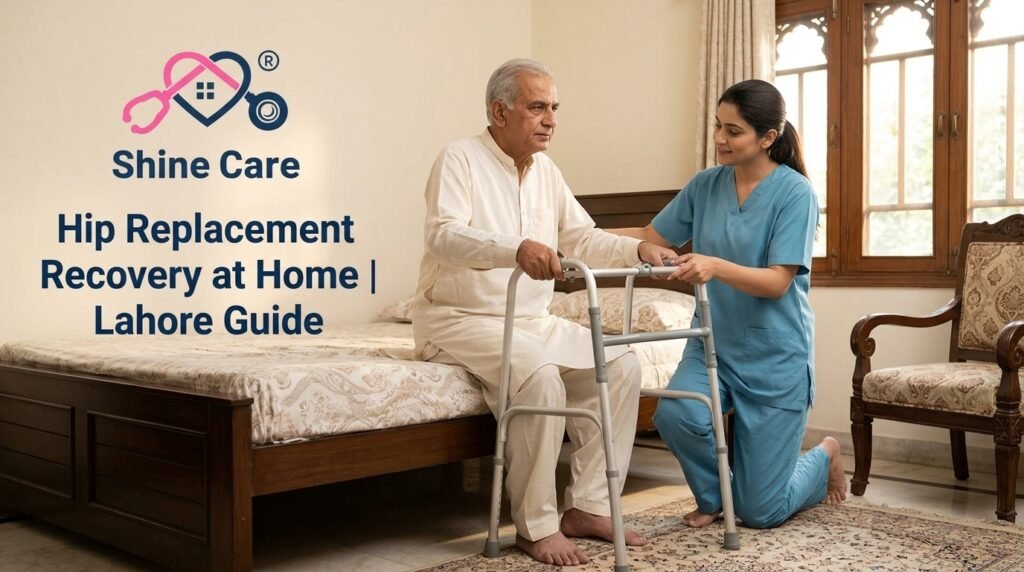
The surgery went well. The patient is home with a new hip, a walker, a list of exercises and a set of instructions about movements they must not make for the next few weeks.
And then they need to use the bathroom.
Hip replacement recovery at home follows the same medical rules everywhere in the world. What changes here is the house. Our bathrooms, our floor-level living, our low charpais and sofas, and the way we pray — every one of those collides with hip precautions in a way no international recovery guide addresses.
At Shine Care we look after post-operative patients across Lahore every week, and the same handful of problems come up in almost every household. This guide covers both halves: the medical rules the surgeon has set, and how to actually live by them in a Lahore home.
First, ask which precautions apply
Hip precautions are not identical for every patient. They depend on the surgical approach the surgeon used.
A posterior approach — the most common — usually means avoiding bending the hip beyond 90 degrees, crossing the legs, and rotating the operated leg inward. An anterior approach often carries different restrictions, sometimes focused on avoiding extending the leg backward.
So the first question before the patient leaves hospital is: which approach was used, and exactly which movements must be avoided? Get it in writing and stick it on the wall of the patient’s room. Families frequently follow precautions they read online that do not apply to their patient’s surgery — or worse, ignore ones that do.
The three rules most patients are given
For a posterior hip replacement, guidance from Kaiser Permanente on hip precautions at home sets out what most patients are told, and it is worth reading exactly:
- Do not bend the hip more than 90 degrees. That includes not leaning forward while sitting down or standing up, not picking things up off the floor, and not bending to tie shoes
- Do not cross the legs, and keep the knees apart
- Do not rotate the leg too far inward. Keep the toes pointing forward or slightly out
The same guidance adds two practical rules that decide how a household must be arranged: do not lift the knee higher than the hip, and do not sit on low chairs, beds or toilets — a raised toilet seat is usually needed for a while.
Those precautions are typically kept for the first six to twelve weeks while the tissue around the new joint heals and stabilises. The surgeon decides when they can ease.
The part no international guide covers: a Pakistani home
This is where families in Lahore genuinely struggle, and where most precaution breaches happen.
The bathroom
A squat toilet is impossible with a 90-degree restriction. It is not a matter of difficulty — the position itself is exactly what the patient has been told to avoid, and attempting it risks dislocating the new joint.
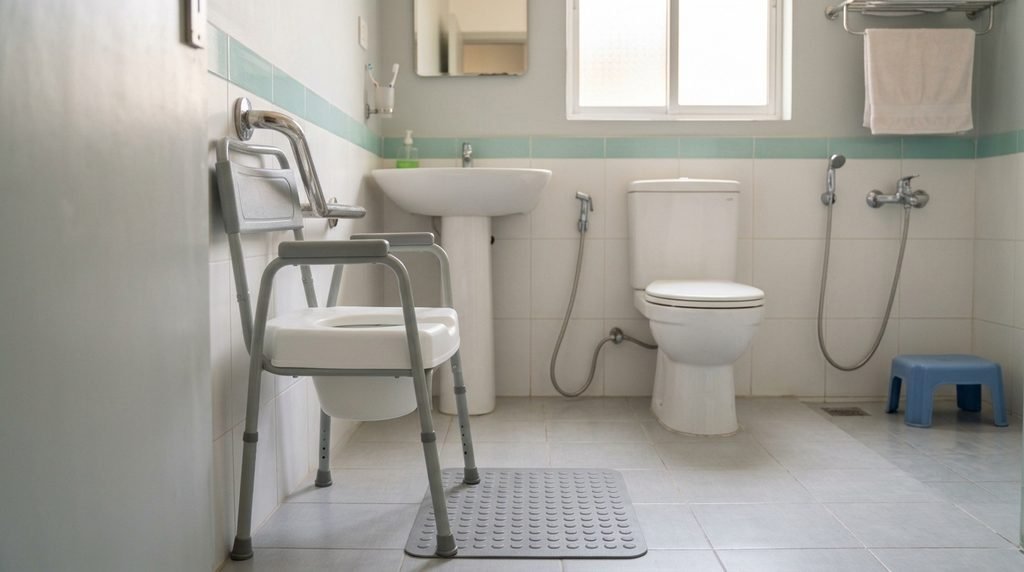
If the house has only a squat toilet, this must be solved before the patient comes home:
- A commode chair placed over or beside the squat pan, or in the patient’s room
- If there is a Western toilet, add a raised toilet seat — a standard one is usually too low
- Grab rails beside the toilet, fixed properly into the wall rather than suction-cup versions
- A plastic stool and hand shower so washing can be done seated, without bending or twisting
- Wet marble is the most dangerous surface in the house. A non-slip mat is not optional
Floor-level living
Sitting on the floor for meals, family gatherings or watching television bends the hip far past 90 degrees and involves getting up from the floor afterwards, which is worse.
For the recovery period the patient eats at a table on a firm chair with armrests, or on a raised chair brought to the dastarkhwan. This feels socially awkward in the first week and stops mattering by the second — explain it once to visiting relatives rather than each time.
Charpai and low beds
A charpai sags in the middle, which means the hip ends up below the knee — a precaution breach every time the patient sits. Low divans and soft sofas do the same.
The patient needs a firm bed at a height where their feet rest flat on the floor when sitting on the edge, with hips level with or above the knees. Adding a firm mattress or a board under a soft one helps. For patients who will be recovering for weeks, an adjustable bed makes the whole period considerably easier.
Namaz
Almost every patient asks this, and it is rarely addressed anywhere.
Sujood and the seated positions of prayer take the hip well past the permitted angle. Praying while seated on a chair is widely accepted where a physical limitation prevents standing or prostration, and this is a temporary period, not a permanent change.
Discuss it with the surgeon so the patient knows exactly what is safe at each stage, and speak to a scholar you trust if the family wants religious guidance. What patients should not do is quietly attempt normal prayer positions and say nothing — this is one of the most common reasons we hear about a precaution being broken.
Prepare the house before surgery, not after
If the operation is planned, use the waiting time. Families who prepare in advance have a far easier first fortnight.
- Clear the walking route between bed, bathroom and sitting area — remove loose rugs, wires and anything to trip over
- Raise the bed to the correct height, or arrange one
- Sort the bathroom — commode or raised seat, grab rails, non-slip mat, plastic stool
- Firm chair with armrests in the sitting area, and one in the patient’s room
- Move daily items to waist height — clothes, medicines, glasses, phone charger. Nothing the patient needs should be at floor or overhead level
- Get a long-handled reacher and shoehorn, and slip-on shoes with a back — no laces, no open slippers
- Good lighting at night on the route to the bathroom
- Decide the sleeping room. If the bedroom is upstairs, arrange a ground-floor room for the first weeks
Movement matters from day one
The instinct is to keep the patient still to protect the new joint. That instinct causes most of the complications.
Modern hip replacement recovery involves getting patients up and moving early, within the limits the surgeon sets. Movement prevents blood clots, chest infection, muscle weakness and stiffness — and each of those is a bigger threat than gentle activity is.
The patient walks with the aid the physiotherapist specified, for short distances and often, rather than one long effort a day. The prescribed exercises are done as instructed, not when the patient feels like it.
This is where Shine Care’s physiotherapy at home in Lahore earns its cost. A patient recovering from hip surgery cannot easily travel to a clinic three times a week — the car journey itself is difficult — and the ones who skip sessions are the ones still limping months later. Our physiotherapists work to the programme the surgeon and hospital team set, in the patient’s own room, so sessions actually happen.
Blood clots: the risk families underestimate
After hip surgery, a clot forming in the leg is a genuine risk, and it can travel to the lungs. Prevention is straightforward and mostly consists of doing what the surgeon already asked.
- Take the prescribed blood-thinning medicine exactly as directed, for the full period
- Do the ankle and foot exercises regularly through the day
- Get up and walk short distances often rather than sitting for hours
- Keep fluids up unless restricted
- Wear compression stockings if they were prescribed, and wear them properly
Report immediately any pain in the calf, back of the knee, thigh or groin; swelling in the leg or groin; or a reddish or purplish colour change in the leg. Sudden breathlessness or chest pain is an emergency.
The wound
Keep the dressing dry and intact. Do not open it early to check, and do not apply anything to the wound — no turmeric, no oils, no antiseptic bought at a pharmacy.
Contact the doctor the same day for increased pain, swelling, warmth or redness around the incision, red streaks spreading from it, pus or discharge, a wound that opens, or fever.
Signs of dislocation — go to hospital
This is the complication the precautions exist to prevent, and families should know what it looks like.
Seek emergency care immediately if:
- There is sudden severe pain in the hip or groin
- The leg looks shorter than the other, or is turned outward or inward at an odd angle
- The patient cannot bend or straighten the leg, or cannot bear weight on it at all
- There is a popping or clunking sensation followed by pain
- The leg or foot is cool, pale, numb or tingling
Do not try to move or reposition the leg. Keep the patient still and get them to hospital.
Sleeping
Most patients are told to sleep on their back for the first weeks. A pillow between the knees keeps the legs from crossing during the night, which is when precautions are broken without anyone realising.
Ask the surgeon before the patient starts sleeping on their side, and which side is permitted. Do not assume.
Getting into a car
Cars are low, and the twisting movement of swinging the legs in is exactly what the patient must avoid.
Use the front passenger seat with it pushed fully back and reclined slightly. The patient backs up to the seat, sits down first keeping the operated leg extended, then swings both legs in together without twisting the hip. A firm cushion raises the seat height. Somebody should be there to steady them.
Reverse the process to get out: legs out together first, then stand.
What recovery usually looks like
Every patient differs, and the surgeon’s timeline is the one to follow. Broadly:
Weeks 1 to 2 — walking with a frame or crutches, short distances indoors, precautions strictly observed, wound healing, pain managed. This is the period where most falls happen.
Weeks 3 to 6 — walking further and more confidently, moving toward a stick, exercises progressing. Precautions still in full force.
Weeks 6 to 12 — the surgeon reviews and may relax some precautions. Strength returns gradually and the limp improves.
Beyond three months — most patients are back to normal daily activity, though full strength and confidence take longer.
Older patients, diabetic patients and those who were less mobile before surgery move through this more slowly. That is expected and not a sign anything has gone wrong.
When home support helps
Some patients manage with family help alone. Support is genuinely useful when:
- The patient lives alone, or the family works full time
- The patient is elderly or frail and needs help with bathing and dressing while precautions are in force
- Diabetes or heart conditions need managing alongside the recovery
- The wound needs regular dressing
- Nobody at home is confident supervising safe movement and transfers
That combination — wound care, medicines, safe movement and watching for complications — is what Shine Care’s post-surgery care at home covers. The first two weeks are when it matters most, and it is also the period when a fall undoes the entire operation.
In practice, most hip replacement patients we look after in DHA, Gulberg, Johar Town and Model Town need an attendant or nurse for the first two to three weeks, tapering off as confidence returns. A Shine Care nurse can also do the wound dressing at home, so the patient is not making a difficult car journey to a clinic for a ten-minute procedure.
Frequently asked questions
Usually six to twelve weeks, but the surgeon decides based on the approach used and how the patient is healing. Do not stop them early because the patient feels well — the joint is still stabilising.
No, not while precautions are in force. Arrange a commode chair or a raised Western seat before the patient comes home. This is the single most important preparation in a Pakistani household.
Only when the surgeon says so, and for many patients this takes several months. Getting up from the floor is harder than sitting down and carries the greater risk.
Not during the precaution period — sujood and the seated positions exceed the safe angle. Praying seated on a chair is widely accepted where physical limitation prevents the usual positions. Discuss the timeline with the surgeon.
Some swelling in the leg and around the wound is expected in the early weeks and usually improves with elevation and movement. Sudden swelling, calf pain or a colour change is not normal and needs assessment the same day.
The physiotherapist teaches the technique before discharge — good leg up first going up, operated leg first coming down, holding the rail. Until that has been taught and practised, arrange a ground-floor room.
Tell Shine Care the date of surgery, the patient’s age and any other conditions such as diabetes, and whether the house has stairs or a squat toilet. We will advise what level of support the first weeks actually need — often an attendant rather than a nurse — and what to prepare before the patient comes home.
Yes. Walking without pain is not the same as the muscles around the joint having recovered their strength. Patients who stop exercises early are the ones with a persistent limp a year later.
Arranging support after hip surgery in Lahore
If a hip replacement is planned or has just happened, the useful time to call is before discharge rather than after. Shine Care can advise on preparing the room and bathroom, arrange an attendant or nurse for the first weeks, and set up physiotherapy at home so the exercise programme is not the thing that slips.
Send us the patient’s details and the surgeon’s instructions, and we will tell you honestly what the case needs — including when it needs less than the family expected.