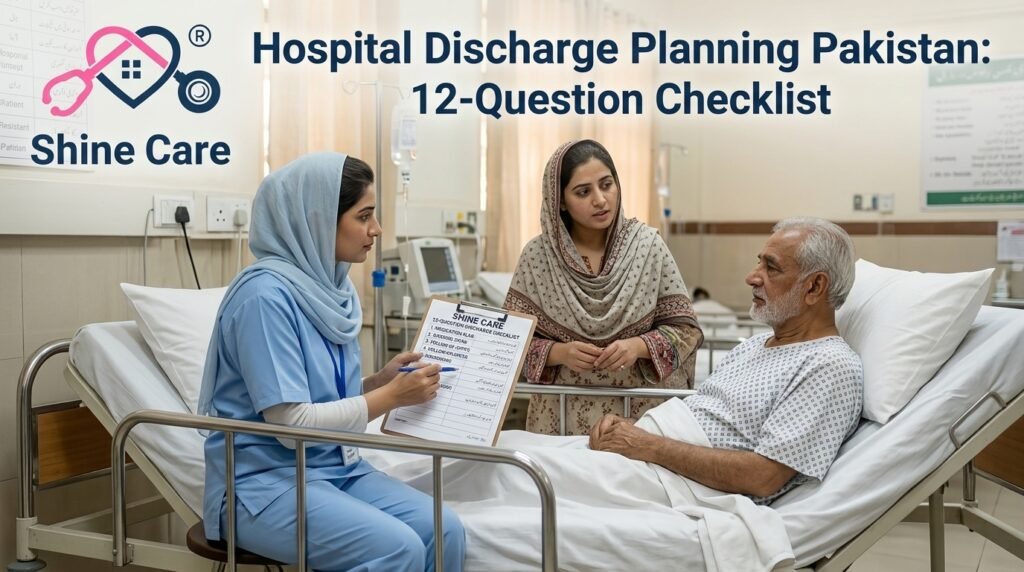
The doctor rounds in the morning and says the words the family has been waiting to hear — “he can go home today”. Everyone relaxes. Bags are packed, the discharge summary is signed, a wheelchair takes the patient to the car, and by lunchtime the elderly father is back in his own bed. Three days later, at 2 AM, he becomes suddenly breathless. The family cannot find the medication list. Nobody remembers what the doctor said about follow-up. The wound looks strange but no one is sure what “normal” is meant to look like. Emergency room again, and another admission. What went wrong was not the initial treatment — it was the discharge, done in a hurry with the family too grateful and too tired to ask the questions that would have prevented the second admission.
Discharge is when hospital care ends and home care begins, and that transition is where more preventable complications happen than anywhere else. This guide walks families through hospital discharge planning Pakistan realities — the twelve questions to ask before the patient leaves, what to arrange in advance at home, and how to build a plan that actually holds. Nothing here replaces the discharging team’s specific instructions; this is the checklist that helps families use those instructions properly.
Why Discharge Planning Matters So Much
The first two weeks after hospital discharge are the highest-risk period. Re-admission rates during this window are substantial in Pakistan, and most of the re-admissions are preventable. Common reasons for early return to hospital:
- Medication errors — wrong doses, missed doses, drug interactions
- Wound infections not caught early
- New symptoms family did not recognise as serious
- Missed follow-up appointments
- Equipment or supplies not arranged in time
- Family unable to manage care they were not trained for
- DVT and pulmonary embolism from immobility
- Falls in a home not set up for the patient’s reduced mobility
- Delayed recognition of complications like sepsis
A twenty-minute discharge conversation, structured around the right questions, prevents most of these.
Who Does What at Home
- Discharging Doctor / Consultant: Writes the discharge summary, prescribes medications, explains the plan, and sets follow-up.
- Discharge Nurse: Explains wound care, medications, warning signs, and equipment use. Often the person the family should ask the practical questions to.
- Family Care Coordinator: Ideally one person in the family takes lead on the discharge conversation, keeps the records, and communicates with everyone else.
- Home Nurse (if arranged): Takes over clinical care at home. A structured home nurse arrangement started before discharge means the nurse can visit the hospital, receive handover, and be at home when the patient arrives.
- Caretaker / Attendant: Present at home for daily support.
- Family Members: Coordinate the practical arrangements, learn what they need to know, and set up the home.
For families in Lahore preparing for discharge of a parent who will need ongoing home care, structured home health care services arranged before discharge produce far better transitions than waiting to arrange help after problems appear.
The Twelve Questions
Question 1: What Is the Diagnosis and What Was Done?
Not just “he had a stroke” but the specific diagnosis, the treatments given, any complications, and the current status. Understanding what happened helps the family recognise what to watch for at home.
Question 2: What Medications Is the Patient Going Home On?
Complete list — every medication, dose, timing, and reason. Compare against what the patient was taking before admission — some may have been stopped, some added, some changed. Ask specifically:
- Which medications are new?
- Which have been stopped?
- Which have changed dose?
- Which cannot be taken with certain foods?
- Which need special timing (before/after meals)?
- How long will each be needed?
Get a written medication list, not verbal instructions.
Question 3: What Are the Warning Signs That Mean We Call the Doctor?
Every discharge should include specific warning signs relevant to the patient’s condition — fever above X, breathlessness, wound changes, confusion, chest pain. Get these in writing so the family does not have to remember under pressure.
Question 4: What Are the Signs That Mean the Emergency Room, Not Just the Clinic?
Different from Question 3. Some symptoms need next-day review; others need 1122 or an ambulance now. Get the distinction.
Question 5: What Follow-Up Appointments Are Needed and When?
Which specialists, what timeframe, and — critically — are the appointments booked, or does the family arrange them? A vague “come back in 2 weeks” often turns into “we didn’t book anything and now the clinic is full”.
Question 6: What Tests or Investigations Need to Be Done at Home?
Some patients need blood tests, wound swabs, or specific monitoring soon after discharge. Home nursing arrangements can handle these without a hospital visit for elderly or immobile patients.
Question 7: How Should the Wound / Catheter / Feeding Tube / Other Device Be Cared For?
Practical hands-on demonstration before discharge — not just verbal instructions. Ask for the family to be shown the technique, then try it under supervision. Confirm supplies are available at home.
Question 8: What Level of Activity Is Safe?
Can the patient walk? Climb stairs? Drive? Pray in the traditional position? Return to work? Ask specifically about the activities that matter to this patient. Get a graduated timeline where relevant.
Question 9: What Diet Should the Patient Follow?
Depending on the condition — diabetic diet, low-salt for heart failure, soft foods for swallowing issues, no grapefruit or leafy greens for certain blood thinners. Written diet advice is more useful than “eat healthy”.
Question 10: What Equipment Is Needed at Home?
Hospital bed? Wheelchair? Oxygen? Suction machine? Nebulizer? Commode chair? Get the list before discharge so equipment can arrive before the patient does, not the next day. Coordinated doctor home visit arrangements often help with these logistics.
Question 11: What Home Care Support Is Recommended?
Nurse? Physiotherapist? Attendant? Full-time or scheduled? For how long? For elderly patients or those with complex needs, this is a critical planning question — arranging support after the patient is already home is much harder than arranging it before.
Question 12: Who Do We Call With Questions?
Not just “the hospital”. Specific contacts:
- The treating consultant’s clinic
- The discharge nurse or care coordinator
- The hospital’s after-hours contact
- Which questions go to which person
Write these on a card kept near the phone.
What to Prepare at Home Before Discharge
The Room
If the patient will be bedridden or have limited mobility, set up the room before they arrive:
- Ground floor if possible
- Near a bathroom
- Hospital bed if needed, in place
- Pressure-relief mattress
- Wheelchair positioned for transfers
- Bedside commode if the patient cannot walk to the bathroom
- Adequate lighting
- Chair for family or caregiver
- Bedside table with essentials within reach
Equipment Delivered
Everything ordered before discharge day. Suppliers get busy — waiting until the patient is home to arrange equipment often means delays.
Medications Filled
Take the prescription from the doctor, fill it at a pharmacy before going home. Do not arrive home to find you need to go out for essential medications.
Home Nurse / Attendant in Place
For patients who will need care at home, arrangement made before discharge. The nurse present when the patient arrives.
Family Roles Assigned
Who is doing what — coordinating with doctors, doing daily care, managing medications, handling emergencies. Not decided after the crisis.
Home Safety Review
Loose rugs removed if fall risk. Grab bars considered. Bathroom accessible. Lighting adequate.
Power Backup
For patients with equipment needing continuous power (oxygen, ventilator, feeding pumps), UPS or generator ready.
Records Folder
The discharge summary, medication list, and follow-up schedule filed and accessible.
The Discharge Day Itself
Do Not Rush
Even if the hospital is under pressure to free the bed, take the time to have the discharge conversation properly.
Bring a Family Member Who Will Be Involved in Care
Not just any relative. The person who will actually be managing medications and appointments needs to hear the instructions directly.
Take Notes
Or record the conversation (with permission). Details slip in stressful moments.
Ask for Written Documentation
Discharge summary, medication list, follow-up appointments, wound care instructions, warning signs — all in writing.
Demonstrations Before Departure
If any technique needs family involvement — wound dressing, injection administration, tube feeding, catheter care — request a demonstration and a supervised trial before leaving.
Confirm the Medications
Reconcile the prescription against what the patient was taking. Ask about any discontinued medications.
Confirm Follow-Up Appointments
Are they booked? If yes, when? If no, how does the family book them?
Transport Home
Comfortable transport suited to the patient’s condition. For weak or immobile patients, ambulance transfer rather than private car.
The First 48 Hours at Home
Highest-risk period. What matters:
First-Night Vigilance
Watch for any change from what the discharge team said to expect. Someone present, not the patient alone.
Medications on Schedule
Even the first doses at home. Set alarms if needed.
Wound / Site Check
Look at the wound or site of any procedure. Note the appearance. Compare over the next days.
Vitals if Appropriate
Temperature, BP, pulse, oxygen saturation as indicated. Write them down.
Mobility and Position
Regular positioning if bedridden. Prescribed exercises if mobile.
Diet and Fluids
As directed. Watch tolerance.
Symptom Watch
Any of the warning signs from Question 3 — contact the doctor same day. Warning signs from Question 4 — go to the emergency room.
Emotional Support
Coming home from hospital is not always the joyful moment families expect. Fatigue, confusion, mood changes, and adjustment take time.
Coordinating With Coexisting Conditions
Most patients being discharged have other conditions to continue managing. Common areas:
- Structured hypertension care continues — BP monitoring, medication adherence
- Ongoing diabetes care — sugar monitoring, medication adjustments, diet
- Chronic conditions may have been affected by the admission — review with the treating doctor
- Elderly patients often have multiple conditions requiring coordinated attention. Structured care for elderly at home usually includes attention to multiple chronic conditions rather than only the reason for the recent admission
Specific Discharge Situations
Post-Surgical Discharge
Wound care, activity restrictions, DVT prevention, pain management, follow-up for stitch removal or wound review.
Post-ICU Discharge
Complex needs — often requiring nursing care, equipment, physiotherapy, and gradual rebuilding. The transition can be dramatic. Substantial pre-arranged support helps.
Post-Cardiac Event
Cardiac rehabilitation, medication compliance, activity progression, warning signs for a second event.
Post-Stroke
Ongoing rehabilitation, medication for stroke prevention, physiotherapy, speech therapy where relevant, home safety adjustments.
Post-Delivery (Vaginal or Caesarean)
Mother’s recovery alongside newborn care. Wound care for caesarean mothers. Warning signs for both mother and baby.
Post-Chemotherapy Discharge
Infection prevention, nausea management, fatigue support, infection warning signs, next cycle scheduling.
Discharge to Palliative Care at Home
Comfort focus. Symptom management priorities. Family emotional support alongside physical care.
Elderly Patient Discharge After Fall or Fracture
Home safety review essential. Mobility support. Falls prevention plan. Physiotherapy for recovery.
When to Delay Discharge
Sometimes families should push back against a proposed discharge:
- Family not comfortable with the care needed
- Home not ready — equipment not delivered, room not set up
- Home nurse not yet arranged
- Prescriptions not yet filled
- Patient still symptomatic in ways the family cannot manage
- Weekend or holiday when follow-up support is limited
- Family caregiver not able to be present in the first days home
Discharging when everyone is ready produces better outcomes than discharging on schedule but with the safety net not in place. Discuss openly with the treating team.
Handling Common Post-Discharge Problems
Medication Confusion
Pill organiser filled by a family member or nurse weekly. Alarms for doses. Written schedule.
New Symptoms
Contact the treating team based on Questions 3 and 4. Do not “wait to see” if uncertain.
Wound Concerns
Photos help track changes. Nurse can review. Any spreading redness, discharge, or fever needs same-day medical review.
Missing Follow-Up
Booked appointments should not be missed. Reschedule if unavoidable.
Difficulty With Care Techniques
Contact the discharging team or arrange nursing support to demonstrate again.
Emotional Distress
Adjustment after hospital is normal. Persistent low mood, anxiety, or difficulty coping deserves attention — not weakness, not something to hide.
Common Mistakes Families Make
Not Asking Enough Questions
Doctors do not always explain everything unprompted. Ask.
Assuming Verbal Instructions Are Enough
Get everything in writing.
Not Reconciling Medications
Continuing old medications alongside new prescriptions causes interactions and errors.
Skipping the Demonstration
“We’ll figure it out at home.” No — get the technique shown while help is available.
Not Arranging Home Support in Advance
Scrambling to arrange a nurse or equipment after discharge causes gaps.
Ignoring Warning Signs
“He’s just tired from hospital.” Sometimes yes; sometimes a serious problem developing.
Missing Follow-Up Appointments
Critical for catching complications early.
Not Involving the Right Family Member
The person managing care at home needs to be the one receiving the instructions, not a passing relative.
Red Flags: When to Contact the Doctor or Emergency Room
Contact the doctor same day for any of the following after discharge:
- Fever
- Wound redness, discharge, or new pain
- New confusion or drowsiness
- New shortness of breath
- Reduced or absent urine output
- Persistent vomiting
- Uncontrolled pain despite prescribed pain relief
- Any concern that “something is not right”
Take to the emergency room / call 1122 immediately for any of the following:
- Chest pain
- Severe shortness of breath
- Bluish colour around lips or fingertips
- Fall with injury or head injury
- Seizure
- Loss of consciousness
- Sudden weakness, slurred speech, facial droop
- Sudden severe pain
- Uncontrolled bleeding
- Signs of sepsis — fever with confusion, low BP, cold clammy skin
For patient-friendly background on hospital discharge and recovery, the NHS guide to leaving hospital is a reliable reference. For your patient’s specific discharge plan, always follow the treating doctor.
FAQs
The document produced by the hospital summarizing the admission — diagnoses, treatments, complications, medications on discharge, and follow-up plan. Get a copy before leaving. Keep it safely in the patient’s records.
Often yes, and sometimes should. Discuss with the treating team. Discharging without home preparation causes many preventable readmissions.
Depends on the patient’s condition and family capacity. For complex care, yes. For simple recovery, sometimes a scheduled nurse visit is enough. For elderly patients with multiple conditions, some nursing support in the first weeks is usually valuable.
Depends on the condition. Usually within 1–2 weeks for stable patients, sooner for complex or new diagnoses. The discharging team should specify.
Discuss with the treating team about priorities. Renting versus buying. Which equipment is essential versus optional. Sometimes coordinated arrangements make the cost manageable.
Sometimes patients feel unsafe about discharge. Take this seriously. Discuss with the medical team about their concerns and whether additional support at home addresses them.