

A loved one has just been discharged from the hospital ICU, but the doctor has made it clear that continuous monitoring still needs to continue at home. This is the moment where most families in Lahore feel completely unprepared. Do you need to buy a hospital bed? Does the house need an oxygen concentrator? Who’s actually qualified to manage a ventilator outside a hospital? The confusion is understandable, but proper planning makes home ICU care both safe and genuinely effective, and that planning follows a fairly clear process once you know what to look for.
What Is ICU Care at Home?
ICU care at home means recreating the intensive monitoring and clinical support a hospital ICU provides, but inside the patient’s own home instead. This includes continuous vital signs tracking, ventilator or oxygen support where required, precisely timed medication administration, and trained nursing staff present around the clock.
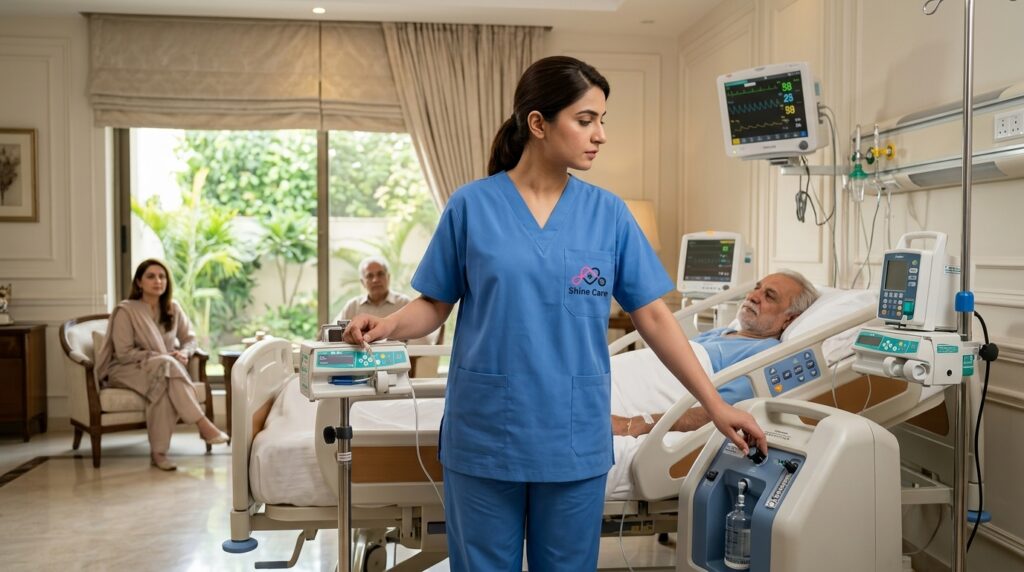
This is meaningfully different from standard home nursing, which typically supports patients who are medically stable but need daily assistance — medication reminders, mobility help, general monitoring. ICU care at home is built specifically for patients whose condition still requires the close, continuous clinical attention a hospital ICU provides, just delivered in a home setting.
The NHS describes intensive care as treatment for people who are seriously ill and need close monitoring along with support for one or more failing organs, often including help with breathing. Home ICU care essentially extends that same principle into a home environment, for patients whose treating doctor has confirmed they’re stable enough to be managed there safely.
Doctors usually recommend transitioning to home ICU care once a patient no longer needs the immediate surgical or emergency response capacity of a hospital, but still requires more than standard home nursing can provide.
Who Can Benefit From Home ICU Care?
Stroke patients recovering from a severe episode often need intensive monitoring in the early weeks, particularly for signs of a second stroke or swallowing complications.
Brain injury patients frequently require close observation of neurological status, alongside support for basic bodily functions that may be affected.
Cancer patients, especially during advanced stages or intensive treatment, sometimes need continuous monitoring for treatment-related complications.
COPD patients with severe respiratory limitations often depend on oxygen therapy and close monitoring of breathing patterns.
Ventilator patients who are stable enough to leave a hospital ICU but still need mechanical breathing support are one of the most common groups arranging home ICU care.
Elderly patients managing multiple serious conditions simultaneously sometimes need ICU-level attention simply due to the combined complexity involved.
Heart disease patients recovering from serious cardiac events often require continuous cardiac monitoring during the critical recovery window.
Neurological disorders affecting consciousness or basic bodily functions typically need the kind of continuous, skilled observation only ICU-trained staff can provide.
Post major surgery patients, particularly after extensive operations, frequently need continued intensive monitoring during the highest-risk recovery period.
Organ failure patients managing conditions like kidney or liver failure often require close monitoring alongside specialized medical equipment.
Step-by-Step: How to Arrange ICU Care at Home
Step 1: Consult the Treating Doctor Before Discharge
Before anything else gets arranged, the treating doctor needs to confirm the patient is genuinely stable enough for home-based ICU care. This conversation should also cover the specific ongoing needs — respiratory support, medication schedule, and any warning signs the family should watch for.
Step 2: Understand the Patient’s Medical Needs
Every home ICU setup should be built around the patient’s actual condition, not a generic template. Does the patient need ventilator support, or just supplemental oxygen? Are there wounds requiring dressing, or a feeding tube to manage? This assessment shapes every decision that follows.
Step 3: Choose a Reliable Home Healthcare Provider Like Shine Care
Selecting a provider with genuine ICU-level experience matters considerably here. Shine Care works through this exact assessment process with families in Lahore, helping determine what equipment and staffing the specific case actually requires before anything gets arranged.
Step 4: Arrange ICU Equipment
Equipment needs vary by patient, but commonly include:
- Hospital bed — for adjustable positioning, patient comfort, and safer care delivery
- Ventilator — for patients unable to breathe adequately without mechanical support
- Oxygen concentrator — for patients needing a continuous supplemental oxygen supply
- BiPAP — for non-invasive respiratory support in patients who need help breathing without full ventilation
- CPAP — for patients requiring continuous airway pressure support, often for specific respiratory conditions
- Patient monitor — for tracking vital signs like oxygen saturation, heart rate, and blood pressure continuously
- Suction machine — for clearing airway secretions, particularly important for patients with limited ability to cough effectively
- Infusion pump — for precise, controlled delivery of IV fluids or medication
- Wheelchair — for safe mobility once the patient is stable enough for supervised movement
- Nebulizer — for delivering inhaled respiratory medication
Step 5: Hire ICU-Trained Nurses
General nursing experience isn’t equivalent to ICU-level training. Look specifically for staff with experience managing ventilators, recognizing early signs of patient deterioration, and handling emergency situations calmly and correctly. This distinction matters more here than in almost any other type of home care.
Step 6: Prepare the Patient’s Room
The room needs proper lighting for clinical tasks, reliable electric backup since equipment like ventilators depend on continuous power, strict cleanliness standards given infection risks, easy accessibility for staff and equipment, clear emergency access routes, and enough space for family members to remain present without crowding the care area.
Step 7: Develop a Personalized Care Plan
This should cover medication timing, monitoring frequency, specific warning signs to watch for, and clear escalation steps if the patient’s condition changes.
Step 8: Schedule Follow-Up Visits
Regular check-ins with the treating doctor ensure the home care plan stays aligned with the patient’s actual medical progress, rather than operating disconnected from ongoing treatment decisions.
Step 9: Educate Family Caregivers
Even with professional nursing staff present, family members should understand the basics of the patient’s condition, what to watch for, and how to support the arrangement without interfering with clinical tasks.
How Shine Care Helps Families Arrange ICU Care at Home
Shine Care begins with a detailed assessment of the patient’s specific condition, understanding exactly what level of support is genuinely required rather than applying a standard package to every case. Doctor coordination follows directly from this, ensuring the home care plan aligns with the patient’s actual treatment rather than operating separately from it.
Equipment arrangement is handled as part of the same process, so the home is properly set up before care begins instead of scrambled together afterward. Qualified ICU nurses are assigned specifically based on the case’s requirements — ventilator management calls for different expertise than post-surgical monitoring, and Shine Care treats that distinction seriously.
Emergency support remains available throughout the arrangement, alongside a clear care plan covering medication timing and monitoring needs. Continuous monitoring stays central to how care is delivered, and family guidance is built into the process, so relatives understand what’s happening and how to stay appropriately involved without feeling shut out of their own family member’s care.
Common Mistakes Families Make
Choosing untrained nurses to save money is one of the most serious errors families make, since general caregiving experience doesn’t prepare someone for ICU-level clinical responsibilities.
Ignoring infection control around wounds, catheters, or respiratory equipment significantly raises complication risk in an already vulnerable patient.
Having no emergency plan in place means precious time gets lost figuring out next steps exactly when quick action matters most.
Poor equipment quality — using unreliable or poorly maintained devices — compromises both accuracy and patient safety.
No documentation of vitals, medication timing, or condition changes creates confusion, especially across nursing shift changes or during doctor consultations.
Skipping follow-ups with the treating doctor means the home care plan can drift out of alignment with the patient’s actual medical needs over time.
What Equipment Is Usually Needed?
| Equipment | Purpose | Required For |
|---|---|---|
| Hospital bed | Adjustable positioning and safer care delivery | Most home ICU patients |
| Ventilator | Mechanical breathing support | Patients unable to breathe adequately unassisted |
| Oxygen concentrator | Continuous supplemental oxygen | Respiratory or COPD patients |
| BiPAP | Non-invasive breathing assistance | Patients needing respiratory support short of full ventilation |
| CPAP | Continuous airway pressure support | Specific respiratory conditions |
| Patient monitor | Continuous vital signs tracking | Nearly all ICU-level cases |
| Suction machine | Clearing airway secretions | Patients with limited ability to cough |
| Infusion pump | Controlled IV fluid or medication delivery | Patients on IV therapy |
| Wheelchair | Safe supervised mobility | Stable patients regaining movement |
| Nebulizer | Inhaled respiratory medication delivery | Respiratory patients |
Benefits of ICU Care at Home
| Factor | Hospital ICU | Home ICU |
|---|---|---|
| Comfort | Clinical, unfamiliar environment | Familiar surroundings, generally less stressful |
| Family support | Limited, restricted visiting hours | Continuous family presence and involvement |
| Cost | Often higher for extended stays | Can be more manageable over time, depending on needs |
| Infection risk | Higher exposure to hospital-acquired infections | Generally lower in a properly managed home setting |
| Recovery | Standardized ward environment | Often more comfortable, personalized recovery experience |
| Personal attention | Divided across multiple patients | One-to-one nursing attention |
How Much Does ICU Care at Home Cost?
Rather than quoting a fixed number that may not reflect your actual situation, it’s more useful to understand what genuinely affects the cost. The type and amount of equipment required makes a difference — a patient needing a ventilator and multiple monitoring devices costs more to support than one needing basic oxygen therapy.
The number of hours of nursing coverage matters significantly too — 24-hour shift-based care naturally costs more than 12-hour coverage. Nurse qualifications play a role as well, since ICU-trained staff with specialized experience represent a different level of expertise than general nursing staff.
The patient’s specific condition affects cost through the complexity of care required, and the expected duration of care — whether it’s a short recovery period or longer-term management — also shapes the overall arrangement. The most reliable way to understand actual costs is a direct conversation based on your family member’s specific situation.
Why Families in Lahore Choose Shine Care
Experienced ICU nurses form the foundation of how Shine Care approaches these cases, since general nursing skills aren’t a substitute for genuine critical care training. Doctor coordination remains consistent throughout every arrangement, keeping the nursing plan aligned with the patient’s actual treatment.
24/7 availability means families aren’t left managing gaps in coverage, and customized care plans are built around each patient’s specific condition rather than a fixed package applied uniformly. Emergency response capability stays central to how ICU-level cases are managed, since quick, correct action matters enormously in these situations.
Compassionate care remains a priority alongside clinical skill — patients in ICU-level situations are often frightened or disoriented, and how they’re treated personally matters as much as the technical care they receive. Advanced equipment support rounds out the approach, ensuring the right devices are properly arranged and maintained throughout the care period.
FAQ
This decision should be made together with the treating doctor, based on whether the patient’s condition is stable enough to be managed safely outside a hospital setting with proper equipment and ICU-trained nursing staff present.
Yes, provided ICU-trained nursing staff are managing the equipment and monitoring the patient closely, alongside proper doctor coordination and a reliable power backup system for the ventilator itself.
A hospital ICU offers immediate access to a full medical team and emergency surgical response, while home ICU care offers a more comfortable, personalized environment with one-to-one nursing attention for patients who are stable enough not to need that immediate hospital-level response capacity.
This depends on equipment availability and the patient’s specific needs, but a proper setup involving assessment, doctor consultation, and equipment arrangement can usually be organized within a short timeframe when planned before the actual discharge date.
Family members don’t need clinical training, since ICU-level tasks remain with trained nursing staff. However, understanding the patient’s condition, recognizing warning signs, and knowing how to support the arrangement without interfering with clinical care is genuinely valuable.
A properly arranged home ICU setup includes clear emergency protocols, direct access to the treating doctor, and a plan for rapid hospital transfer if the patient’s condition genuinely requires a higher level of care than can be managed at home.
Yes, elderly patients managing several conditions simultaneously are among those who commonly benefit from ICU-level home care, provided a proper assessment confirms they’re stable enough to be managed safely outside a hospital setting.
A reliable home healthcare provider coordinates regular equipment checks and maintenance as part of the ongoing care plan, since poorly maintained devices compromise both accuracy and patient safety over an extended care period.
Final Thoughts
Arranging ICU care at home is a genuinely serious undertaking, and it only works well when it’s approached systematically — proper doctor consultation, the right equipment, and nursing staff with real ICU training, not general experience with some extra equipment layered on top. Families who work through each step carefully tend to have a much smoother transition than those who try to piece things together reactively after discharge.
If your loved one is preparing for hospital discharge and requires ICU-level support at home, Shine Care can help you plan every stage of the transition — from arranging equipment and assigning ICU-trained nurses to creating a personalized home care plan. Contact our team to discuss your patient’s medical requirements.