
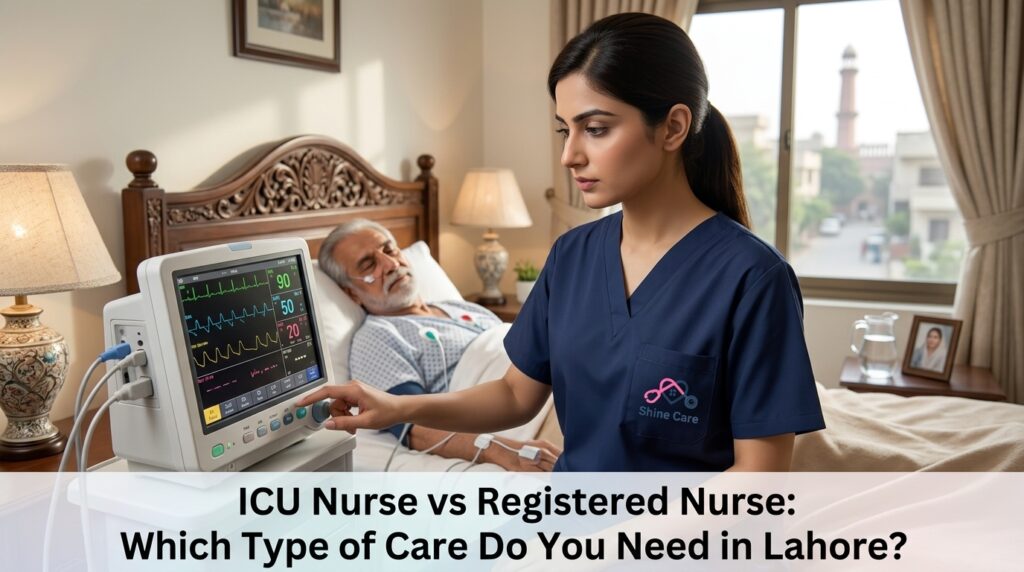
An ICU nurse typically has specialized experience caring for critically ill or medically complex patients, including those recovering from intensive care, managing ventilator support, or requiring close, continuous clinical observation. A registered nurse provides professional nursing care across a broad range of needs, including medication management, wound care, post-surgical recovery, and elderly care.
Neither type is automatically “better” — the right choice depends on the patient’s specific condition, treatment requirements, monitoring needs, and the treating doctor’s recommendation. Home nursing, at either level, should never replace emergency medical care when a patient’s condition genuinely requires immediate hospital attention.
Why Choosing the Right Nurse Matters After Hospital Discharge
The transition from hospital to home is often where families feel most uncertain. A patient who was closely monitored around the clock in a ward suddenly needs that same level of attention managed at home, without the immediate backup of a full medical team down the hallway.

Continuity of care matters enormously during this period. The nursing support arranged at home should align directly with what the hospital discharge summary recommends, not a generic arrangement disconnected from the patient’s actual treatment plan.
Medication support becomes critical in these first weeks, since timing and dosage errors are more likely during a transition than once a routine is firmly established. Monitoring for changes in condition — a wound that isn’t healing as expected, new confusion, or unusual fatigue — requires someone trained to recognize what’s normal recovery versus what needs a doctor’s attention.
Family confidence grows considerably when the right level of nursing support is in place, since relatives can trust that someone qualified is watching for the specific risks relevant to their family member’s condition. This also helps prevent avoidable complications, since early recognition of a developing problem often means the difference between a manageable adjustment and a hospital readmission.
Knowing when medical escalation is required is perhaps the most important piece of this puzzle. A properly matched nurse understands the boundary between what can be managed at home and what genuinely needs a doctor’s involvement or emergency care.
What Is an ICU Nurse?
An ICU nurse typically comes from a background in intensive or critical care nursing, often within a hospital ICU setting, working with patients whose conditions require continuous, close monitoring. This background usually includes advanced patient observation skills, developed specifically through experience managing medically complex cases where small changes in condition can signal serious complications.
ICU nurses generally have direct experience working with intensive-care equipment — ventilators, advanced monitoring systems, and other technology used for critically ill patients. This experience matters considerably when a patient’s home care needs involve similar equipment or monitoring requirements.
It’s worth being clear that not every ICU nurse performs every complex procedure independently in a home setting, and the specific scope of what a given nurse can safely provide should always be verified directly, based on their individual qualifications, experience, and the patient’s doctor-approved care plan. Verifying actual qualifications and relevant experience matters far more than assuming a job title alone guarantees a specific skill set.
What Is a Registered Nurse?
A registered nurse holds formal nursing education and professional registration, qualifying them for a wide range of clinical responsibilities across general and specialized patient care. This includes patient assessment, medication support, wound care, and monitoring vital signs as part of routine nursing practice.
Registered nurses commonly provide post-surgery care, supporting patients through standard recovery periods that don’t involve intensive-care-level complexity. Elderly care and chronic disease support — managing diabetes, hypertension, or similar ongoing conditions — fall well within typical registered nursing scope.
Patient and family education is also a core part of the role, since a registered nurse often helps families understand medication schedules, warning signs to watch for, and how to support a patient’s recovery safely between nursing visits or shifts.
ICU Nurse vs Registered Nurse: Side-by-Side Comparison
| Factor | ICU Nurse | Registered Nurse |
|---|---|---|
| Primary area of expertise | Critical and intensive care | General and specialized clinical nursing |
| Typical patient condition | Critically ill, medically complex, or recently discharged from ICU | Stable, recovering, or managing chronic conditions |
| Level of monitoring | Close, continuous observation | Routine, scheduled monitoring |
| Critical-care experience | Extensive, hospital ICU background | May vary; not the primary focus of training |
| Experience with complex medical equipment | Typically higher, depending on background | May depend on individual experience |
| Post-ICU recovery support | Often well-suited, depending on qualifications | May be suitable for less complex recovery, based on the care plan |
| Routine nursing care | Capable, though may be a different daily focus | Core area of expertise |
| Medication management | Yes, particularly for complex regimens | Yes, standard part of the role |
| Wound care | Yes, including more complex wounds depending on experience | Yes, including standard post-surgical wound care |
| Elderly patient support | Suitable, though may be less specialized than general elderly-focused RNs | Well-suited, often a core focus area |
| Long-term home care | Depends on the patient’s ongoing complexity | Often well-suited for stable, ongoing needs |
| Suitable home-care situations | Complex, high-monitoring cases | Broad range of routine and moderate-complexity cases |
This comparison should be read as a general guide rather than a strict rule. The right choice always depends on the specific nurse’s qualifications, experience, and the patient’s individual care plan, ideally discussed directly with the treating doctor.
What Services Can an ICU Nurse Provide at Home?
Where clinically appropriate and based on the individual nurse’s qualifications and the patient’s doctor-approved care plan, an ICU nurse may provide close monitoring of vital signs for patients whose condition requires more frequent or detailed observation than routine nursing typically involves. Care for medically complex patients, including those with multiple concurrent conditions, often falls within this scope.
Post-ICU recovery support helps bridge the transition from hospital intensive care to a stable home routine. Oxygen therapy support, and ventilator-related care under appropriate medical supervision, may be included depending on the nurse’s specific training and the care plan established with the treating doctor. Similarly, BiPAP or CPAP support, tracheostomy care, and suctioning may be provided where the nurse’s qualifications and the patient’s needs align.
NG tube care and feeding support, catheter care, and advanced wound care are commonly within an ICU-experienced nurse’s capability. Medication administration continues as part of this care, alongside close monitoring for changes in the patient’s condition and ongoing communication with the treating doctor or broader healthcare team.
Important safety note: Emergency symptoms — including sudden severe difficulty breathing, chest pain, loss of consciousness, or any acute deterioration — require immediate medical attention and should never be managed solely through routine home nursing. Home care, at any level, works alongside a treating doctor’s guidance, not as a substitute for emergency medical services when they’re genuinely needed.
What Services Can a Registered Nurse Provide at Home?
A registered nurse typically provides medication administration as prescribed, including injection services where appropriate and within their scope of practice. Wound dressing for standard post-surgical or chronic wounds is a routine part of the role, alongside general post-operative care during typical recovery periods.
Vital-sign checks, catheter care, and NG tube support fall within standard registered nursing responsibilities. Elderly nursing care and chronic disease support — helping manage conditions like diabetes or hypertension day to day — represent one of the most common reasons families arrange registered nursing care at home.
Patient hygiene assistance and mobility support round out daily care, while health education helps families understand what to expect and watch for during recovery. Routine clinical observation ties all of this together, ensuring changes in the patient’s condition get noticed and appropriately reported.
When Might a Patient Need an ICU Nurse at Home?
Families sometimes consider ICU-level home nursing in situations like a recent ICU discharge, where the patient’s condition, while improved, still requires closer monitoring than standard nursing typically provides. Ventilator-dependent or highly complex patients, and those requiring tracheostomy care, often benefit from a nurse with this specific background.
Patients requiring close clinical observation due to an unstable or evolving condition, severe neurological conditions, advanced respiratory support needs, complex post-surgical recovery, or multiple concurrent medical needs may also be situations where ICU-level nursing experience becomes particularly relevant.
In every case, the treating doctor should guide this decision, since they have direct knowledge of the patient’s specific condition, risks, and what level of home monitoring is genuinely appropriate.
When Might a Registered Nurse Be the Right Choice?
Many home nursing situations in Lahore fall well within standard registered nursing care — routine post-surgery recovery without significant complications, regular medication support, standard wound dressing, and stable chronic illness management. Elderly patients requiring general nursing assistance, routine monitoring, rehabilitation support, and general home nursing needs typically fit comfortably within this category as well.
ICU Nurse vs Registered Nurse for Elderly Care
Routine nursing support is often entirely sufficient for elderly patients managing stable chronic conditions, general daily health monitoring, and standard medication management. Advanced clinical monitoring becomes more relevant when an elderly patient has multiple complex medical conditions simultaneously, or has recently been discharged from intensive care.
It’s also worth distinguishing between caregivers and nurses in this context. A caregiver supports daily living tasks without medical training, while a nurse — whether ICU-experienced or a general registered nurse — handles the clinical side of care. A proper patient assessment, ideally involving the treating doctor, helps determine which combination of support genuinely fits an elderly patient’s situation.
ICU Nurse vs Registered Nurse After Surgery
A straightforward recovery from a routine procedure typically doesn’t require ICU-level nursing experience — standard wound care, medication support, monitoring, and mobility assistance from a registered nurse are usually sufficient. More complex recovery, particularly following major surgery with a higher complication risk, or recovery immediately following an ICU stay, may benefit from a nurse with more intensive-care background.
Regardless of which type of nurse is arranged, any signs of complications — unusual pain, fever, wound changes, or unexpected symptoms — should prompt medical review rather than being managed purely through routine home observation.
ICU Nurse vs Registered Nurse for Stroke Patients
Stroke recovery varies enormously depending on severity. Patients with significant mobility limitations, feeding difficulties, or aspiration risk often need closer monitoring and more specialized daily support. Vital-sign monitoring matters particularly in the early recovery period, when the risk of a second stroke or other complications remains elevated.
Rehabilitation support, often working alongside physiotherapy, applies to most stroke recovery cases regardless of nurse type. The specific level of nursing needed genuinely depends on the stroke’s severity and the patient’s current stability, which the treating doctor is best positioned to assess.
How to Choose the Right Nurse for Home Care in Lahore
- Ask directly about the nurse’s specific qualifications and registration status
- Verify nursing registration where formally applicable
- Check for ICU or other relevant clinical experience matching your patient’s condition
- Share the doctor’s discharge summary with the nursing provider
- Explain the patient’s current condition clearly and completely
- Discuss any specific procedures the patient’s care plan requires
- Confirm shift duration and scheduling that fits your household
- Ask directly how emergencies are handled during a nursing shift
- Clarify how communication and reporting will work, especially for family members who can’t be present
- Make sure the nurse’s actual experience matches what your patient’s condition genuinely requires
Questions Families Should Ask Before Hiring
- What is your specific nursing qualification, and is it currently registered?
- Do you have direct experience with my family member’s specific condition?
- What equipment or procedures are you trained and comfortable managing?
- How do you handle a situation where the patient’s condition suddenly changes?
- Will you coordinate directly with our treating doctor, and how often?
- What happens if you’re unavailable for an assigned shift?
- Can care be adjusted if my family member’s needs change over time?
- How will you communicate updates to family members, including those living abroad?
- What specific training do you have with equipment like ventilators, BiPAP, or feeding tubes, if relevant to our case?
- What would prompt you to recommend returning to the hospital rather than continuing home care?
Why Families Choose Shine Care for Home Nursing in Lahore
Shine Care focuses on patient-centered care, starting every case with an actual conversation about the patient’s condition rather than a generic intake process. Experienced nursing staff are matched based on relevant background — whether a case calls for ICU-level experience or standard registered nursing care — rather than assigned without regard to the patient’s specific needs.
Personalized care planning shapes every placement, built around the patient’s actual diagnosis, doctor’s recommendations, and daily routine. Male and female nursing staff are available, subject to availability, so families can choose based on what’s most appropriate for their situation.
Flexible care schedules support both short-term needs, like post-surgical recovery, and longer-term arrangements for chronic or ongoing conditions. Coordination happens based on each patient’s specific requirements, and service is available across Lahore for families needing this kind of support.
Home Nursing Coverage Across Lahore
Shine Care provides home nursing services across DHA Lahore, Bahria Town Lahore, Johar Town, Gulberg, Model Town, Wapda Town, Valencia Town, Faisal Town, Lahore Cantt, Askari, Bedian Road, and Barki Road. If your home falls outside these areas, reach out directly to confirm whether coverage is available.
Frequently Asked Questions
Not necessarily “more qualified” overall — an ICU nurse typically has specialized experience in critical care, while a registered nurse has broad clinical training across many areas. The right choice depends on what your patient’s specific condition actually requires, not a general ranking of one over the other.
Yes, many ICU-experienced nurses provide home care, particularly for patients with complex or intensive monitoring needs. The specific services provided should always align with the nurse’s individual qualifications and the patient’s doctor-approved care plan.
This is generally most relevant for patients discharged from an ICU who still need close monitoring, those with ventilator or tracheostomy needs, or patients with multiple complex medical conditions. Your treating doctor is best positioned to advise on this specific decision.
Yes, for most routine surgical recoveries without significant complications, a registered nurse’s training and experience are well-suited to managing wound care, medication, and general recovery support.
Yes, elderly care is one of the most common areas registered nurses support, including medication management, chronic disease monitoring, and general daily health support.
Not necessarily. Many patients stabilize enough by discharge that standard registered nursing care is sufficient. This depends entirely on the patient’s specific condition and the treating doctor’s assessment at the time of discharge.
Where appropriate and based on the individual nurse’s training, ventilator-related care and tracheostomy management may be included, always under the guidance of the patient’s doctor-approved care plan.
This depends on the stroke’s severity and the patient’s current stability. More significant mobility or feeding complications, or ongoing monitoring needs, may call for more intensive nursing experience, while stable, lower-complexity recovery may be well-managed by a registered nurse.
Yes, both male and female nursing staff are typically available, subject to current availability, and families can discuss this preference when arranging care.
Yes, nursing shifts can typically be arranged for a range of durations, including 12-hour or full 24-hour coverage, depending on what the patient’s condition and household situation require.
Share the patient’s diagnosis, any hospital discharge summary, current medications, specific procedures required, and any particular concerns your family has noticed, so the right nurse can be matched to the case.
No. Home nursing, whether provided by an ICU-experienced nurse or a registered nurse, supports ongoing care and recovery but does not replace emergency medical services when a patient’s condition genuinely requires immediate hospital attention.
Conclusion
ICU nurses are generally suited to patients with complex or critical-care needs, particularly those transitioning from intensive hospital care or managing advanced medical equipment at home. Registered nurses are well-suited to a broad range of routine and ongoing nursing requirements, from post-surgical recovery to elderly care and chronic disease management.
Ultimately, the patient’s doctor, diagnosis, current stability, and established care plan should guide the final decision between these two types of nursing support, rather than an assumption that one is universally superior to the other.
Contact Shine Care to discuss your family member’s specific care needs and receive guidance on arranging the right kind of home nursing support in Lahore.