

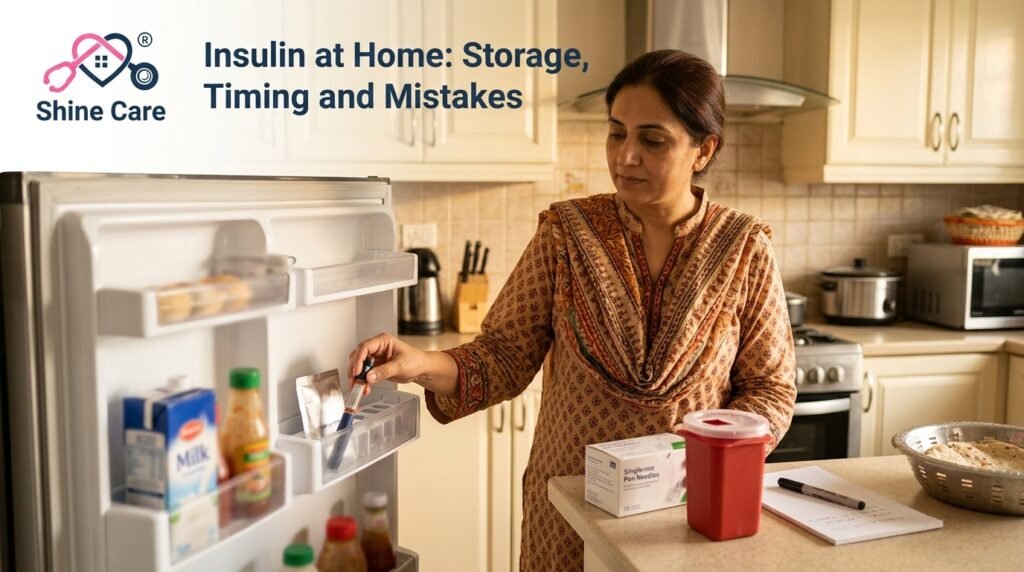
A patient in Lahore takes their insulin exactly as prescribed, at the right times, without missing a dose — and their sugar readings still make no sense.
Very often the insulin is not the problem. The way it has been stored is, or where it is being injected, or a needle that has been used eleven times. None of those show up on a prescription, and none of them are usually explained properly.
This guide covers insulin injection at home in Lahore: how to store it in our climate, the eight mistakes that quietly ruin control, and the situations where getting it wrong becomes an emergency.
Storage: the part Lahore makes harder
The instruction leaflet says opened insulin can be kept at room temperature for up to 28 days. Families read that and leave the pen on a shelf.
But look at what “room temperature” actually means. Guidance from the US Food and Drug Administration on insulin storage states that insulin in vials or cartridges may be left unrefrigerated at a temperature between 59°F and 86°F — roughly 15°C to 30°C — for up to 28 days and continue to work.
Thirty degrees. A closed room in Lahore in June sits well above that for most of the day, and during load-shedding hours it climbs higher.
The FDA is equally clear about the consequence: insulin loses some effectiveness when exposed to extreme temperatures, and the longer that exposure, the less effective it becomes — which shows up as loss of blood glucose control over time.
That is the explanation for a great many “unexplained” high readings in a Lahore summer. The patient is taking insulin that is no longer doing its job properly.
What to do in our climate
- Keep the in-use pen or vial in the fridge door through the summer months, not on a shelf — unless the treating doctor has advised otherwise for the specific insulin
- Take it out 15 to 30 minutes before injecting. Cold insulin stings going in and is the reason many patients start dreading the injection
- Never leave it in a car, on a windowsill, near a stove, or in direct sunlight
- Write the date you opened it on the pen or vial with a marker. Almost nobody does this, and it is how expired insulin stays in use
- Use a cool bag or insulated pouch for travel, without direct contact with ice
Fridge rules — and the mistake that destroys insulin completely
Unopened insulin belongs in the fridge at 2°C to 8°C until its expiry date.
Never freeze insulin, and never use insulin that has frozen. Freezing destroys it permanently, and it cannot be recovered by warming it up.
The trap is that insulin can freeze at the back of a fridge without anybody intending it. Keep it in the door or on a middle shelf, well away from the freezer compartment and the cold air outlet. Older fridges here run colder at the back than the dial suggests.
Load-shedding
Long outages warm a fridge, which is the opposite problem in summer and rarely thought about.
- Keep the fridge door closed during outages — it holds temperature for hours if left shut
- Do not move insulin to a freezer “to keep it cold” during an outage. That destroys it
- For very long daily outages, ask the pharmacy or your doctor about an insulated cooling pouch
- If insulin has clearly been warm for days, tell the doctor rather than continuing and wondering why control has slipped
What spoiled insulin looks like
Clear insulins should be completely clear and colourless. Cloudy insulins should look evenly milky after mixing.
Do not use it if you see clumps, floating particles, a frosted or crystalline appearance on the inside of the vial, a colour change, or if a clear insulin has become cloudy. Show it to a pharmacist or doctor rather than deciding at home.
The eight mistakes that quietly ruin control
1. Reusing needles
Extremely common here, and understandable — needles cost money. It is also directly linked to the next problem on this list.
Injection technique guidance is unambiguous: never reuse pen needles or syringes, because reuse is linked to lipohypertrophy formation. A reused needle is also blunt and barbed after the first use, which is why injections start hurting more.
2. Not rotating injection sites
Patients find one spot that does not hurt and use it every single day for years.
That area develops lipohypertrophy — firm, rubbery lumps of thickened fatty tissue under the skin. And here is why it matters: insulin injected into those lumps is absorbed unpredictably. Some days too little gets in, some days a delayed amount arrives all at once.
Erratic sugars, unexplained hypos, and rising insulin doses that never quite work — all of that can come from lumps that nobody has ever examined.
What to do: rotate between the main sites the doctor has approved, and rotate within each site as well, keeping each injection about a centimetre away from the last. Inspect the skin before every injection, and avoid any lumpy or bruised area.
3. Injecting into the lump because it does not hurt
This follows directly from the last one and it is the reason patients resist changing.
Lipohypertrophic tissue has reduced sensation, so injecting into it is comfortable. The patient keeps going there precisely because it is the least painful spot — and absorption keeps getting worse.
If a patient says one area “does not hurt at all”, that is a reason to have it examined, not a reason to keep using it. And be aware: when a patient moves off a lump onto healthy tissue, absorption improves and the dose may need reviewing by the doctor.
4. Shaking cloudy insulin instead of rolling it
Premixed and cloudy insulins must be resuspended before injecting. The correct method is to roll the pen or vial gently between the palms about ten times, then tip it end over end.
Shaking creates air bubbles and froth, which means the dose delivered is not the dose set.
5. Not priming the pen
Before each injection, a small priming dose is expelled with the needle pointing upward until a drop appears at the tip. This clears air from the needle.
Skip it, and part of the dose is air. The patient believes they took their full dose. They did not.
6. Pulling the needle out too quickly
Injection guidance is specific here: after pressing the dose button fully, count to ten before withdrawing the needle.
Pull out immediately and insulin leaks back out of the skin. Patients often notice a wet patch and assume it is normal — it is a lost portion of the dose, happening at every single injection.
7. Injecting through clothes
It happens in a rush, or for privacy in a joint family household. It prevents the patient from seeing the site, stops proper site inspection, blunts the needle, and risks infection.
If privacy is the reason, that is a solvable problem — arrange a private space and a routine time.
8. Injecting into muscle instead of fat
Insulin is meant to go into the fatty layer just under the skin. Into muscle, it is absorbed much faster and unpredictably, which can cause a hypo.
Guidance recommends a 4mm pen needle to minimise the risk of intramuscular injection, with children and slim adults sometimes needing a lifted skin fold. Ask the treating doctor which needle length suits this patient rather than using whatever the pharmacy handed over.
Timing
Insulin timing is set by the doctor for the specific type prescribed, and it is not something to adjust at home. But two principles are worth understanding.
Rapid and short-acting insulins are tied to meals. Taking them and then not eating on time is one of the most common causes of hypoglycaemia in our households — someone takes their insulin, then the food is delayed by an hour because guests arrived.
Long-acting insulin works best taken at roughly the same time every day. Drifting by two or three hours from one day to the next produces exactly the erratic readings families struggle to explain.
Write the prescribed times on a card and keep it where the insulin is stored. And if the patient is elderly or forgetful, somebody should be checking rather than assuming.
Ramadan
Every insulin-treated family asks this, and it deserves a proper answer.
Fasting changes both when the patient eats and how their body handles insulin, and insulin doses and timings almost always need adjusting for Ramadan. Some patients on insulin are medically advised not to fast at all, particularly those with a history of hypos, poor control, or other complications — and Islamic guidance recognises exemption where health would be harmed.
What causes harm is a patient quietly deciding to fast, keeping their usual doses, and telling nobody.
Have the conversation with the doctor before Ramadan begins, not during the first week — and speak to a scholar you trust if the family wants religious guidance. Never adjust insulin doses for fasting on your own.
Sick days: the rule that saves lives
When a diabetic patient falls ill — fever, infection, vomiting, diarrhoea — the instinct is to stop the insulin because they are not eating.
Do not stop insulin because the patient is not eating. Illness raises blood sugar even without food, and stopping insulin during illness is a leading cause of diabetic emergencies.
Ask the treating doctor for written sick-day instructions before they are needed: whether doses change, how often to check sugar during illness, when to check for ketones, and at what point to go to hospital. Keep that card with the insulin.
Hypoglycaemia: recognise it and treat it fast
Every household with an insulin patient should know these signs and have something sugary within reach at all times.
Early signs: shaking, sweating, palpitations, sudden intense hunger, anxiety, tingling around the lips, pale skin.
Later signs: confusion, slurred speech, unusual behaviour, blurred vision, drowsiness, difficulty concentrating.
What to do if the patient is awake and able to swallow: give a fast-acting sugar immediately — glucose tablets, half a glass of regular juice or a sugary drink, or a few teaspoons of sugar in water. Wait 10 to 15 minutes and recheck. Once recovered, give a snack containing starch if the next meal is not due soon.
Seek emergency care immediately if the patient is unconscious, having a seizure, or cannot swallow safely. Never put food or drink into the mouth of a patient who is not fully awake.
Two local notes. Elderly patients often lose the early warning signs entirely and go straight to confusion, which families mistake for age. And in summer, sweating and weakness get blamed on the heat — check the sugar rather than assuming.
Sharps disposal
Used needles go into a puncture-proof container with a lid, kept out of children’s reach. Never loose in a household bin, never in a plastic shopping bag, never left on a bedside table.
An empty hard-plastic detergent bottle with a secure cap works where a proper sharps container is not available. Label it clearly, tape the lid down when three-quarters full, and ask your pharmacy or clinic about disposal.
Insulin support at home in Lahore
Many patients manage their own insulin without difficulty. Support becomes genuinely useful in specific situations.
Ongoing diabetes management
Sugar monitoring, insulin timing, diet, foot checks and recognising the early signs of a hypo all sit together. That whole picture is diabetes care at home.
Daily supervision for patients who cannot manage alone
Elderly patients, patients with poor eyesight, tremor or arthritis, and patients with memory problems frequently cannot draw up or inject reliably. An assistant nurse can supervise the routine, check the sites, and make sure doses and meal timing actually match.
Clinical care and technique review
Where the injections are being given by staff, or where technique and injection sites need proper assessment, that is the work of a registered nurse — including examining for lipohypertrophy, which is rarely checked and often the missing explanation for erratic control.
Injections as a scheduled visit
Where a patient needs a specific injection given properly rather than continuous care, a nurse visits, does it and leaves. That falls under short procedures at home.
Blood tests without the journey
HbA1c and other tests guide every dose adjustment. Home lab sampling means an elderly or unwell patient is not travelling across Lahore for a blood draw.
Support for older patients
For elderly patients who need help with insulin alongside everything else — meals, mobility, hygiene and company — that sits within elderly care at home.
Frequently asked questions
Guidance allows opened insulin at room temperature for up to 28 days — but that assumes a temperature no higher than about 30°C. In a Lahore summer, the fridge door is the safer place. Ask your doctor about the specific insulin you use.
One warm night is unlikely to ruin it, but repeated exposure to high temperatures reduces its effectiveness. If sugars are unexpectedly high and the insulin has been warm, mention it to the doctor rather than simply increasing the dose.
No. Reuse is linked to lipohypertrophy and the needle is blunt after the first injection, which increases pain and tissue damage. This is the one cost saving that ends up costing far more in poor control.
Common causes include injecting into lipohypertrophic lumps, inconsistent injection timing, insulin that has been stored too warm, not counting to ten before withdrawing the needle, and inconsistent meal timing. Ask a nurse or doctor to examine the injection sites — this is very often the answer.
No. Illness raises blood sugar even without food, and stopping insulin during illness is dangerous. Ask the doctor for written sick-day rules in advance.
Yes, and it is common for elderly patients. The training should come from the doctor or nurse, formally, and should cover storage, site rotation, technique, and recognising a hypo — not just how to press the pen.
Yes. Take it out of the fridge 15 to 30 minutes before injecting. This one change makes injections noticeably more comfortable and improves how consistently patients take them.
Something fast-acting and easy to reach in every room the patient spends time in — glucose tablets, juice or plain sugar. Make sure everybody in the house knows where it is and what the early signs look like.
Arranging support in Lahore
Shine Care provides nursing and daily support for diabetic patients across Lahore, working to the plan set by the treating doctor. If sugars are erratic despite correct doses, ask us to have the injection sites and technique reviewed — it is a short visit that often explains months of poor control.
Contact us to discuss it.