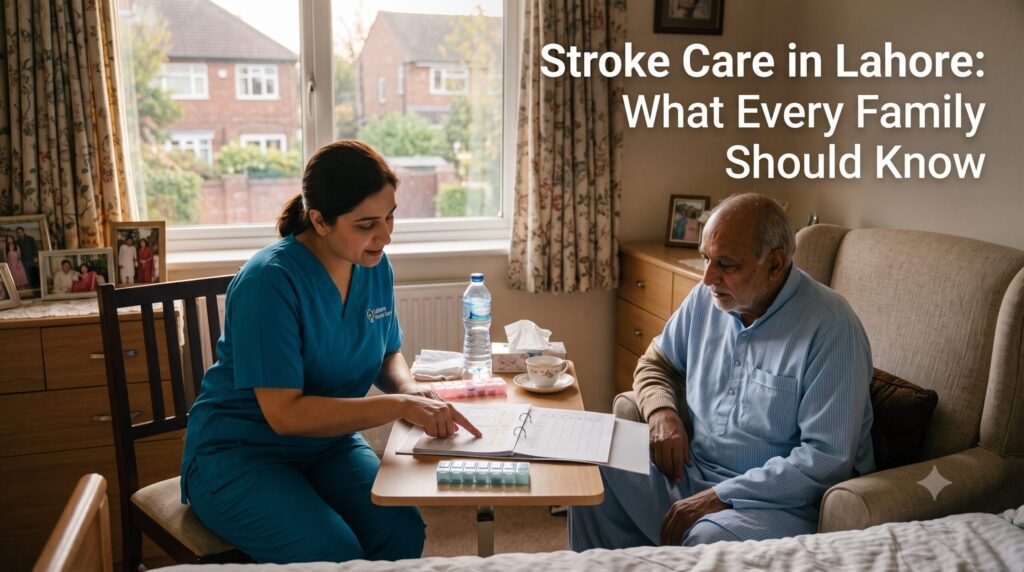
A stroke changes a household overnight. One day everything is normal, and the next, a family in Lahore is sitting in a hospital corridor trying to understand what just happened to their father, mother, or spouse. This guide is meant to help with exactly that moment. Below, we’ve broken down what a stroke actually is, the different types, the warning signs families often miss, and what proper stroke care in Lahore should look like once the patient comes home.
What Is a Stroke, Really?
A stroke happens when blood supply to part of the brain gets cut off or reduced. Without oxygen, brain cells begin to die within minutes, which is why speed matters so much in the first few hours.
There isn’t just one kind of stroke, though. The type a patient has changes both the immediate treatment and the recovery path afterward.
Types of Stroke Patients Deal With
Ischemic Stroke This is the most common type, caused by a blood clot blocking an artery that supplies the brain. Roughly 8 out of 10 strokes fall into this category.
Hemorrhagic Stroke This happens when a blood vessel in the brain ruptures and bleeds. It’s less common than ischemic stroke but tends to be more severe, and recovery often takes longer.
Transient Ischemic Attack (TIA) Often called a “mini-stroke,” a TIA causes stroke-like symptoms that resolve within minutes or hours. It’s a serious warning sign of a larger stroke to come, and it should never be dismissed as “nothing happened.”
Each type calls for a different level of monitoring at home. A patient recovering from a hemorrhagic stroke, for instance, usually needs closer nursing supervision than someone recovering from a TIA.
Warning Signs Families in Lahore Often Miss
Doctors commonly use the term FAST to describe the early signs of a stroke:
- F – Face drooping: One side of the face feels numb or looks uneven when the person smiles.
- A – Arm weakness: One arm drifts downward or feels weak when raised.
- S – Speech difficulty: Words sound slurred, or the person struggles to speak clearly.
- T – Time to call for help: If any of these signs appear, getting to a hospital quickly matters more than anything else.
Some families in Lahore mistake early stroke symptoms for fatigue or a minor dizzy spell, especially in elderly patients living alone. That delay in recognizing the signs is often what makes recovery harder later on.
Life After the Hospital: Why Home Care Matters
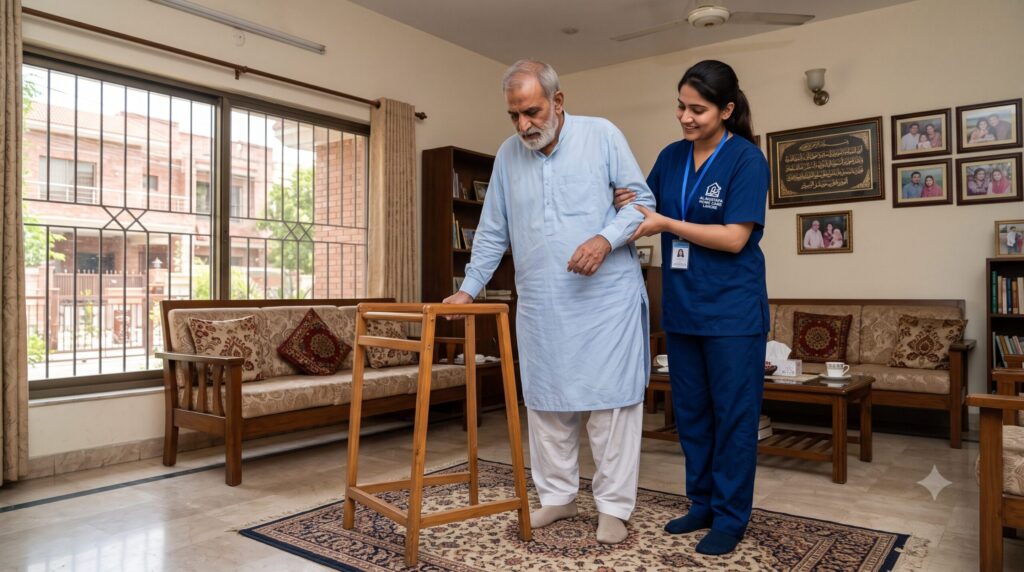
Once a stroke patient is medically stable, the hospital usually discharges them, but recovery is far from over. This is where things get complicated for most families — figuring out how to manage physiotherapy, medication schedules, and daily mobility support without a hospital nurse around.
This is exactly the gap that home-based stroke care is meant to fill.
How Most Home Care Providers Approach Stroke Recovery
To be fair to families comparing their options, it’s worth understanding how stroke care usually works with most providers in Lahore.
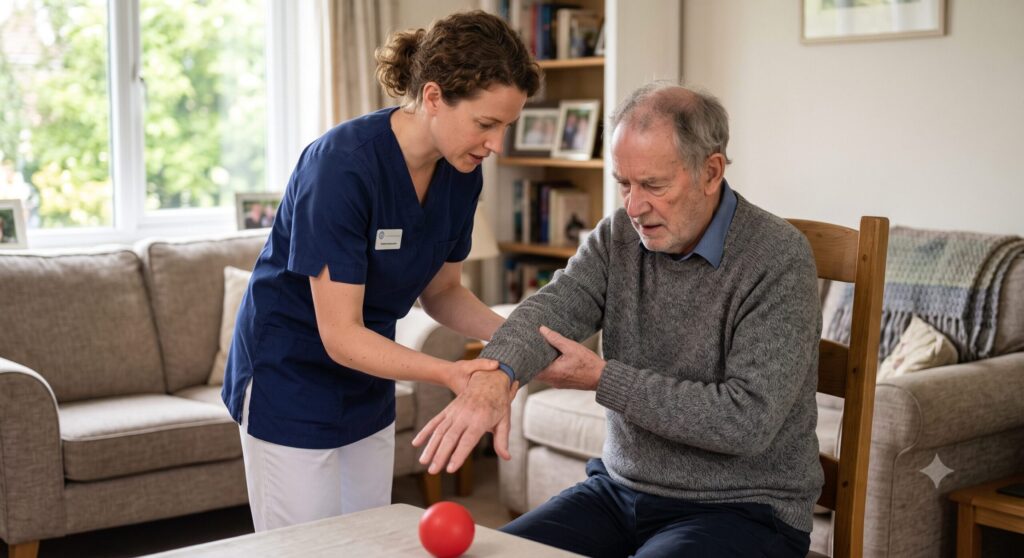
Typically, a caregiver is assigned to assist with basic daily tasks — helping the patient move, eat, and stay comfortable. Physiotherapy, if included at all, is often outsourced to a separate visiting therapist who isn’t directly coordinating with the caregiver. Medical monitoring tends to be minimal unless specifically requested, and there’s usually limited communication back to the family about how the patient is actually progressing week to week.
This approach isn’t wrong, exactly. But for stroke patients, gaps in coordination between the caregiver, the physiotherapist, and the family can slow recovery down without anyone noticing until progress stalls.
How Shine Care Handles Stroke Recovery Differently
Our approach is built around keeping everyone on the same page — the nurse, the caregiver, the physiotherapist, and the family.
Coordinated care, not separate services. Instead of treating nursing, physiotherapy, and daily assistance as three disconnected services, our team works as one unit around a single recovery plan.
Trained specifically for stroke patients. Our caregivers and nurses understand movement limitations, speech difficulties, and swallowing risks that come with stroke recovery, rather than applying generic elderly care methods.
Regular progress updates for the family. You’ll know how mobility, speech, and daily function are improving, not just that “everything is fine.”
Flexible care intensity. Whether a patient needs a few hours of support a day or full-time nursing after a severe hemorrhagic stroke, the plan adjusts to the actual medical need rather than a fixed package.
Family training included. We show family members how to safely assist with transfers, feeding, and daily movement, so care doesn’t fall apart when our staff isn’t in the room.
Why Choose Shine Care for Stroke Care in Lahore
Families usually come to us after realizing that stroke recovery needs more than a general caregiver. A few reasons they stay with us:
- Nurses and caregivers specifically experienced with post-stroke patients
- Physiotherapy built into the care plan, not handled as an afterthought
- Transparent, honest communication about recovery progress
- Flexible scheduling, from part-time visits to round-the-clock care
- Coverage across major areas of Lahore, including Gulberg, DHA, Model Town, and Johar Town
Our Stroke Care Process
- Initial call – You share the patient’s condition and stroke type with our team.
- Assessment – A coordinator reviews the medical history and current mobility or speech limitations.
- Care plan design – We build a plan combining nursing, physiotherapy, and daily assistance based on the assessment.
- Staff matching – A nurse and caregiver experienced with stroke recovery are assigned.
- Care begins at home – Support starts, often within a day or two of the initial call.
- Ongoing review – We adjust the plan as the patient’s condition changes over time.
We Also Serve Families in Islamabad
Shine Care operates in Islamabad as well, through our sister service, Shine Care Home Nursing. If you have family recovering from a stroke there, the same coordinated approach to nursing, physiotherapy, and caregiver support is available in Islamabad too.
Frequently Asked Questions
Ischemic stroke is the most common, caused by a blood clot blocking blood flow to part of the brain.
Home care usually starts right after hospital discharge, once the patient is medically stable enough to be managed outside a hospital setting.
Many patients see improvement with consistent rehabilitation and practice, though the pace varies depending on the severity of the stroke.
Yes, physiotherapy is built directly into our stroke care plans rather than arranged separately.
A caregiver assists with daily activities like bathing and mobility, while a nurse handles medical tasks such as medication management and monitoring vital signs. Our stroke care plans typically involve both.
Yes, round-the-clock care is available for patients who need continuous supervision, particularly after a hemorrhagic stroke.
This depends on the type and severity of the stroke. Our coordinators assess this during the initial consultation and recommend the right combination.
Yes, through Shine Care Home Nursing, similar services are available in Islamabad.
Yes, we train family members on safe transfer techniques, feeding support, and daily movement assistance.
Recovery timelines vary widely depending on stroke type and severity, ranging from a few weeks to several months of consistent rehabilitation.
Conclusion
Stroke recovery isn’t just about physical therapy exercises. It’s about coordination — making sure the nurse, the caregiver, and the family are all working from the same plan, with clear communication throughout.
If your family is navigating stroke recovery in Lahore, Shine Care’s team is ready to build a coordinated care plan around your loved one’s specific needs.
Ready to arrange stroke care at home? Contact Shine Care to speak with our care coordinators, or explore our full Stroke Care service here.