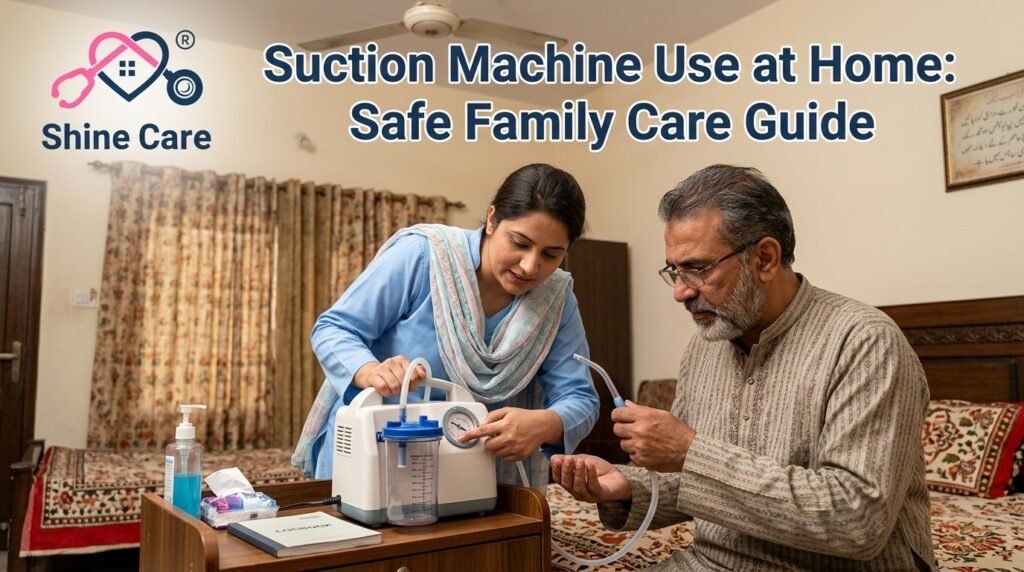
The stroke patient came home last week. The doctor said suction would be needed for secretions the family father cannot cough out. The equipment supplier delivered a machine, showed the family how to switch it on, and left. Now, at 2 AM, the patient is making a rattling sound the family has never heard, secretions are visible at his mouth, and the daughter — hand shaking — is holding a suction catheter she has watched a nurse use twice, wondering exactly how far to push it, how long to suction for, and whether she is about to make things worse.
Suction machines save lives. Used wrongly, they injure airways, cause bleeding, drop oxygen saturation, and introduce infections. In Pakistani households, families are often expected to become suction operators after a demonstration or two, with limited real training. This guide walks families through suction machine use at home realities — when suctioning is needed, what safe technique looks like, what warning signs matter, and how to build a home care arrangement that protects the patient rather than putting them at risk. Nothing here replaces the nurse’s hands-on training or the doctor’s specific protocol; this is the background layer that makes the training make sense.
Why Suction Is Needed at Home
Healthy people constantly produce secretions and clear them automatically through swallowing and coughing. When either of these fails, secretions accumulate and can:
- Block the airway
- Cause aspiration into the lungs
- Drop oxygen saturation
- Cause pneumonia
- Distress the patient
Suction machines pull secretions out mechanically when the patient cannot clear them on their own. Common home users include:
- Post-stroke patients with weak swallow and weak cough
- Patients with tracheostomies
- Patients on home ventilators
- Advanced motor neurone disease
- Cerebral palsy patients with persistent secretion issues
- Bedridden elderly with chronic chest problems
- Some cancer patients as part of palliative care
- Patients recovering from certain airway or chest surgeries
Who Does What at Home
- Doctor / Pulmonologist / Physician: Prescribes suctioning as part of the care plan, sets the recommended pressure and frequency, and treats any complications that develop.
- Registered Nurse: Performs suctioning for tracheostomy and ventilator patients — this is not a family task without significant training. Teaches family safe technique for oral suction where it is appropriate. Structured home nurse presence at the bedside for high-risk patients is what makes home suction safe rather than dangerous.
- Physiotherapist: Chest physiotherapy loosens secretions so suctioning is more effective. Also teaches positioning that reduces the need for suction.
- Caretaker / Attendant: Trained to perform oral suction and to recognise when nurse involvement is needed. Should not perform tracheostomy or deep suction without specific training.
- Family: Learns basic technique for support and emergencies, notices when the patient’s condition changes, and ensures supplies and equipment are maintained.
For families in Lahore caring for a patient who needs regular suctioning, structured health at home arrangements that combine trained nursing with adequate consumables and clear protocols work better than family attempts to manage alone after a brief demonstration.
Two Very Different Types of Suction
Oral or Oropharyngeal Suction
Removing visible secretions from the mouth and throat. Relatively lower risk. Can be done by trained family members after proper instruction.
Deep or Tracheal Suction
Passing the catheter down through a tracheostomy or nasally into the trachea. Higher risk. Requires training and, for tracheostomy patients, usually nursing skill.
The two are not interchangeable. Families should never perform deep suction without specific training from a nurse, and should never attempt tracheostomy suction on their own without appropriate teaching. Coordinated care for elderly patients requiring regular deep suction should include nurse coverage for the times suction is likely to be needed.
When to Suction
Suctioning should be needs-based, not scheduled. Signs the patient needs suction:
- Visible secretions in the mouth or airway
- Wet, rattling sounds when breathing
- Coughing that does not clear the secretions
- Falling oxygen saturation
- Increased breathing rate or work of breathing
- Patient distress or agitation
- Restlessness that resolves after suctioning
Suctioning without indication damages the airway, drops oxygen, and stresses the patient unnecessarily. Over-suctioning is as harmful as under-suctioning.
Setting Up the Machine Safely
Before You Start
- Confirm the machine is clean and assembled correctly
- Confirm suction pressure is set to the prescribed level — usually 80–120 mmHg for adults, less for children
- Fresh sterile catheter of the correct size
- Sterile gloves for tracheostomy suction
- Container of sterile normal saline for flushing the catheter
- Fresh disposable underpad if needed
- Pulse oximeter on the patient’s finger to monitor saturation
Correct Pressure
Too low — cannot clear secretions effectively. Too high — damages the airway lining, causes bleeding, and drops oxygen dangerously. The pressure gauge on the machine shows current suction; adjust with the regulator until the prescribed level is reached.
Correct Catheter Size
Too big — damages the airway and cannot pass into narrow tubes. Too small — cannot clear thick secretions. The doctor or nurse specifies the size for the patient. Catheters are colour-coded by size internationally.
Safe Oral Suction Technique
For clearing visible secretions in the mouth and throat:
Position the Patient
Semi-upright — 30 to 45 degrees head elevation. Head turned slightly to one side to allow drainage.
Hand Hygiene
Wash hands. Apply clean gloves.
Attach Fresh Catheter
Sterile packaging opened just before use. Attach the catheter to the tubing without touching the catheter tip.
Test the Suction
Briefly suction sterile water or saline through to confirm the machine is working and pressure is correct.
Insert Without Suction
Guide the catheter gently into the mouth toward the visible secretions. Do not apply suction while advancing — this damages the airway.
Apply Suction on Withdrawal
Once at the target area, cover the suction control port with your thumb, and gently withdraw the catheter while suctioning. Move slowly, allowing suction to clear secretions.
Limit Each Pass
10–15 seconds maximum. Longer drops oxygen dangerously. Even if secretions remain, stop and allow the patient to recover before another pass.
Flush the Catheter
After each pass, suction some saline through the catheter to flush secretions out of the tubing.
Watch Saturation
Monitor the pulse oximeter throughout. If saturation drops below the doctor’s set threshold, stop suctioning and allow recovery. Pre-oxygenate before further suction if the patient is on supplemental oxygen.
Rest Between Passes
Allow at least 30 seconds between passes for the patient’s oxygen to recover.
Reassess
After suctioning is complete, listen to the breathing, watch the chest, and confirm secretions have been cleared adequately.
Dispose Properly
Discard the used catheter. Remove gloves. Wash hands.
What NOT to Do
Do Not Suction Longer Than 15 Seconds Per Pass
Oxygen drops rapidly during suction. Prolonged suction causes hypoxia, bradycardia, and even cardiac arrest in vulnerable patients.
Do Not Apply Suction While Advancing
Damages the airway lining. Only apply on withdrawal.
Do Not Move the Catheter Aggressively
Gentle rotation is fine. Vigorous pushing or twisting damages tissue.
Do Not Suction on a Schedule
Suction when clinically indicated, not on the clock.
Do Not Reuse Catheters
Single-use only. Reused catheters carry bacteria back into the airway.
Do Not Ignore Alarms or Falling Saturation
These signal a problem. Stop, recover, reassess.
Do Not Perform Deep or Tracheostomy Suction Without Training
The risks are real. Get a nurse to teach the specific technique for your patient before attempting.
Signs Suctioning Is Causing Problems
Stop and reassess if:
- Oxygen saturation drops rapidly
- Heart rate changes significantly
- Blood appears in the aspirated secretions
- Patient becomes very distressed or agitated
- Colour change — pale, blue-tinged
- Repeated coughing that does not settle
- Increased secretions after suctioning
These may indicate the technique is wrong, the pressure is too high, or the patient has developed a complication.
Managing Common Scenarios
Thick Secretions That Will Not Come Out
Instil a small amount of sterile saline (2–3 mL) if the doctor or nurse has directed this, wait a moment for it to thin the secretions, then suction. Do not routinely instil saline without medical guidance — evidence is mixed and some patients are harmed by it.
Patient Coughs Hard During Suction
Stop suction briefly, let the patient cough — coughing is actually helpful and often clears more than suction alone.
Patient Cannot Tolerate Suction
Some patients gag or become very distressed. Try smaller catheter size, shorter passes, and consider whether chest physiotherapy could reduce the need for suctioning.
Bleeding After Suction
Small streaks in the aspirated secretions may be from minor airway irritation. Persistent or increasing bleeding needs medical review. Contact the doctor.
Blocked Tubing
Detach the catheter, flush the tubing with water, reattach. Have replacement tubing available.
Sudden Airway Obstruction
Emergency. If suction does not clear it and the patient’s saturation is dropping, position the patient, continue attempts to clear, and call for medical help. For tracheostomy patients, be prepared for tube changes only if trained.
Chest Physiotherapy Alongside Suction
Suction alone often does not clear deeper secretions. Chest physiotherapy — positioning, percussion, vibration — moves secretions from smaller airways into larger ones where suction can reach them. For patients on regular suction:
- Chest physio 30 minutes before scheduled suction pass often improves clearance
- Positioning changes throughout the day reduce secretion accumulation
- Adequate hydration keeps secretions less viscous
- Humidified oxygen reduces the drying that thickens secretions
A physiotherapist who visits regularly for a patient on suction often reduces the total suction frequency needed.
Preventing Complications
Infection Prevention
- Hand hygiene before and after every suction
- Sterile gloves for tracheostomy suction
- Sterile technique with catheters
- Fresh catheter every pass
- Machine and jar cleaning as per protocol
Airway Trauma Prevention
- Correct catheter size
- Correct pressure
- Gentle technique
- No suction on advancement
- Limited duration
Hypoxia Prevention
- Pre-oxygenate before deep suction in patients with borderline saturation
- Limit each pass
- Adequate rest between passes
- Continuous saturation monitoring
Aspiration Prevention
- Head-of-bed elevation
- Position turned to allow drainage
- Effective clearance before repositioning
Special Situations
Post-Stroke Patients With Weak Cough
Occasional suction for oral secretions common. Family can learn oral suction technique for these patients with proper training.
Tracheostomy Patients
Regular deep suction usually needed. Trained nursing presence essential. Not a family-alone task.
Home Ventilator Patients
Continuous trained nursing. Suction is part of ICU-level home care.
Palliative Care Patients
Suction for symptom control. Balance clearing secretions with patient comfort. Sometimes gentle repositioning does more than suction.
Pediatric Patients
Special considerations — smaller catheters, lower pressure, more careful monitoring. Never use adult technique on children.
Diabetic Patients With Neurological Complications
Combined swallowing and cough weakness. Coordinated diabetes care alongside airway management often needed.
Patients With BP Fluctuations
Suction can transiently raise BP. Structured hypertension care should include awareness of this in the treatment plan.
Building the Right Home Setup
For families in Lahore setting up home suction for a patient, coordinated arrangements typically include:
- Trained registered nurse coverage matched to patient need
- Appropriate suction machine with backup availability
- Adequate consumable supply — catheters, saline, gloves
- Chest physiotherapy on a schedule
- Pulse oximeter for continuous monitoring
- Emergency response plan including manual suction backup and hospital contact
- Regular medical review by a visiting doctor for ongoing patients
Common Mistakes Families Make
Attempting Deep Suction After Watching a Nurse
Watching is not learning. Hands-on training under supervision matters.
Suctioning on a Schedule Instead of by Need
Damages the airway with no benefit. Suction when secretions are audible or visible.
Ignoring Falling Saturation During Suction
Continuing suction while the patient becomes hypoxic causes real harm.
Using Household Water or Non-Sterile Saline
Only sterile saline in the airway. Household water can introduce infection.
Not Having Backup for Power Failure
Manual suction backup should always be present for patients dependent on regular suction.
Skipping Machine Cleaning
Contaminated jars and tubing become bacterial reservoirs. Reference the specific cleaning routine covered in dedicated maintenance guides.
Not Getting Adequate Nursing Support
Attempting to manage a tracheostomy patient with family-only care is dangerous. Match nursing coverage to actual need.
Red Flags: When to Seek Emergency Help
Contact the doctor or take to the emergency room / call 1122 for any of the following:
- Suction fails to clear an obstructing secretion and the patient is becoming hypoxic
- Significant bleeding from the airway during or after suction
- Sudden severe drop in oxygen saturation not recovering after suction
- Bluish colour around lips or fingertips
- Tracheostomy tube coming out
- Patient becomes unresponsive during suction
- Sudden severe chest pain or shortness of breath
- Fever with new coloured secretions — possible infection
- Complete machine failure with no backup
For patient-friendly background on airway clearance and safe suctioning, the NHS guide to tracheostomy care and suction is a reliable reference. For your patient’s specific protocol, follow the treating doctor and nurse.
FAQs
Basic oral suction can be safely done by family with proper training. Deep suction and tracheostomy suction require specific nursing training and should generally be done by trained personnel.
10–15 seconds maximum per pass. Longer drops oxygen dangerously. Multiple short passes with rest between are far safer than one long pass.
Signs of over-suctioning include bleeding in the aspirated secretions, airway trauma, patient distress, dropping saturations, and increased secretion production. Suction when needed, not on schedule.
Mixed evidence. Only if the doctor or nurse has specifically directed it. Small amounts of sterile saline can help thin thick secretions in some patients, but routine instillation is not recommended.
Manual suction bulb as backup. For tracheostomy or ventilator patients, second machine on standby. Emergency hospital transfer if needed.
Depends on frequency of need and patient complexity. Tracheostomy and ventilator patients usually need continuous trained coverage. Occasional oral suction needs may be managed with periodic nurse visits and trained family or attendants.