

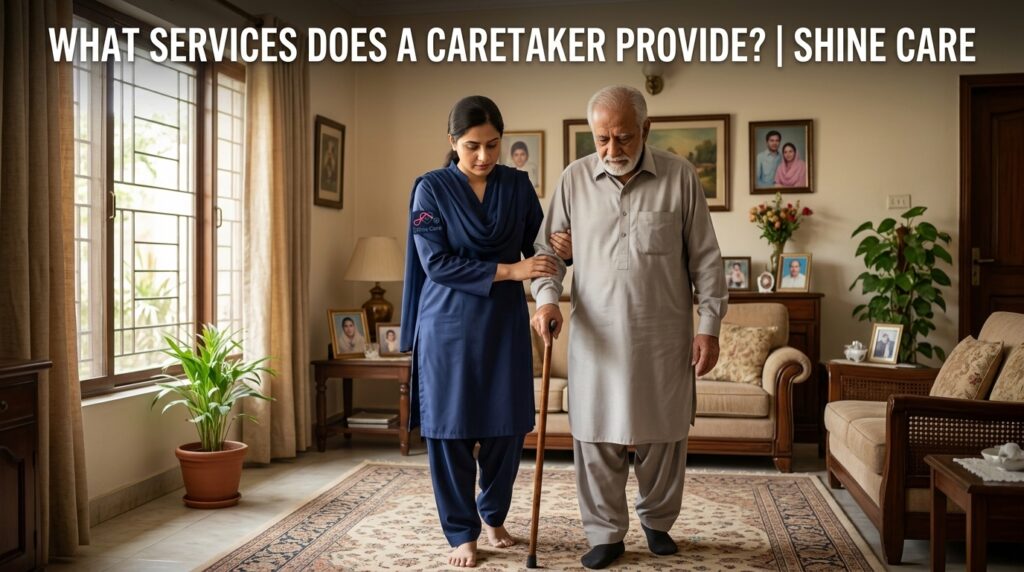
A caretaker provides hands-on daily support for someone who can no longer safely manage parts of their own life alone — bathing, walking, eating, taking medicine on time, and simply not spending the day isolated. This role sits between full medical nursing and casual family help, filling a gap that most households don’t realize exists until an elderly parent has a fall, or a patient comes home from the hospital needing more support than anyone expected. Shine Care has placed caretakers with families across Lahore for exactly these situations, and this guide breaks down precisely what the role covers, what it doesn’t, and how to know when your family actually needs one.
What Is a Professional Caretaker?
A professional caretaker is someone trained specifically to support a person’s daily physical needs, safety, and general wellbeing at home. Unlike a family member juggling this alongside work and other responsibilities, a caretaker’s entire focus during their shift is the patient — noticing small changes, maintaining routine, and providing consistent, reliable presence day after day.
This is different from a nurse, who handles clinical tasks like medication administration, wound care, and monitoring for medical complications. A caretaker’s responsibilities center on daily living support rather than medical intervention, though the two roles often work together for patients with more complex needs.
What Services Does a Caretaker Provide?
The full scope of caretaker services covers far more ground than most families expect going in. Here’s what’s actually included.

Daily Personal Care Assistance
This forms the foundation of the role — helping a patient get through their day safely, from waking up to settling in for the night, with consistent support at every step.
Bathing & Grooming Support
Caretakers help patients bathe safely, reducing fall risk in the bathroom, and assist with grooming tasks like hair care and dressing that become difficult with limited mobility or strength.
Toileting Assistance
This is one of the more sensitive parts of the role, handled with dignity and respect. Caretakers assist patients who can’t manage bathroom needs independently, always prioritizing the patient’s comfort and privacy.
Meal Preparation & Feeding Assistance
Beyond simply cooking, this includes assisting patients who struggle to eat independently, watching for swallowing difficulties, and ensuring meals actually get eaten rather than left untouched.
Medication Reminders
Caretakers help ensure medicine gets taken at the right time, though actual administration of injections or complex medical dosing remains a nurse’s responsibility, not a caretaker’s.
Walking & Mobility Assistance
Supporting safe movement around the home is one of the most important fall-prevention measures a caretaker provides, particularly for elderly or recovering patients.
Wheelchair Assistance
For patients using a wheelchair, caretakers help with transfers, positioning, and safe movement between rooms or during outings.
Transfer Assistance (Bed to Chair)
Moving a patient safely from bed to chair, or chair to bed, requires proper technique to avoid injury to both the patient and the caretaker — this is a specific skill, not something intuitive.
Companionship & Emotional Support
Many elderly patients spend long stretches alone, and a caretaker’s presence genuinely reduces isolation, which affects both mental and physical wellbeing over time.
Bedridden Patient Care
This includes regular repositioning to prevent bedsores, hygiene maintenance, and constant attentiveness for patients who cannot move independently at all.
Post-Surgery Recovery Support
Caretakers assist with mobility, daily routine, and general comfort during the weeks following surgery, when patients need consistent hands-on help but aren’t necessarily requiring clinical nursing.
Elderly Care at Home
General daily support for aging patients — medication reminders, mobility help, meal assistance, and companionship — covers the majority of caretaker placements across Lahore.
Dementia & Alzheimer’s Care
This requires a specific communication approach, patience with repetition, and calm handling of confusion or agitation, which trained caretakers are prepared for in a way general caregiving experience doesn’t cover.
Stroke Patient Assistance
Caretakers support mobility, feeding, and daily routine for stroke patients recovering at home, often working alongside physiotherapy sessions to reinforce progress between visits.
Support for Disabled Individuals
Caretakers assist with daily tasks that a physical or cognitive disability makes difficult, adapting their support to the individual’s specific needs rather than a one-size-fits-all approach.
Night Care & 24-Hour Care
For patients needing overnight supervision or continuous coverage, caretakers work in shifts to ensure someone alert and capable is present around the clock.
What Caretakers Do NOT Do
Caretakers do not administer injections, manage complex medication schedules, perform wound dressing, or handle clinical monitoring like blood pressure interpretation for medical decisions. These tasks require a trained nurse, and a responsible caretaker recognizes and respects this boundary rather than attempting tasks outside their training. Families sometimes assume a caretaker can cover everything a patient needs — this misunderstanding is worth clearing up before care begins, not after.
Professional Caretaker vs Family Caregiver
| Factor | Professional Caretaker | Family Caregiver |
|---|---|---|
| Training | Trained specifically in caregiving techniques | Usually learns informally, without structured training |
| Availability | Dedicated, scheduled presence | Divided between caregiving and other responsibilities |
| Consistency | Reliable, structured routine | Can vary based on family members’ own schedules |
| Objectivity | Notices changes without emotional strain | May miss subtle changes due to closeness and fatigue |
| Burnout risk | Manageable through shift rotation | High, especially over extended periods |
| Best suited for | Ongoing or intensive daily care needs | Occasional or short-term support alongside other help |
Benefits of Hiring a Professional Caretaker
- Reduces the physical and emotional burden on family members managing daily life
- Provides consistent, trained attention that catches small problems before they escalate
- Allows elderly or recovering patients to remain safely at home rather than in an institutional setting
- Offers families peace of mind, particularly when relatives live far away or work demanding hours
- Supports better emotional wellbeing for patients through genuine companionship and routine
- Reduces fall risk and other safety hazards through active daily supervision
Signs Your Loved One Needs a Caretaker
- Missed medication doses or confusion about timing
- One or more falls, even minor ones that seemed harmless
- Difficulty managing bathing, dressing, or toileting independently
- Noticeable weight loss or skipped meals
- Increasing confusion or memory lapses during daily conversations
- A family caregiver showing signs of exhaustion or burnout
- A recent hospital discharge with care needs the family isn’t confident managing alone
How to Choose the Right Caretaker
Ask directly about background verification, relevant experience with your patient’s specific condition, and what happens if the assigned caretaker is unavailable one day. A good provider matches caretakers to the patient’s actual needs rather than assigning generically, and answers these questions clearly rather than vaguely.
Quick Facts Box
- Caretakers focus on daily living support, not medical or clinical tasks
- Care can be arranged for a few hours daily, overnight, or full 24-hour coverage
- Both male and female caretakers are typically available based on family preference
- A proper caretaker arrangement includes a clear replacement policy for absences
- Background verification should happen before, not after, placement in your home
Why Families in Lahore Choose Shine Care
Shine Care matches caretakers to each patient’s actual condition — a caretaker experienced with dementia care is a different fit than one experienced with post-surgical recovery, and this distinction shapes every placement we make. Every caretaker completes background verification before entering a family’s home, since trust matters enormously when someone is caring for a vulnerable relative daily.
Families across DHA Lahore, Gulberg, Johar Town, Model Town, Bahria Town Lahore, Wapda Town, Valencia Town, Lahore Cantt, and Askari Lahore have worked with Shine Care for both short-term recovery support and long-term elderly care arrangements, with coverage extending toward Bedian Road and Barki Road as well.
Why Choose Shine Care
- Caretakers matched specifically to your patient’s condition and personality
- Background verification completed before any placement
- Both male and female caretakers available based on preference
- Flexible scheduling, from a few hours daily to full 24-hour coverage
- Prompt replacement if your assigned caretaker is unexpectedly unavailable
Common Mistakes Families Make
Choosing based only on price often means skipping proper background verification, which matters far more than a small cost difference when a vulnerable family member’s safety is involved.
Assuming a caretaker can handle medical tasks leads to gaps in care when a patient actually needs clinical attention that only a nurse can provide.
Not asking about the replacement policy leaves families unprepared when a caretaker is unexpectedly unavailable and no backup plan exists.
Skipping a proper introduction period between the caretaker and patient can create unnecessary friction that a short adjustment period would have resolved.
Ignoring the family caregiver’s own exhaustion until it becomes a crisis, rather than bringing in support proactively before burnout sets in.
Benefits of Home Care Checklist
- Patient remains in familiar, comfortable surroundings
- Family stays closely involved in daily decisions
- One-on-one attention rather than divided institutional care
- Lower exposure to hospital-acquired infections
- Personalized routine built around the patient’s actual preferences
- Often more cost-effective than an extended hospital or facility stay
Step-by-Step Hiring Process
- Contact Shine Care by phone or WhatsApp to discuss your family member’s situation.
- Share relevant details — the patient’s condition, daily routine, and specific concerns.
- Receive a proposed plan, including suggested hours and caretaker matching based on the case.
- Confirm scheduling and preferences, including male or female caretaker if relevant.
- Caretaker placement begins, with an introduction period to confirm the fit works well.
- Ongoing check-ins ensure the arrangement continues to suit your family member as needs evolve.
Areas We Serve Across Lahore
Shine Care provides caretaker services across DHA Lahore, Gulberg, Johar Town, Model Town, Bahria Town Lahore, Wapda Town, Valencia Town, Lahore Cantt, and Askari Lahore, with coverage extending to households along Bedian Road and Barki Road. If your home falls outside these areas, reach out directly to confirm availability.
How to Hire a Caretaker
Reach out to Shine Care directly through phone or WhatsApp, describe your family member’s situation, and we’ll walk you through matching the right caretaker based on the specific care needed, preferred schedule, and any particular preferences your family has.
Conclusion
A caretaker’s role covers far more than most families initially realize — from the basics of bathing and meals to specialized support for conditions like dementia, stroke recovery, or long-term disability. Getting the right person in place, matched properly to your family member’s actual needs, makes the difference between an arrangement that genuinely helps and one that creates more stress than it solves.
If your family in Lahore needs caretaker support for a parent, recovering patient, or loved one managing a long-term condition, reach out to Shine Care. We’ll talk through the situation honestly and help you understand exactly what kind of support fits.
Frequently Asked Questions
This depends on his specific recovery needs. If wound care or medication management is required, a nurse should be involved initially, with a caretaker supporting daily mobility and routine alongside that clinical care.
Yes, this happens sometimes, and it’s worth addressing directly rather than persisting with a mismatch. A good provider will reassign someone better suited to your parent’s personality and needs.
Yes, caretakers experienced in dementia care are trained to handle evening confusion, sometimes called “sundowning,” with calm, consistent reassurance rather than correction or argument.
Many caretaker arrangements include accompanying patients to appointments as part of daily support, though this should be confirmed directly based on your specific arrangement.
An agency verifies background, matches caretakers to specific conditions, and provides a replacement if needed. Hiring directly through informal channels typically means none of these protections exist.
Yes, wheelchair and transfer assistance is a core caretaker skill, trained specifically to protect both the patient and caretaker from injury during the process.
This depends on how many daily tasks she’s struggling with and how much risk is involved, such as fall history or medication errors. A proper assessment during the initial conversation helps determine the right level of support.
Yes, night care is specifically arranged for patients needing overnight supervision, including those with dementia-related wandering risk.
We aim to keep the same caretaker assigned once a good fit is confirmed, adjusting only when genuinely necessary for scheduling or other reasons.
A general sense of your family member’s daily routine, specific challenges you’ve noticed, and any relevant medical background helps us match the right caretaker from the start.