
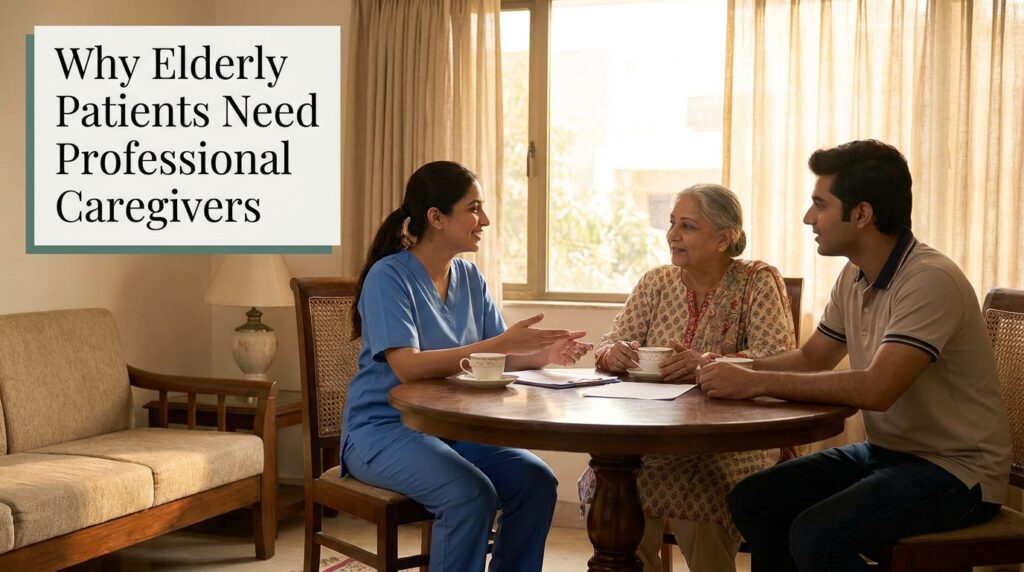
Every family believes, at least at first, that love and good intentions are enough to care for an aging parent. And in a lot of ways, they are — nobody is questioning how much a daughter or son cares. But why elderly patients need professional caregivers comes down to something more specific than love: it’s about catching what love alone doesn’t train you to see. A missed early warning sign, a medication interaction nobody thought to check, a subtle change in behavior that gets written off as “just getting older” when it’s actually something treatable. This is the gap professional caregiving exists to close, and it’s worth understanding clearly before a family has to learn it the hard way.
What “Professional” Caregiving Actually Means
This isn’t about questioning a family’s ability to love or show up for their parent. It’s a skill and pattern-recognition difference. A trained caregiver has seen dozens of elderly patients go through similar transitions — mobility decline, medication changes, early cognitive shifts — and knows what’s a normal part of aging versus what’s an early sign of something that needs medical attention. A family member, understandably, is seeing this for the first time, with their own parent, under emotional pressure that makes objective observation harder, not easier.
Professional caregiving means someone is present specifically to notice, document, and respond to changes — not just to keep a loved one company, which matters too, but isn’t the same function.
The Medical Risks Untrained Care Can Miss
This is where the stakes actually are, and it’s worth being specific rather than vague about it.
Infections don’t always look like infections in elderly patients. A urinary tract infection, for instance, often doesn’t present with the classic burning or urgency symptoms younger patients get. Instead, it frequently shows up as sudden confusion, agitation, or unexplained falls — symptoms that a family caregiver might reasonably mistake for a bad day, dementia progression, or just aging. According to Northwestern Medicine, older adults’ weakened immune response and age-related changes in brain chemistry mean infections can trigger delirium well before any typical physical symptom appears — which is exactly the kind of pattern a trained caregiver is taught to watch for, and an untrained one often isn’t.
Medication interactions build up silently. Elderly patients are frequently on multiple medications prescribed by different doctors for different conditions, and the interactions between them aren’t always obvious to someone without clinical training. A professional caregiver tracks timing, dosage, and side effects as a matter of routine, not as an afterthought.
Dehydration and nutrition issues get missed easily. An elderly patient who’s quietly eating and drinking less isn’t always vocal about it, and the early signs — mild confusion, fatigue, dizziness — overlap heavily with normal aging symptoms in a family’s eyes.
Why Family Caregivers Burn Out — and Why That’s a Safety Issue
Caregiver burnout gets talked about as an emotional problem, and it is one. But it’s also a patient safety issue that doesn’t get enough attention. An exhausted family caregiver, running on disrupted sleep and stress, is far more likely to miss a subtle symptom, forget a medication dose, or simply not have the bandwidth to notice that something feels “off” with their parent that day.
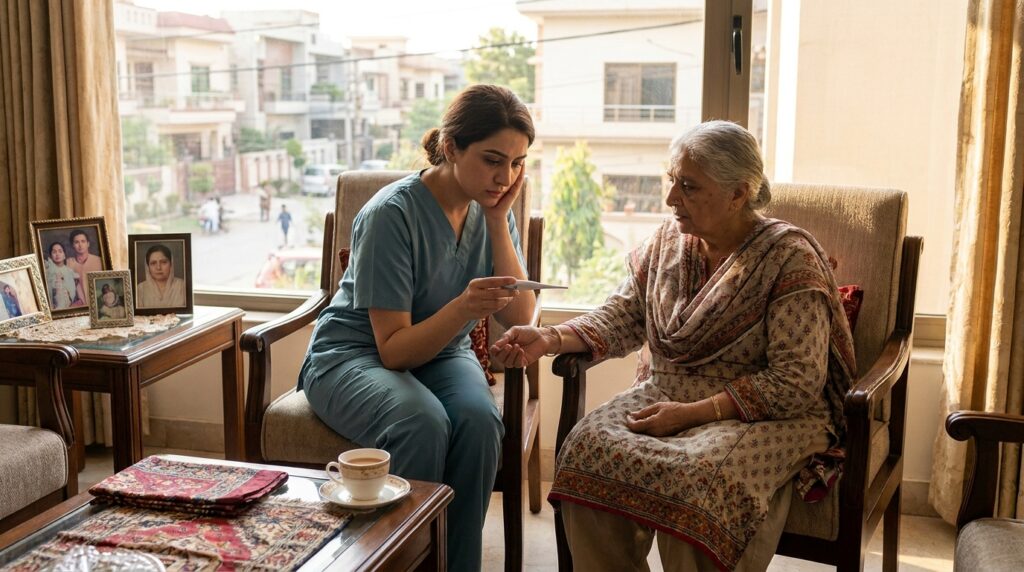
This isn’t a character flaw. It’s what happens to anyone providing round-the-clock, high-stakes care without training, backup, or rest. Professional caregivers exist partly to prevent this exact failure point — not by replacing family involvement, but by carrying the parts of daily care that require consistent attention a single exhausted family member simply can’t sustain indefinitely.
What Professional Caregivers Actually Catch That Families Often Don’t
In practice, this looks like small, specific things: noticing that a patient has started favoring one side when walking, days before an actual fall happens. Catching that an elderly patient has gone quiet over meals — not refusing food outright, just eating less than usual — and flagging it before it becomes a real nutrition problem. Recognizing that a patient’s slightly slurred speech one afternoon isn’t just tiredness, and knowing when that warrants an urgent call to a doctor versus when it’s genuinely nothing.
None of this is dramatic. It’s the accumulation of small, trained observations that either get caught early or don’t get caught until they’re a bigger problem.
Signs It’s Time to Bring in Professional Help
- Falls happening more than once, even minor ones that seem harmless
- Medications missed, doubled up, or taken at inconsistent times
- Sudden confusion, agitation, or behavior that seems “off” without an obvious cause
- Noticeable weight loss or reduced appetite over several weeks
- The primary family caregiver showing signs of exhaustion, frustration, or burnout
If several of these are present, it’s usually a sign that the situation has moved past what family support alone can safely manage.
What to Look for in a Professional Caregiver
Not every caregiver is equipped for elderly-specific care. Before hiring, it’s worth confirming:
Verified background and references — someone will be in your parent’s home regularly, often alone with them, and this shouldn’t be assumed to be fine without checking.
Experience with elderly-specific conditions, not just general caregiving — dementia, mobility decline, and chronic illness management each require a different kind of attention.
A clear replacement policy — what happens if the assigned caregiver is unavailable one day should be settled before you need the answer.
Genuine patience and communication skills, especially important where memory issues or slower communication are involved.
How Shine Care Approaches Elderly Care in Lahore
We start every case with an actual conversation about the patient’s condition, daily routine, and what the family is already managing, rather than assigning a generic caregiver. From there, we match someone with relevant experience to the specific situation — a caregiver who has handled diabetic patients before, for instance, rather than a general placement. Once care begins, we stay in touch and adjust the arrangement as the patient’s needs shift, which they typically do over time.
Shine Care’s Wider Network — Islamabad & Specialized Care
Shine Care’s elderly care services are based in Lahore, but the same standard of care is also available elsewhere. If your family is based in Islamabad, Shine Care Home Nursing provides the same trained, background-verified nursing and elderly care directly to families there. And if your loved one’s situation goes beyond general daily support — post-surgical recovery, ICU-level home setup, or other specialized clinical needs — Heaven Care in Lahore also provides full home nursing services, including elderly care, alongside its focus on specialized and post-operative cases. Whichever situation applies, the same underlying approach carries across all three: caregivers matched to the actual condition, not assigned generically.
Frequently Asked Questions
No. Many families bring in professional caregivers simply because an elderly parent needs consistent daily support and monitoring, even without a specific diagnosed condition. Waiting until a serious illness forces the decision often means missing the early window where professional care could have prevented complications.
Yes, and this is actually the more common arrangement. A caregiver typically covers specific hours or tasks — medication timing, mobility support, monitoring — while family members remain involved in other parts of daily life and decision-making.
If there are missed medications, falls, or signs of confusion, consistent daily support is usually warranted. If the concerns are more occasional, a lighter arrangement or periodic check-ins might be enough — this is worth discussing directly during an assessment call.
The risk isn’t usually one dramatic event — it’s the accumulation of small missed signs (medication errors, undetected infections, unnoticed weight loss) that eventually surface as a bigger, harder-to-reverse problem, like a hospital admission that might have been avoidable.
Yes, though this requires a caregiver with specific experience in memory-related conditions, since the communication approach differs from general elderly care.
Care can be arranged for daytime, overnight, or full 24-hour coverage, depending on what the situation actually requires.
A qualified replacement is arranged so care isn’t interrupted — this is worth confirming with any provider before hiring.
No. It typically means the level of care needed has moved beyond what’s realistic without trained support — recognizing that is a responsible decision, not a failure.
For most requests, an assessment call and caregiver match can usually happen within a short timeframe, with urgent cases prioritized.
If you’re noticing signs that your parent needs more consistent support than the family can safely provide alone, reach out to Shine Care for an honest assessment call. We’ll talk through the situation directly and help you understand what level of care actually makes sense.